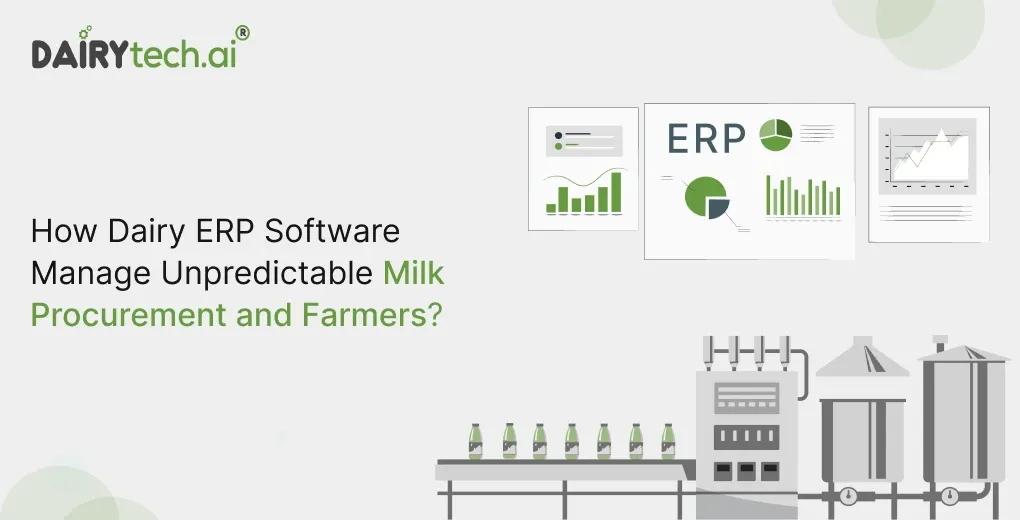
Milk procurement is one of the most volatile and operationally complex functions in the dairy value chain. The dairy milk supply fluctuates due to seasonality, animal health, weather conditions, and farmer participation, while processing plants continue to operate against fixed production schedules and strict quality standards.
Handling this imbalance manually or through disjointed systems often results in excess inventory, shortages, quality losses, and strained relationships with farmers. Dairy ERP software brings structure, visibility, and intelligence to milk procurement operations. This blog delves into how dairy ERP can help manage unpredictable milk procurement.
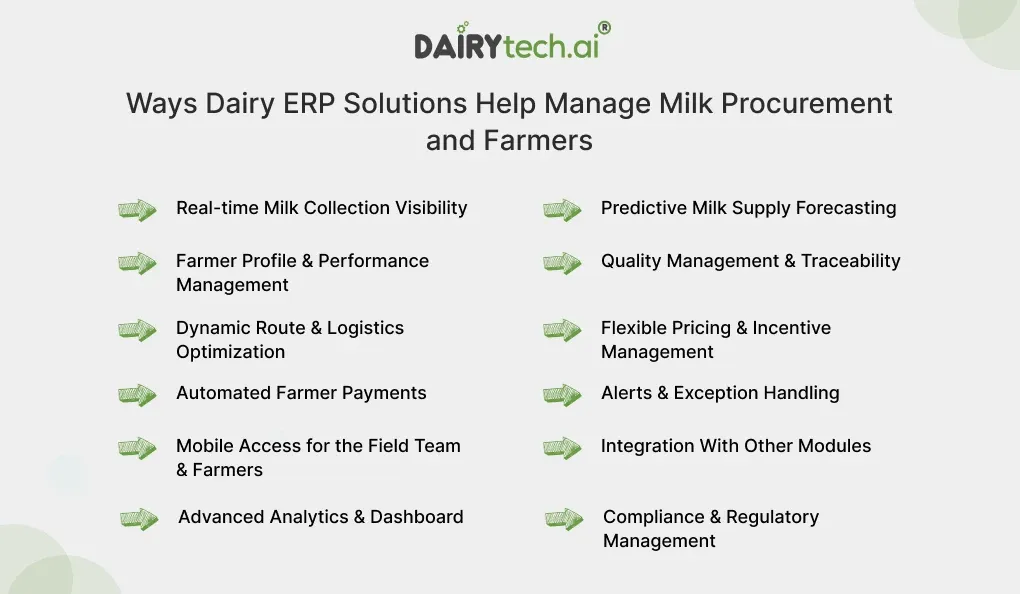
Ways dairy ERP solutions help manage milk procurement and farmers
Dairy ERP solutions integrate real-time collection data, quality parameters, farmer profiles, logistics, and forecasting tools into a single platform. This enables processors to anticipate variability, offering greater control over procurement uncertainty, improved operational efficiency, and stronger collaboration with farmers. These are the dairy ERP software features that help dairy companies manage farmers and uncertain milk procurement.
Real-time milk collection visibility
In dairy operations, timing and accuracy are everything. When milk supply changes daily, relying on delayed or manual updates can quickly lead to shortages, excess inventory, or quality issues. This is where real-time milk procurement visibility becomes critical.
A dairy ERP system captures milk collection data instantly at the source, whether it is a village collection centre or an individual farmer. As soon as milk is received, the system records key details such as quantity, fat content, SNF, temperature, and quality test results. This data is captured digitally through integrated testing equipment or mobile apps used by field staff, eliminating delays and manual errors.
All this information is consolidated into a central dashboard, giving procurement teams a live view of milk inflow across locations, routes, and farmers. Managers can easily compare actual milk received against planned or forecasted volumes and spot gaps immediately. When supply drops in a specific area, a tanker is delayed, or milk quality deteriorates, you can track the issue with real-time visibility.
Predictive milk supply forecasting
Milk supply is never constant. Seasonal changes, weather conditions, animal health, and farmer participation influence milk availability on any given day. Predictive milk supply forecasting enables dairy businesses to stay prepared for these fluctuations rather than reacting to them at the last minute.
A dairy ERP system analyzes historical milk collection data across villages, routes, and individual farmers to identify recurring patterns and trends. It considers factors such as seasonal yield variations, past supply dips, festival demand cycles, and farmer delivery behaviour. The system utilizes this data to generate accurate forecasts of expected milk volumes for upcoming days, weeks, or seasons.
These forecasts are continuously refined by comparing expected supply with actual milk received. When deviations occur, such as an unexpected drop in supply or a sudden surge, the system highlights the variance, allowing procurement teams to adjust their plans quickly. Over time, this feedback loop improves forecasting accuracy and reliability.
Farmer profile & performance management
Farmers are the foundation of milk procurement, yet their supply patterns, quality consistency, and reliability can vary significantly. Farmer profiles and performance management enable dairy businesses to understand better, engage with, and support their farmer network, particularly when milk supply is uncertain.
A dairy ERP maintains a complete digital profile for each farmer, capturing essential details such as location, herd size, historical milk volumes, quality trends, and payment history. Over time, the system builds a clear picture of each farmer’s supply behavior, highlighting patterns in consistency, seasonal fluctuations, and quality performance.
Based on this data, the ERP evaluates farmer performance using measurable indicators, like delivery regularity, average yield, SNF levels, and compliance with quality standards. Farmers can then be grouped into performance categories, such as high-performing, inconsistent, or at-risk, making it easier for procurement teams to prioritize engagement and support.
Quality management & traceability
When milk procurement is unpredictable, maintaining consistent quality becomes even more critical. Quality management and traceability ensure that every liter of milk collected meets defined standards and can be tracked back to its source, regardless of supply fluctuations.
A dairy ERP system captures quality test results at the point of collection, including parameters such as fat, SNF, temperature, acidity, and adulteration checks. These results are recorded instantly and linked directly to the farmer, collection center, date, and batch. Automated quality rules flag deviations in real-time, allowing field teams to take immediate corrective action before poor-quality milk enters the supply chain.
Beyond quality checks, the ERP provides end-to-end traceability across the procurement process. Each batch of milk can be tracked from the farmer to the collection point, then transported to the processing plant. This level of visibility is crucial for the timely resolution of issues, regulatory compliance, and quality audits.
Dynamic route & logistics optimization
Milk availability can change daily, but collection schedules and transportation costs remain constant pressures from dairy businesses. Dynamic route and logistics optimization helps align collection operations with real-time supply conditions, ensuring efficiency even when procurement is uncertain.
A dairy ERP system plans and adjusts milk collection routes based on actual milk availability, geographic factors, and vehicle capacity. Instead of following fixed routes, the system allows procurement teams to dynamically reroute tankers when milk supply increases or decreases or shifts between locations. GPS integration provides real-time visibility into vehicle movement, collection status, and delays.
The ERP also optimizes load planning by matching tanker capacity with expected collection volumes. If supply is lower than forecasted in one area, vehicles can be redirected to alternate locations, reducing empty runs and unnecessary fuel consumption. Collection timelines are continuously monitored to ensure milk reaches chilling centres and processing plants within quality-safe limits.
Flexible pricing & incentive management
When milk supply is unpredictable, pricing plays a critical role in influencing farmer behavior and stabilizing procurement. Flexible pricing and incentive management enable dairy businesses to encourage consistent supply and better quality through transparent, data-driven payment structures.
A dairy ERP system supports multiple milk pricing models, including volume-based pricing, fat and SNF-linked rates, and quality-based bonuses or penalties. Pricing rules can be easily configured to reflect seasonal variations, regional differences, or strategic procurement priorities. For instance, farmers who regularly produce high-quality milk may receive greater incentives during times of low supply.
The ERP software for the dairy industry automatically calculates incentives, penalties, and bonuses based on actual milk quality and quantity parameters captured at collection centres. This eliminates manual errors and ensures farmers are paid fairly and consistently. All pricing details are clearly documented and accessible, improving transparency and trust.
Automated farmer payments
Timely and accurate payments are essential for maintaining farmer trust, especially when milk supply is inconsistent. Automated farmer payments ensure that payments are paid fairly, transparently, and on time, regardless of fluctuations in milk volumes or pricing structures.
A dairy ERP system automatically calculates farmer payouts based on actual milk quality, quality parameters (such as fat and SNF), and applicable pricing and incentive rules. Once calculations are completed, payments are automatically processed digitally to the farmer’s account. This reduces manual efforts and eliminates calculation errors.
Farmers can access detailed payment statements showing how their earnings were calculated, including quantities supplied, quality results, bonuses, and deductions. This transparency minimizes disputes and fosters confidence in the procurement.
Alerts & exception handling
In milk procurement, even small disruptions can quickly escalate into major operational issues. Alerts and exception handling enable dairy businesses to identify and address problems when they arise rather than after they impact production or quality.
A dairy ERP system continuously compares procurement activities to forecasts of milk supply and predetermined benchmarks. When exceptions occur, such as a sudden drop in milk supply, missed collections, quality deviations, route delays, or payment discrepancies, the system automatically triggers alerts. These notifications are delivered to the relevant teams in real-time, enabling immediate attention and action.
Exception workflows guide field staff and managers through corrective steps, whether it involves rerouting a tanker, engaging with farmers, adjusting production plans, or escalating critical issues. Each exception is logged within the system, creating a clear audit trail and supporting a continuous improvement process.
Mobile access for the field team & farmers
Milk procurement operations extend far beyond the dairy plant, often into remote villages and collection centres. Mobile access for the field teams and farmers ensures that critical procurement data flows seamlessly between the field and the central system, without delays or manual intervention.
A dairy ERP system delivers mobile applications for field staff to capture milk collection data, quality test results, route progress, and farmer interactions directly at the collection point. Even in areas with limited connectivity, offline functionality allows data to be recorded and synced once a network is available, ensuring accuracy and continuity.
For farmers, mobile access enables visibility into their own supply and payments. Through a simple, user-friendly interface, farmers can view milk delivery quality results, pricing details, and payment status. This transparency strengthens communication and reduces dependency on manual records or intermediaries.
Integration with other modules
Milk procurement doesn’t operate independently, as it also impacts production planning, inventory levels, finance, and distribution. Integration with other ERP modules ensures that changes in milk supply are automatically reflected across the entire dairy operation.
A software for the dairy industry connects milk procurement to production, inventory, quality, finance, and sales modules through a single, unified platform. As milk is collected, procurement data instantly updates inventory levels, production schedules, and quality records. Finance modules receive accurate inputs for farmer payments, cost tracking, and profitability analysis, avoiding manual reconciliation.
This seamless data flow enables production teams to adjust processing plans based on actual milk availability, while the inventory manager can plan buffer stocks during surplus or lean times. Management gains a consolidated, real-time view of operations, enabling faster and more informed decisions.
Advanced analytics & dashboard
Managing unpredictable milk procurement requires actionable insight. Raw procurement data is transformed into lucid, insightful intelligence by sophisticated analytics and dashboards, facilitating quicker and more effective decision-making.
A dairy ERP system consolidates data from milk collection, quality testing, farmer performance, logistics, pricing, and payments into intuitive dashboards. These dashboards provide real-time visibility into key metrics, including daily milk inflow, forecast vs. actual procurement, quality trends, route efficiency, and farmer reliability. Users can easily drill down by region, route, village, or individual farmer to identify patterns and issues.
Advanced analytics tools help identify trends that are not immediately visible, such as recurring seasonal shortages, declining quality from specific locations, or cost inefficiencies in logistics. Scenario analysis and performance comparison allow management to evaluate different procurement strategies and plan for future demand with greater confidence.
Compliance & regulatory management
In the dairy industry, ensuring food safety and regulatory compliance is non-negotiable. With unpredictable milk procurement, maintaining these standards consistently can be challenging. Compliance and regulatory management within a dairy ERP enable businesses to support legal requirements while maintaining product quality.
The ERP system tracks every stage of milk collection, testing, transportation, and processing, creating a complete digital record of operations. It ensures that all milk meets quality and safety standards before entering the supply chain and maintains audit-ready logs for inspections. Alerts notify teams if any compliance parameters are breached, enabling immediate corrective action.
Conclusion
Managing unpredictable milk procurement is one of the biggest challenges dairy businesses face. Fluctuations in supply, varying quality, and complex logistics can disrupt production, strain farmer relationships, and impact profitability. Dairy ERP software addresses these challenges by providing real-time visibility, predictive forecasting, quality management, farmer performance tracking, flexible pricing, automated payments, and advanced analytics, all in a single, integrated platform.
DairyTech.ai is an ERP consulting and implementation company that helps dairy businesses navigate these complexities. Our dairy ERP solutions help streamline procurement, optimize logistics, strengthen farmer engagement, and ensure compliance, turning uncertainty into operational efficiency and growth. Explore how DairyTech’s dairy ERP can help your business manage supply volatility, improve quality, and foster stronger farmer partnerships; schedule a demo now.