Products, such as milk, cheese, butter, and buttermilk, are highly perishable in nature, making cold-chain integrity from processing plant to point of sale crucial. As your dairy business scales and distribution networks become more diverse (distributing to multiple depots, distributors, and retail channels), managing intricacies in both distribution and last-mile delivery becomes increasingly challenging.
Traditional systems and manual coordination are no longer efficient in handling today’s real-time demand shifts, route variability, inventory visibility, and regulatory compliance. Factors such as delays, stock mismatches, and delivery inefficiencies can not only increase operational costs but also impact product quality and customer trust.
The dairy ERP software unifies distribution planning, inventory management, logistics execution, and last-mile delivery into a single, integrated platform. With real-time visibility, automated workflows, and data-driven decision-making, ERP enables dairy enterprises to optimize complex distribution networks, streamline last-mile operations, and consistently deliver fresh products.
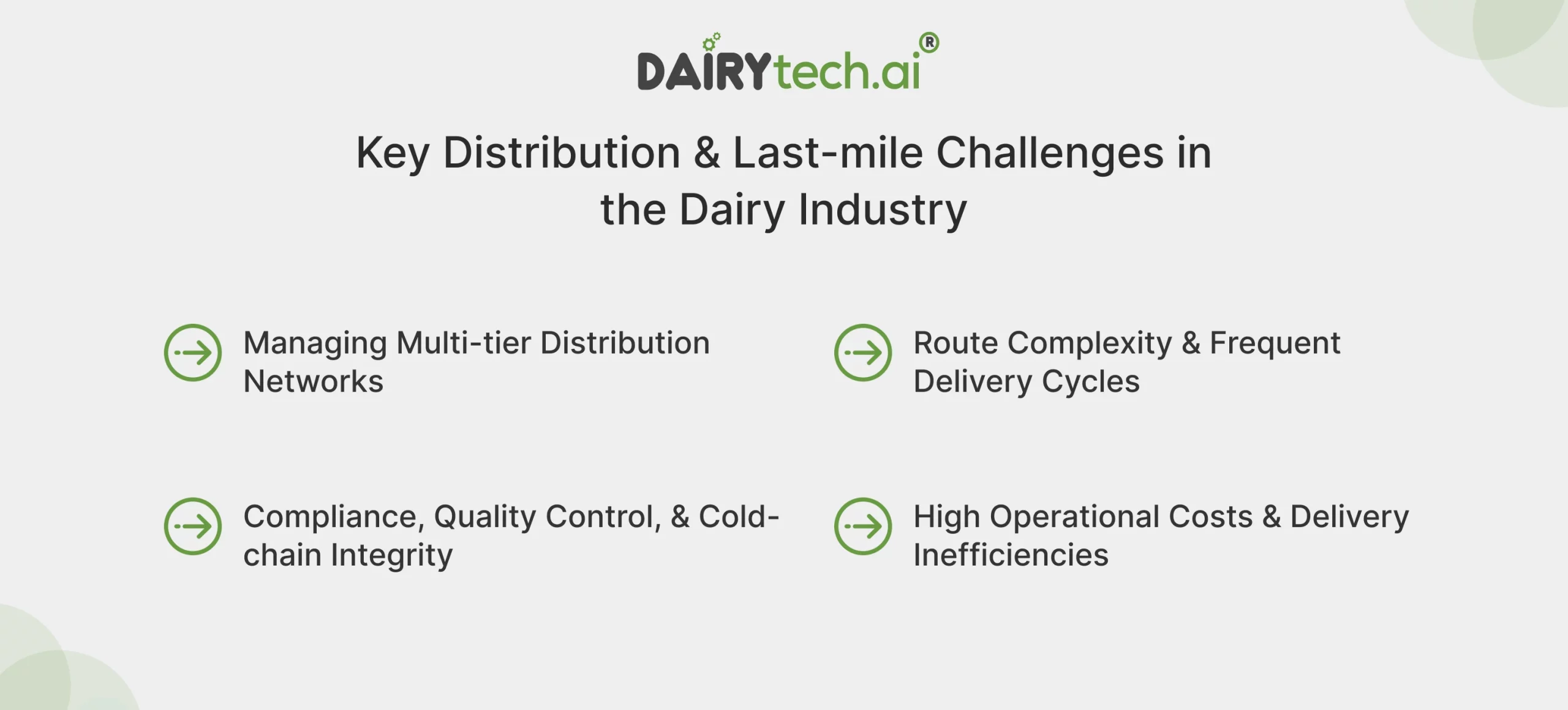
Key distribution and last-mile challenges in the dairy industry
Dairy distribution is more complex than most supply chains because products are perishable, deliveries are frequent, and quality must be maintained till the final delivery point. Below are the major challenges dairy businesses face.
Managing multi-tier distribution networks
Dairy products move through multiple stages, including processing plants, warehouses, distributors, and retailers. Coordinating stock movement and information across all these levels is difficult without a centralized system.
Route complexity and frequent delivery cycles
Dairy deliveries are often made daily and cover many routes. Planning efficient routes while handling traffic, delivery windows, and changing demand adds operational strain.
Inventory visibility across locations
Without real-time inventory data, businesses struggle to know the quantity of stock available at each location. This can lead to overstocking, stockouts, or expired products.
Compliance, quality control, and cold-chain integrity
Dairy products must be stored and transported at the right temperature and meet strict regulatory standards. Any lapse or gap can result in spoilage, compliance issues, or product recalls.
High operational costs and delivery inefficiencies
Fuel costs, vehicle maintenance, manual processes, and delivery errors increase overall expense and reduce profitability.
Together, these challenges make it hard for dairy businesses to ensure timely deliveries, control costs, and maintain product quality. This is where a dairy ERP system becomes essential.
Why do traditional systems fail?
Many dairy businesses still rely on spreadsheets, disconnected software, or manual processes to manage distribution and last-mile delivery. While these methods may perform well at a small scale, they become major bottlenecks as operations grow and complexity increases. These limitations lead to higher costs, operational inefficiencies, and service disruptions. The dairy ERP software transforms distribution management from a manual, reactive process into a streamlined, data-driven operation, enabling dairy businesses to handle complexity, improve delivery performance, and maintain product quality at scale. Here is why traditional systems fail today.
Fragmented tools and manual process
Different teams often use separate systems for production, inventory, sales, and logistics. This creates data silos, forcing staff to rely on manual data entry, increasing errors, delays, and duplicated effort.
Lack of real-time data and coordination
Traditional systems do not provide live updates on inventory levels, vehicle status, or deliveries. As a result, teams cannot coordinate effectively or respond promptly to issues such as delays, shortages, or changes in order.
Limited scalability as the distribution network grows
As the number of depots, routes, and customers increases, manual or basic systems struggle to keep up. Adding new locations or distributors often requires more manpower rather than smarter processes.
Inability to respond quickly to demand fluctuations
Demand for dairy products can change daily due to seasonality, promotions, or market conditions. Without integrated forecasting and planning tools, businesses cannot adjust production, inventory, or delivery plans fast enough.
Role of dairy ERP in distribution optimization
Dairy ERP plays a critical role in simplifying and optimizing complex distribution and last-mile delivery operations. It acts as a single, integrated platform that connects all departments, locations, and partners involved in the dairy supply chain. Below is a detailed explanation of how it supports distribution optimization.
Centralized data and process integration
Dairy ERP consolidates all operational data, such as production, inventory, sales orders, dispatch, logistics, and finance, into a unified system. All your team members work on the same dataset, rather than separate ones. This eliminates data duplication, reduces manual data entry, and ensures consistency across processes. For example, once an order is confirmed, inventory availability, dispatch planning, and invoicing are automatically aligned without manual intervention.
Real-time visibility across the supply chain and logistics
With ERP software for the dairy industry, businesses gain real-time insights into inventory levels, batch and lot status, vehicle movements, and delivery progress. Managers can instantly see where products are located, which orders are pending, and whether deliveries are on schedule. This visibility helps teams proactively address issues such as delays, temperature deviations, or stock shortages before they impact customer or product quality.
Automation of distribution planning and execution
Dairy ERP automates key distribution tasks, such as order consolidation, route planning, vehicle assignment, dispatch scheduling, and delivery confirmation. Automation reduces dependency on manual planning, lowers the risk of errors, and improves operational speed. For instance, the system can automatically assign deliveries based on route efficiency, delivery priorities, and vehicle capacity, ensuring faster and more cost-effective distribution.
Standardization of workflows across locations
Dairy operations often involve multiple plants, depots, and distribution centers. ERP systems enable businesses to unify workflows, rules, and reporting structures, standardizing processes across all locations. This ensures that inventory handling, dispatch procedures, compliance checks, and documentation follow the same standards everywhere. Standardization enhances control and simplifies training, making it easier to scale operations without compromising efficiency or compliance.
Features of a dairy ERP solution for streamlining complex distribution
Dairy distribution involves managing high volumes, short shelf life, multiple channels, and strict quality requirements simultaneously. A dairy ERP system integrates planning, execution, and control across the distribution network, addressing this complexity. Integrating the robust capabilities of dairy ERP can help you manage complex distribution networks with greater authority, accuracy, and efficiency while safeguarding product quality and regulatory compliance at every stage. Below is a detailed explanation of how ERP supports each critical area.
Demand forecasting and production alignment
Dairy ERP uses historical sales data, seasonal trends, promotions, and distributor demand to generate accurate demand forecasts. These forecasts are directly linked to production planning, ensuring that the right quantities are produced at the right time. This alignment minimizes overproduction, reduces wastage due to expiry, and prevents stock shortages that can disrupt distribution. As demand changes, the ERP dairy system enables quick adjustments to production and dispatch plans, ensuring a balanced and responsive supply chain.
Inventory and batch/lot tracking across warehouses
The ERP system provides end-to-end visibility of inventory across plants, cold storages, depots, and distributor warehouses. Each product batch or lot is tracked with critical details, such as production date, expiry date, and quality status. This level of tracking helps ensure FIFO/FEFO compliance, reduces product loss, and enables precise stock allocation during order fulfillment. In the case of quality issues or recalls, ERP enables businesses to identify affected batches and their exact locations.
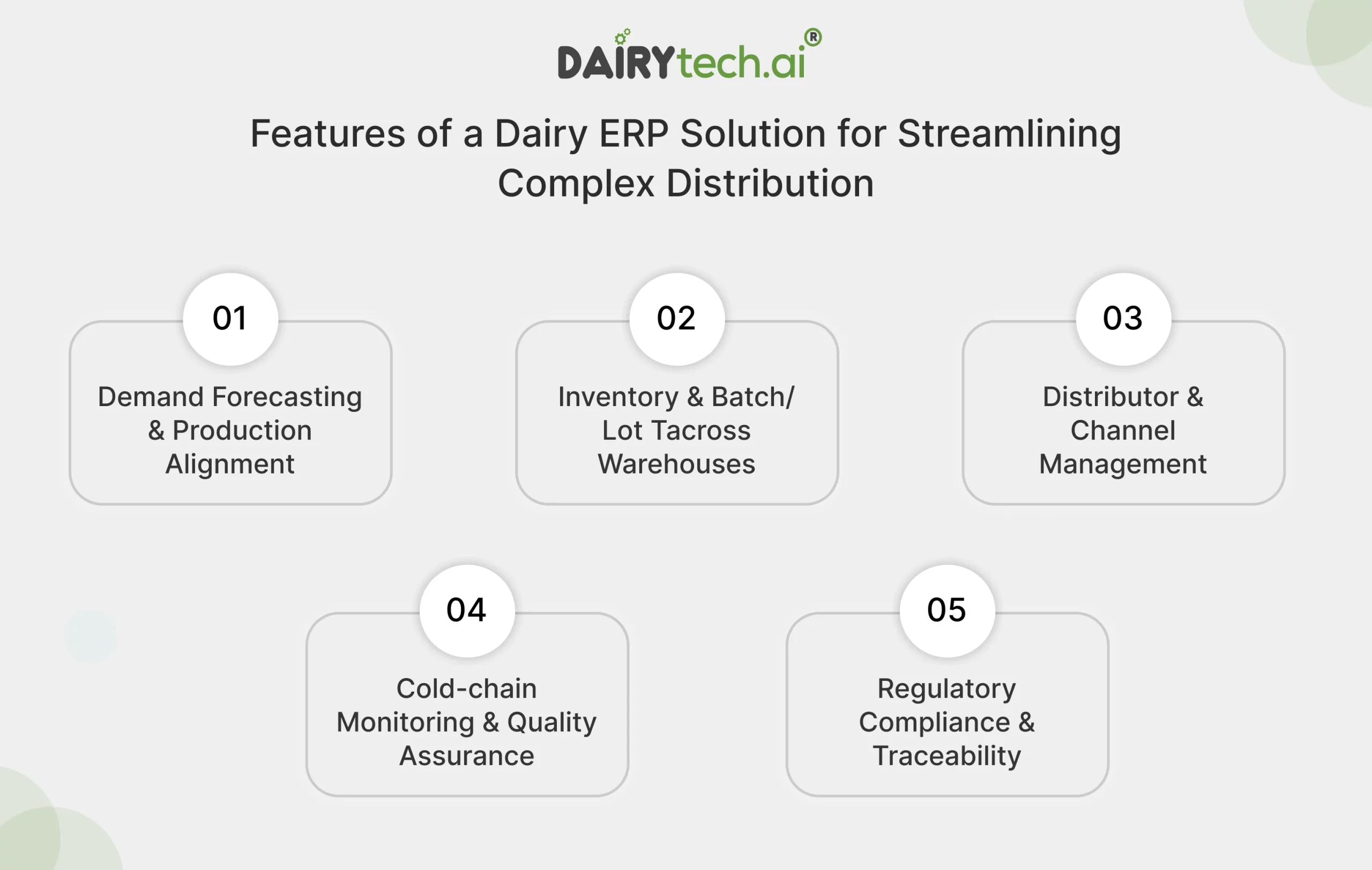
Distributor and channel management
Dairy RP centralizes management of distributors, wholesalers, retailers, and direct-to-consumer channels within a single platform. It tracks distributor orders, stock levels, credit limits, pricing agreements, and performance metrics. This enhances coordination, reduces order processing errors, and ensures consistent service across channels. The ERP software for the dairy industry provides demand visibility from downstream partners, enabling businesses to plan distribution more accurately and strengthen distributor relationships.
Cold-chain monitoring and quality assurance
Maintaining the cold chain is critical in dairy distribution. ERP integrates temperature monitoring data from storage facilities and transport vehicles to ensure products remain within required temperature ranges throughout the distribution process. Alerts are triggered if deviations occur, allowing immediate corrective action. ERP also enforces quality checks at dispatch and delivery points, helping maintain product freshness, safety, and brand reputation.
Regulatory compliance and traceability
Dairy ERP supports compliance with food safety regulations by maintaining complete digital records of production, storage, transportation, and delivery activities. It enables full traceability, from raw milk procurement to final delivery, ensuring audit readiness at all times. Automated documentation, quality logs, and compliance reports reduce manual effort and help businesses meet regulatory requirements efficiently while minimizing the risk of penalties or recalls.
How can you enhance last-mile delivery performance?
Last-mile delivery is the most time-sensitive and cost-intensive part of dairy distribution. Any delay, error, or lack of visibility at this stage can lead to spoilage, customer dissatisfaction, and revenue loss. A dairy ERP system strengthens last-mile performance by bringing structure, automation, and real-time control to delivery operations. Digitizing and integrating last-mile delivery operations can help businesses reduce delivery costs, improve on-time performance, maintain product quality, and deliver a consistent, reliable customer experience. Here are the ways to enhance last-mile delivery performance.
Route planning and optimization
The system plans the most efficient delivery routes based on order volume, delivery locations, time windows, vehicle capacity, and traffic patterns. This reduces unnecessary travel, shortens delivery times, lowers fuel consumption, and ensures products reach customers while still fresh. Optimizing routing is especially important for daily, high-frequency dairy deliveries.
Vehicle and fleet management
The ERP system offers complete visibility into the fleet, including vehicle availability, capacity, maintenance schedules, and temperature-controlled units. It helps assign the right vehicle to the right route, prevents overloading, and ensures vehicles are fit for refrigerated transport. Maintenance alerts and usage tracking reduce breakdowns and improve fleet reliability.
Delivery scheduling and proof of delivery (POD)
With ERP, delivery schedules are automatically generated and shared with drivers and delivery teams. Mobile-enabled proof of delivery captures digital signatures, timestamps, quantities delivered, and the condition of goods at the customer location. This reduces disputes, speeds up billing, and improves accountability across the delivery process.
Handling returns, shortages, and damages
The dairy ERP enables quick and accurate recording of returns, shortages, or damaged goods directly at the point of delivery. Reasons are logged in the system, inventory is adjusted automatically, and credit notes or replacements are processed without delays. This structured handling reduces revenue leakage and improves customer trust.
Real-time delivery tracking and exception management
ERP provides real-time tracking of delivery vehicles and order status throughout the last mile. Operations teams can monitor delays, route deviations, or temperature issues as they happen. Automated alerts allow quick corrective action, such as rerouting vehicles or notifying customers before problems escalate.
Business benefits of ERP-driven dairy logistics
Implementing an ERP system specifically designed for dairy logistics offers measurable business value beyond operational improvements. The system can help businesses control costs, improve service, and build a resilient distribution network that supports long-term growth. Integrating distribution, logistics, and last-mile delivery into a single platform, dairy enterprises can achieve the following benefits.
Reduced delivery time and transportation costs
ERP-driven route optimization, vehicle utilization, and automated dispatch planning reduce unnecessary travel and idle time. Deliveries are completed on time with fewer resources, leading to lower fuel consumption, optimized fleet utilization, and reduced overall transportation expenses.
Lower wastage and spoilage
Real-time inventory visibility, batch and expiry tracking, and strict FIFO/FEFO enforcement help ensure products are dispatched and delivered before expiration. Cold-chain monitoring further minimized temperature deviations, significantly reducing spoilage, write-offs, and product returns.
Improved service levels and customer satisfaction
Accurate order fulfillment, reliable delivery schedules, and real-time delivery tracking improve on-time, in-full (OTIF) performance. Faster issue resolution, transparent communication, and consistent product quality strengthen customer trust and long-term relationships with distributors and retailers.
Better decision-making through analytics and dashboards
ERP provides centralized dashboards and performance reports covering delivery efficiency, inventory turnover, route performance, and cost metrics. Management can identify bottlenecks, monitor KPIs, and make data-driven decisions to improve logistics performance and profitability.
Scalability to support business growth
As dairy operations expand into new regions, channels, or product lines, operational complexity also increases. Standardized processes, centralized control, and flexible configuration enable businesses to grow while maintaining efficiency, compliance, and service quality.
Bottom-line
The dairy ERP solutions integrate demand planning, inventory management, cold-chain monitoring, route optimization, and last-mile execution into a single platform. This empowers dairy businesses to respond quickly to market changes, scale operations efficiently, and maintain full control across the supply chain.
DairyTech.ai offers industry-focused dairy ERP solutions specifically designed to address real-world challenges of dairy distribution and last-mile delivery. With deep domain expertise, advanced analytics, and automation-driven workflows, we help dairy enterprises to optimize delivery performance, ensure compliance, and reduce operational costs without compromising product quality.
Connect with us today to schedule a consultation to see how we can help you simplify complex distribution, enhance last-mile delivery, and build a future-ready dairy supply chain.