If you run a dairy business, you know how much you rely on routine. Daily milk subscriptions work best when quantities are fixed and plans are clear. Production, packaging, and delivery all depend on knowing exactly what needs to go out each day.
However, in reality, customers regularly change their subscriptions. Someone skips a delivery. Another increases quantity. A few add new products at the last minute. Each change may look small, but you feel the impact immediately. Production numbers stop matching demand. Extra milk gets wasted. Delivery teams scramble to adjust routes and schedules.
After a while, these constant adjustments begin damaging the business. Costs rise, margins shrink, and your team spends more time fixing problems than running operations. This is where dairy ERP software makes a real difference. It helps you stay in control, even when subscription demand keeps changing.
This blog explores the impact of last-minute subscription changes on dairy businesses and how dairy ERP software can help manage demand effectively.
Why are last-minute subscription changes so common in dairy businesses?
Last-minute subscription changes are a part of everyday dairy operations. They happen due to customer habits, seasonal demand shifts, and system gaps. These changes are mistakes. They are expected in subscription-based models. The real challenge is managing them efficiently. Reasons last-mile subscription changes are so common in dairy businesses.
Daily changes in customer needs
Milk consumption changes daily in most households. Guests, cooking plans, or sudden usage increase demand. On some days, families need less milk than usual. Customers adjust subscriptions to match their needs. These frequent changes affect daily planning.
Seasonal demand fluctuations
Milk demand rises during festivals and special occasions. It drops during vacations, heatwaves, or rainy seasons. Seasonal habits strongly influence daily orders. These changes often happen without early warning. Dairies must respond quickly to stay efficient.
Last-minute order modifications
Many customers update subscriptions late in the day. Some changes come just before dispatch time. Teams receive updates too late for smooth planning. Planning numbers stop matching actual demand. Delivery teams must adjust routes quickly.
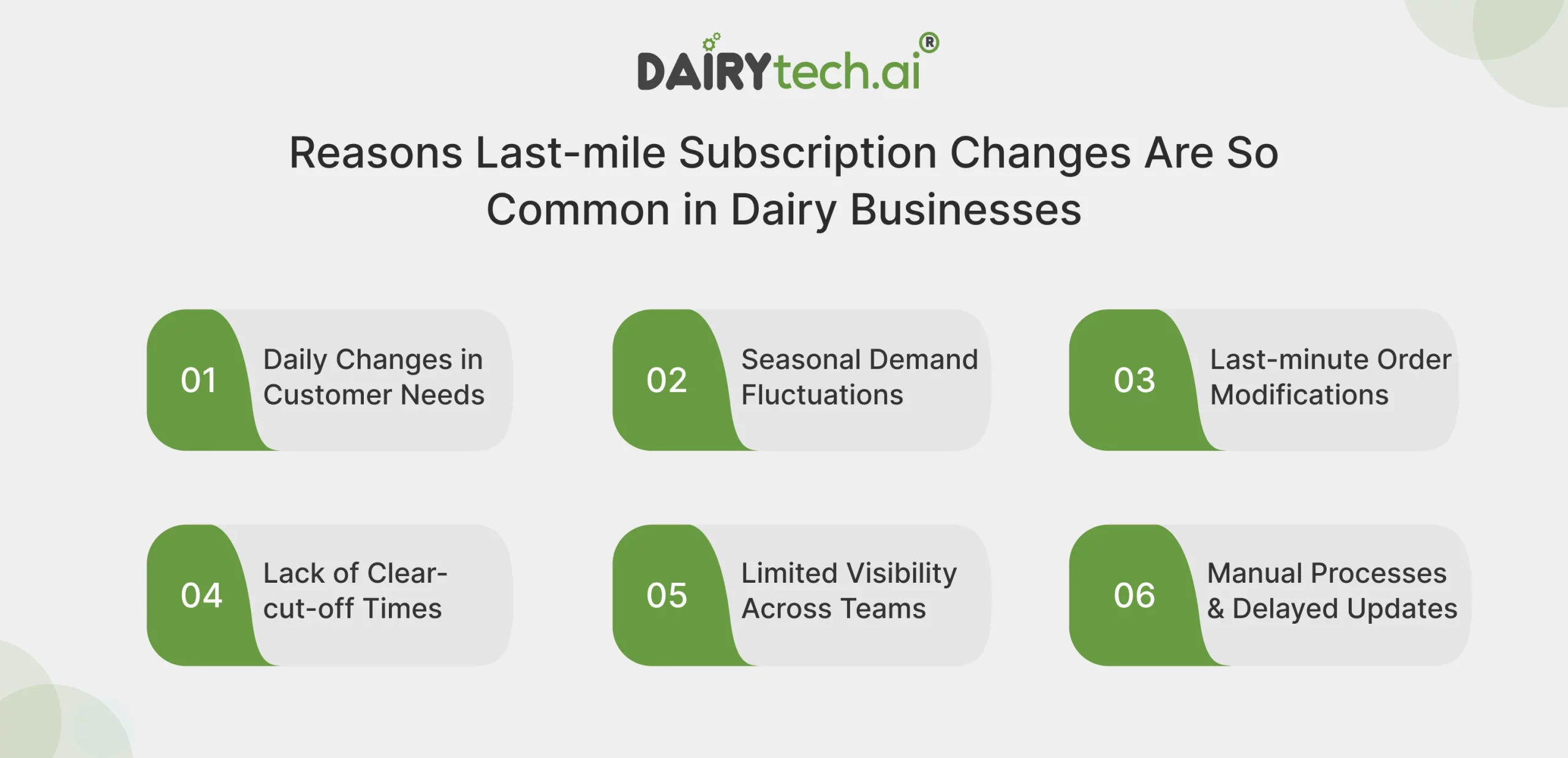
Lack of clear-cut-off times
Some dairies allow subscription changes until the last moment. There is no fixed time to lock daily orders. Teams do not get enough time to plan. Production and delivery become rushed. Errors and delays increase as a result.
Limited visibility across teams
Order updates do not reach all teams instantly. Production and delivery often work with outdated data. Teams struggle to stay aligned. This creates confusion and rework. Operational efficiency suffers quickly.
Manual processes and delayed updates
Many dairies still depend on spreadsheets or phone calls. Updating orders takes time and effort. Manual entry increases the risk of mistakes. Small delays create larger problems later. Operations become reactive instead of planned.
Where does inefficient subscription management in dairy add up?
Last-minute subscription changes do not cause one problem. They create losses across production, inventory, delivery, and finances. These costs often stay hidden. Over time, they quietly reduce profitability and efficiency. Areas that are impacted due to inefficient subscription management.
Production inefficiencies
When subscription numbers change late, production plans become inaccurate. Extra milk gets produced to stay safe. This milk often goes unsold and is wasted. Sometimes production falls short instead. This leads to missed or partial deliveries.
Inventory and procurement losses
Packaging materials are planned based on expected orders. Sudden changes create shortages or excess stock. Extra pouches, bottles, or labels go unused. In some cases, teams rush to buy materials at higher prices.
Distribution and logistics disruptions
Delivery routes are planned using fixed order volumes. Last-minute changes force quick route adjustments. Vehicles travel longer distances than needed. Fuel costs increase, and drivers work longer hours. Delays become more common.
Financial and revenue leakage
Incorrect deliveries lead to refunds and credits. Some orders are canceled after production begins. This results in a direct revenue loss. Reactive decisions incur operating costs. Profit margins slowly shrink over time.
Why do traditional ways fail to control subscription demand?
Many dairy businesses still rely on spreadsheets and manual tracking. These tools were not built for daily subscription changes. As order volume grows, they create confusion instead of control. This makes demand management harder every day. Reasons traditional methods are no longer effective in controlling subscription demand.
Fragmented data across teams
Sales, production, and delivery teams often use different files. Information sits in separate systems. Updates do not flow automatically. Teams end up working with inconsistent numbers. This leads to incompatible planning and execution.
Delayed updates and no real-time visibility
Spreadsheets update only when someone edits them. Changes are not visible instantly. By the time teams see updates, it is often too late. Production and delivery decisions get delayed. This increases errors and wastage.
Human errors in last-minute changes
Manual consolidation takes time and focus. During rush hours, mistakes are common. Numbers get missed or entered incorrectly. One small error affects multiple teams. These errors are costly and hard to trace.
No control over cut-off times
Spreadsheets cannot enforce order deadlines. Customers can change orders anytime. Teams cannot easily log daily quantities. Approvals remain manual and slow. This makes planning unpredictable and stressful.
How does dairy ERP software bring demand under control?
Dairy ERP software enables you to manage subscriptions, production, and delivery within a single platform. It replaces scattered tools with a single source of truth. This helps you respond to change quickly and confidently, instead of reacting late, enabling you to stay in control of demand. Here are the ways the diary ERP software brings demand under control.
Real-time subscription change visibility
Dairy ERP software shows subscription changes instantly. When a customer updates an order, every team sees it immediately. Production, inventory, and delivery work with the same numbers. There is no waiting for calls or messages. This real-time visibility reduces confusion and last-minute surprises.
Automated cut-off and change rules
Dairy ERP software lets you set clear-cut-off times. Customers can only change subscriptions within the allowed time window, also known as the cut-off time. Once orders are locked, teams can plan with confidence. This prevents late disruptions. It also reduces stress during production and dispatch hours.
Demand forecasting based on subscription trends
Dairy ERP software tracks historical subscription data. It identifies patterns in daily, weekly, and seasonal demand. You can see when changes usually happen. This helps you plan production better. Forecasting reduces overproduction and milk wastage.
Integrated production and dispatch planning
Dairy ERP software connects orders with production and delivery plans. When demand changes, plans update automatically. Production quantities adjust in real time. Delivery routes also realign. This keeps operations efficient, even during frequent changes in subscription orders.
With a dairy ERP system, you stop firefighting daily issues. You gain predictability, accuracy, and control. Teams work with clarity instead of urgency. Demand changes no longer hurt margins and become manageable.
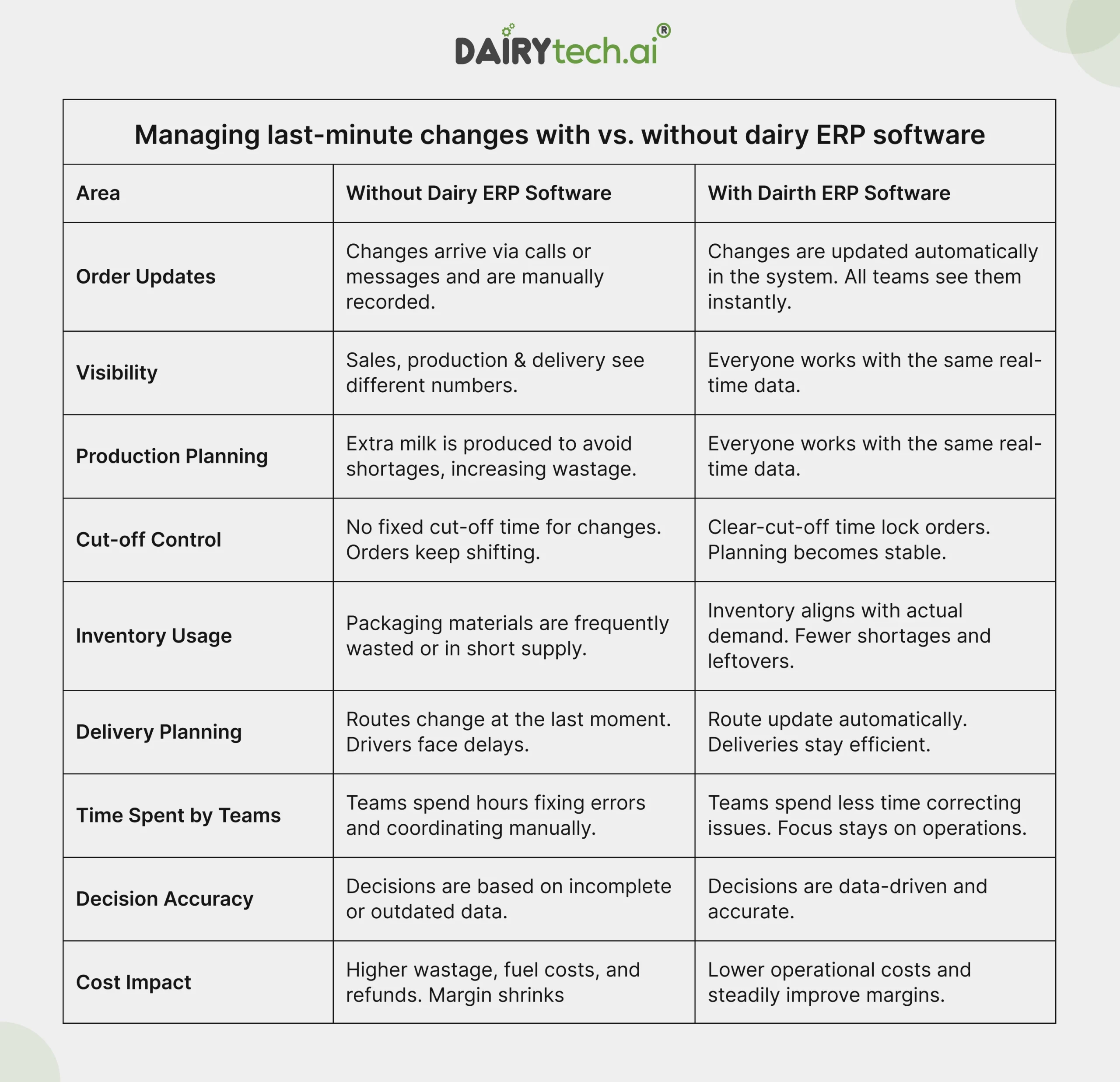
Managing last-minute changes with vs. without dairy ERP software
Without the dairy ERP software, last-minute changes create daily chaos. Teams react instead of planning. Costs rise quietly over time. With the dairy ERP software, changes are controlled and predictable. You save time, reduce waste, and make better decisions every day.
Key operational metrics that dairy ERP software helps you improve
Running a dairy with subscription-based deliveries is challenging without dairy ERP solutions. Last-minute changes in orders can disrupt production, increase costs, and frustrate customers. Dairy ERP software helps you manage these changes efficiently and transform operational challenges into measurable business improvements. Let’s look at the key areas where ERP makes a real difference.
Reduce milk wastage
Milk wastage happens when production exceeds actual demand. Many dairies produce further “just in case”, which results in unsold milk and losses. Dairy ERP software monitors subscription demand in real time and forecasts future trends. Production can be planned accurately daily. The result is less wastage, lower raw material costs, and higher margins. It also improves operational efficiency and reduces environmental impact.
Improve order fulfillment accuracy
Incorrect or missed deliveries frustrate customers and require extra work to fix. The ERP software for the dairy industry ensures all teams see subscription changes instantly. Automated alerts and dashboards guide packing and delivery teams. This reduces errors significantly. Accurate deliveries increase trust, reduce refunds and complaints, and retain existing customers. High service reliability strengthens your reputation and retention rates.
Reduce production-to-demand variance
A mismatch between planned production and actual demand leads to overproduction or shortages. Both affect your overall business profitability. ERP software connects subscriptions directly to produce plans. Orders are updated in real-time, and forecasts help anticipate upcoming trends. This reduces variance, keeps operations smooth, prevents milk wastage, and avoids missed deliveries. Stable production planning also saves labor and resource costs.
Lower delivery costs
Last-minute changes often make delivery routes inefficient. Drivers travel with extra fuel, and work longer hours. ERP software automatically recalculates delivery routes based on real-time order updates. Routes are optimized daily, which minimizes unnecessary travel. This reduces fuel and labor costs, increases delivery efficiency, and allows the company to expand without hiring more drivers.
Boost customer satisfaction and retention
Customer satisfaction suffers when deliveries are late, incorrect, or inconsistent. ERP ensures subscriptions are fulfilled in a timely and accurate manner. When customers receive what they frequently order, trust boosts. Satisfied customers stay longer, reducing churn. High retention protects recurring revenue, while happy customers often bring in new subscriptions through referrals.
Dairy ERP software not only organizes data but also converts it into measurable improvements. Less waste, accurate deliveries, optimized routes, and satisfied customers all contribute to higher margins and predictable revenue. With ERP, dairy owners can finally shift from reactive daily challenges to running a smooth, scalable, and profitable business.
What should you look for in dairy ERP software to manage subscriptions?
Choosing the right dairy ERP software is critical. Subscription management should be easy, precise, and scalable thanks to the system. Here are the key features to focus on.
Subscription lifecycle management
Your ERP should track every stage of a subscription, from new sign-ups to cancellations and pauses. It should handle order changes, skips, and add-ons automatically. This ensures you understand what each customer wants every day. With proper lifecycle management, production and delivery plans always align with real demand.
Real-time dashboards and alerts
The dairy ERP system provides instant visibility of orders, inventory, and deliveries. Dashboards show key metrics at a glance. Alerts notify you of last-minute changes or potential issues. Teams can respond quickly as a result, avoiding errors and reducing waste. Real-time information keeps your operation proactive instead of reactive.
Production and logistics integration
The software should link subscription orders directly to production plans and delivery routes. When a customer changes an order, the production schedules and route automatically update. This saves time and prevents mismatches. All teams work from the same accurate data.
Recurring billing and invoicing
An effective ERP solution should automate recurring billing for daily, weekly, or monthly subscription orders. It should generate accurate invoices based on actual deliveries. Billing errors and manual effort should drastically reduce disputes with customers.
Scalability for growing subscriber bases
Your dairy ERP system should handle growth without slowing down operations. As subscriptions increase, the system must still manage orders, production, and logistics efficiently. Scalable software prevents bottlenecks and supports expansion. You can grow without overloading your team.
Ease of use for operational teams
Even a great ERP fails if staff can’t use it well. Look for software with an easy, intuitive interface. Training should be simple, and daily tasks should be straightforward. Ease of use drives adoption, reduces the likelihood of errors, and ensures smooth operations.
Conclusion
Last-minute changes are going away. They are part of running a modern dairy business. What matters is how well you manage them. Without the proper system, these changes can result in increased waste, costs, and daily stress.
Dairy ERP software helps you stay in control. It brings visibility, automation, and accuracy to subscriptions, production, delivery, and billing. Instead of reacting to problems, you plan. This leads to less waste, higher margins, and happier customers.
DairyTech.ai offers an ERP solution specifically for dairy businesses. It helps you manage subscriptions, forecast demand, automate billing, and align production with real orders. All teams work from one system. Decisions become faster and more reliable. Connect with dairy ERP experts to discuss your business if you want to reduce losses and scale your subscriptions smoothly.