Modern dairy businesses are under constant pressure due to the increasing costs of milk, energy, and transport, while selling prices often change without warning. Margins in the dairy industry are already tight. Even small gaps in pricing errors can quickly turn profits into losses.
Yet many dairy companies still rely on delayed reports and disconnected systems. This makes it difficult to see where money is being made or lost in real time. This is where ERP software for the dairy industry comes in. A modern dairy ERP stores financial and operational data in a single database, enabling businesses to gain clear visibility and stronger control over margins.
Financial visibility challenges in dairy businesses
Many dairy companies struggle to get a clear picture of their finances because data is scattered across teams and systems. Information related to procurement, production, and finance is often stored individually. This makes it difficult to track costs and margins in real-time. As a result, financial decisions are made with limited visibility and delayed insights. Here are the financial visibility challenges faced in the dairy business.
Disconnected systems
Many dairy businesses utilize multiple tools for procurement, production, inventory management, and finance. Since these systems do not talk to each other, teams work with incomplete or conflicting data. This creates confusion and makes it difficult to track costs from milk intake to finished goods. Teams spend more time reconciling numbers than analyzing.
Delayed or inaccurate cost data
Cost data is often available only at the end of a reporting cycle. By then, margin issues have already affected the business. Manual entries and spreadsheets can also introduce errors, reducing confidence in the numbers. This limits timely and informed decision-making.
No clear view of profitability
Without integrated data, businesses struggle to see true profitability by product, batch, or plant. Costs are usually averaged, which hides underperforming products. As a result, pricing and production decisions are based on assumptions. This makes margin control more difficult.
Too much manual work
Finance teams rely heavily on spreadsheets and manual reporting. These processes are time-consuming and are difficult to scale as operations grow. Manual work also increases the risk of mistakes and delays. This leaves little time for strategic financial planning.
Why is margin control especially critical in the dairy industry?
The dairy industry operates in a high-cost, low-margin environment. Products are perishable, processes are complex, and compliance requirements are strict. Even small gaps in cost control can quickly impact profitability. This makes margin visibility and control a business priority. Here are the reasons margin control is critical in the dairy industry.
Shorter shelf life
Dairy products spoil quickly and must be sold within tight timeframes. Delays in production or distribution increase the risk of losses. Unsold or expired inventory directly reduces margins. Careful planning is critical to avoid waste.
Yield and wastage
Milk yield can vary due to quality and processing conditions. Small losses during production add up over time. Wastage reduces usable output and increases per-unit costs. Incorrect by-product validation further impacts margins.
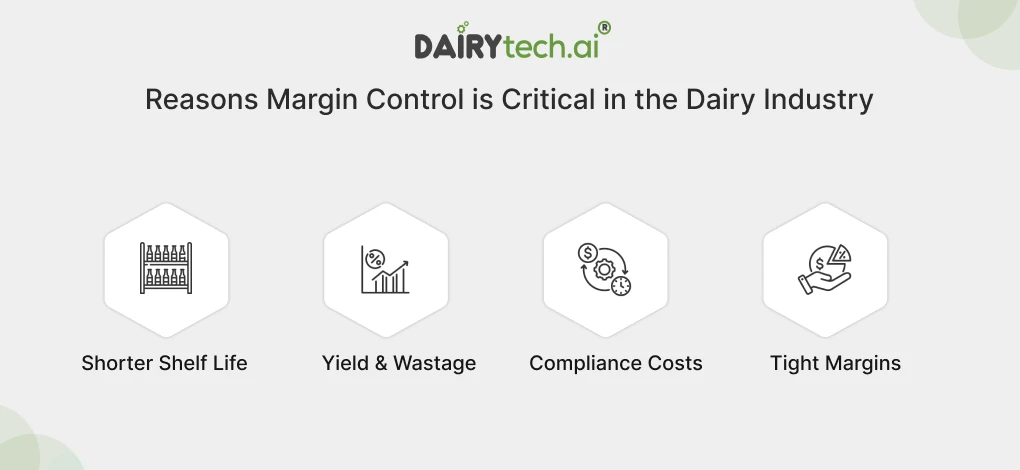
Compliance costs
Dairy businesses must adhere to strict food safety and regulatory rules. Testing, audits, and documentation add to operating costs. Quality failures can lead to recalls or penalties. These expenses can significantly affect margins.
Tight margins
Dairy margins are already thin due to price pressure and rising costs. Small inefficiencies in labor, energy, or materials quickly reduce profits. Without close monitoring, these issues often go unnoticed. Over time, they erode overall profitability.
Why do traditional accounting and legacy systems fail?
Many dairy businesses rely on old accounting systems or spreadsheets that were not built for modern operations. These tools provide limited visibility, slow reporting, and poor integration with production data. As a result, businesses struggle to make timely, informed decisions and effectively control margins. Here is why traditional accounting and legacy systems are failing.
Delayed reporting
Legacy systems mostly provide retrospective financial data. Reports often arrive days or weeks after transactions occur. This delay prevents managers from identifying cost overruns or inefficiencies in actions. Real-time decision-making becomes almost impossible.
Disconnected operational data
Old systems cannot link production, inventory, and sales data with financial results. Costs are often averaged rather than traced to actual batches or products. Without integrated data, it is difficult to understand true profitability.
Multi-site challenges
Managing multiple plants, products, or locations is cumbersome in legacy systems. Data must often be consolidated manually, which increases the risk of errors and delays. Complex operations require more robust systems to maintain consistency and accuracy.
Limited scalability and compliance risks
As businesses grow, legacy tools struggle to handle increased volumes and complexity. Compliance reporting, audits, and regulatory requirements become harder to meet. Scaling operations without losing control over costs and margins is a major challenge.
How does ERP enable financial visibility across dairy operations?
Dairy operations involve a variety of factors, including milk procurement, production, packaging, and distribution. Traditional systems often leave gaps in visibility, making it difficult to track costs, monitor margins, and make decisions. ERP software integrates all business processes and functions into a single system, giving managers a clear, real-time view of financial and operational performance across the organization. Ways the dairy ERP system enables financial visibility.
Centralized data
ERP systems bring together data from procurement, production, inventory, sales, and finance. All departments work from the same information, eliminating discrepancies. Centralized data ensures that costs, revenues, and operational metrics are accurate and easily accessible. This transparency helps managers make faster, more informed decisions.
Real-time cost tracking
With ERP, costs are tracked at every stage, including milk intake, processing, packaging, and distribution. Managers can see the true cost of each batch or product immediately. This helps identify inefficiencies, control wastage, and adjust pricing before margins are impacted.
Integrated financials
The ERP for the dairy businesses links operational activities directly to financial reporting. Inventory valuation, labor costs, energy consumption, and overheads are automatically reflected in accounts. This reduces manual work, minimizes errors, and ensures reports are accurate and up-to-date.
Accurate margin analysis
The dairy ERP system integrates production and financial data using product, batch, and customer margin analysis. Businesses can identify profitable products, underperforming lines, and base pricing and production decisions on real data. This level of insight is impossible with disconnected systems.
Better decision-making
ERP dashboards and analytics enable managers to track KPIs in real time. This can forecast costs, plan production, and optimize resource use. Immediate access to reliable data supports faster decisions that protect margins and improve overall profitability.
How does dairy ERP software help businesses with margin control?
Perishable goods, inconsistent yields, and low profits present margin management challenges for dairy operations. Traditional systems make it difficult to track costs accurately or respond to inefficiencies promptly. Dairy ERP software addresses this issue by connecting operational and financial data, allowing businesses to monitor costs, track performance, and take proactive measures to protect and improve margins. Ways dairy ERP software helps businesses with margin control.
Detailed margin analysis
ERP systems provide margin insights at the product, batch, and customer level. This means businesses can see which products or customers are most profitable and which are reducing margins. With this information, pricing, production, and sales strategies can be adjusted quickly to protect overall profitability.
Yield, variance, and wastage tracking
ERP tracks milk yield, production variances, and wastage throughout the processing cycle. Any deviations or losses are immediately visible, allowing corrective actions to be taken before they impact profits. This reduces waste, optimizes production, and ensures that resources are used efficiently.
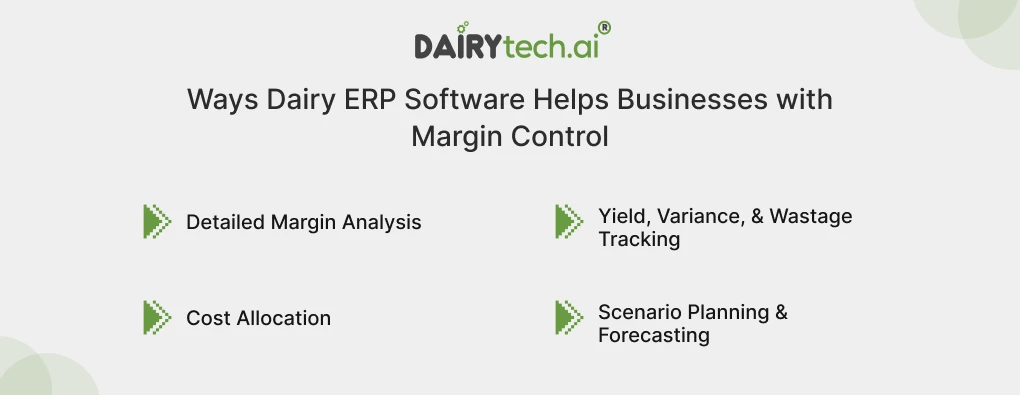
Cost allocation
Dairy ERP software allocates costs accurately for milk components, labor, overhead, and energy. Every batch and product reflects the true cost of production. This eliminates hidden expenses and ensures that pricing decisions are based on real numbers, preventing margin leakage.
Scenario planning and forecasting
ERP systems enable businesses to simulate different scenarios, such as changes in raw material costs or production volume. Managers can forecast margins under various conditions and make informed decisions in advance. This proactive approach minimizes risk and supports better planning for growth and profitability.
Key functionalities of ERP software for dairy businesses
Dairy operations involve several intricate procedures, including obtaining raw milk, producing, packaging, and distributing it. Managing costs, quality, and compliance across these steps requires more than basic accounting. ERP software designed for dairy businesses offers specialized features to help streamline operations, enhance visibility, and maintain profitability while lowering risks. Here are the key functionalities of the ERP system for dairy businesses.
Milk procurement and pricing
ERP systems help manage milk sourcing from multiple suppliers more efficiently. They track procurement volumes, pricing agreements, and quality parameters. This ensures that costs are accurately captured and supplier performance is monitored. Businesses can optimize purchasing, reduce procurement costs, and maintain consistent raw material quality.
Lot traceability and compliance
The dairy ERP system provides complete traceability of each milk batch from farm to finished product. It supports compliance with food safety regulations by keeping detailed records of production, testing, and distribution. This reduces the risk of recalls, ensures audit readiness, and protects both margins and brand reputation.
Shelf-life and expiry management
ERP tracks the shelf life of dairy products across inventory and distribution channels. Managers receive alerts for products nearing expiry, helping reduce waste. Maintaining timely sales and optimizing stock rotation safeguards company profits and boosts client satisfaction.
Co-product and by-product accounting
Processing milk often produces co-products and by-products, including cream, whey, or butter. ERP software assists in precisely accounting for these, allocating accurate expenses and earnings. This prevents margin leakage and ensures that all outputs contribute to profitability.
Benefits of adopting an ERP system for financial and margin control
Implementing an ERP system offers dairy businesses better control over costs and margins. Connecting financial and operational data enables dairy enterprises to identify inefficiencies early and supports informed decision-making. This results in improved profitability, stronger compliance, and greater confidence in financial management. Here are the benefits of implementing a dairy ERP system for finance and margin control.
Improved profitability
ERP provides clear visibility into costs at every stage of operations. This helps identify the margin leakage caused by wastage, inefficiencies, or pricing gaps. With accurate cost data, businesses can take corrective action early. Over time, this leads to stronger and more consistent profitability.
Faster decisions
Real-time dashboards and reports replace delayed financial statements. Managers can quickly assess performance and respond to issues as they arise. This reduced reliance on estimates and assumptions. Decisions are made with greater speed and confidence.
Better pricing control
ERP enables accurate cost analysis for products and customers. Businesses can set prices based on true production costs and expected margins. This strengthens contract negotiations and reduces the risk of underpricing. Pricing decisions become more strategic and data-driven.
Stronger compliance
ERP systems maintain detailed records for audits and regulatory reporting. Compliance data is easily accessible and updated. This reduces audit risks and manual efforts during inspections. Businesses stay compliant without adding operational complexity.
When is the right time to invest in dairy ERP?
nvesting in a dairy ERP system is more than just a technological choice; it’s a business decision. Many dairy companies delay ERP adoption until problems become too costly to ignore. Recognizing the right signals early helps businesses avoid margin losses, operational inefficiencies, and compliance risks while supporting sustainable growth. Examine these aspects to determine if a dairy ERP system is necessary.
System limiting growth
If existing systems struggle to handle growing transaction volumes, it is a strong warning sign. Frequent manual work, data mismatches, and reporting delays slow down decision-making. Teams spend more time fixing data than analyzing performance. When systems no longer support business goals, ERP becomes necessary.
Business expansion
Scaling operations or adding new product lines increases complexity. Managing SKUs, plants, or suppliers with spreadsheets and legacy tools leads to errors. ERP provides structure, standard processes, and centralized control. This allows growth without losing visibility or control over costs.
Rising compliance needs
Regulatory requirements in the dairy manufacturing industry continue to increase. Manual compliance tracking raises the risk of missed records, audit issues, or penalties. ERP systems automate documentation, traceability, and reporting. This reduces compliance risk while saving time and effort.
Margin and cash pressure
When margins shrink and working capital becomes tight, better visibility is critical. ERP helps track costs, inventory, and receivables in real-time. This supports better pricing, inventory control, and cash flow management. Timely insights help protect margins and financial stability.
Conclusion
Rising costs, narrow margins, and increasing compliance demands have made financial visibility and margin control crucial, requiring precise, real-time insight across operations. Without the right systems, small inefficiencies can quickly turn into major profit losses.
A customized dairy ERP integrates financial and operational data, allowing for better cost control, more informed decisions, and long-term profitability. This is where DairyTech.ai adds value. With industry-focused ERP capabilities, we help dairy businesses gain real-time financial visibility, improve yield and margin control, and stay compliant while scaling with confidence.
Connect with our dairy experts to see how our dairy ERP system can transform your financial visibility and help your business grow.