There is a quiet revolution taking place in Canada’s dairy industry, and it is happening on generational family farms, where owners who have spent decades supplying raw milk to third-party dairies are finally asking a different question: Why can’t we make it ourselves and sell it ourselves?
That answer is changing. And Summit Station Dairy & Creamery in Hamilton, Ontario, is the proof.
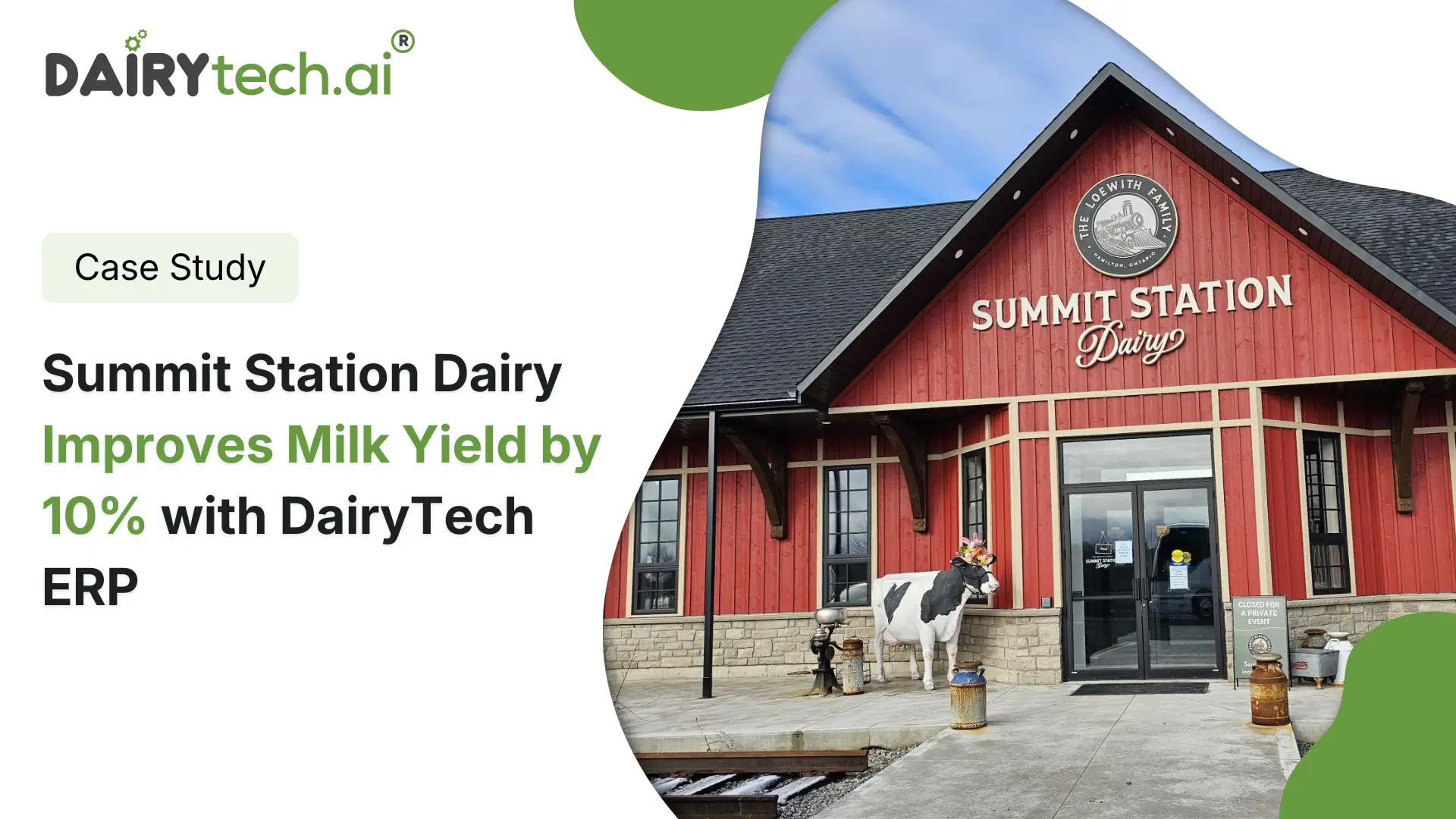
The Loewith family, 4 generations and 75 years into farming, did not just launch a milk delivery service in October 2023. They built a small-batch creamery, developed 21 distinct product SKUs across 7 product lines, implemented a glass-bottle return-and-reuse program, and opened an on-farm retail store, all simultaneously and all powered by DairyTech ERP.
This is the story of how they did it and what every dairy manufacturer can learn from them.
The Problem
The transition from a raw milk supplier to a multi-SKU dairy manufacturer exposed 6 significant operational challenges that no spreadsheet or manual system could reliably address.
Challenge 1: Chaotic Raw Milk Allocation Across 21 SKUs
Summit Station produces approximately 20,000 liters of raw milk per day from 450 cows. Before DairyTech, deciding how to allocate that raw milk across 21 different products was largely a daily guessing exercise. How much whole milk to bottle? How much to divert to cream separation? How much do you want to flavor with chocolate or strawberry? How much does it cost to culture yogurt or process it into cheese curds?
Without demand data linked to the production floor, the farm risked chronically overproducing some SKUs while underproducing others, a costly problem in a business where raw material is highly perishable and every unsold liter represents lost margin.
Challenge 2: No Direct Consumer Access
Every liter of milk left the farm and disappeared into someone else’s supply chain. Summit Station had no storefront, no customer data, no ability to sell premium or artisanal products, and no brand presence with end consumers.
Challenge 3: Creamery Small-Batch Scheduling
Cheese curds are arguably Summit Station’s most distinctive artisanal product; the on-farm store even has a viewing window so customers can watch them being made. But fresh cheese curds have an extremely short window of peak quality: they are at their best within 24–48 hours of production and lose their signature squeak within days.
This creates a manufacturing timing problem unlike any other SKU in the range. Producing too early means delivering sub-par curds to customers and members. Producing too late means failing to fulfill orders. And since the creamery batch process takes time, improvising production on the fly is not an option.
The same challenge applies to yogurt (which requires controlled culturing time) and small-batch butter (which depends on cream available after milk processing).
Challenge 4: No Membership Management Capability
The family envisioned a membership model: customers pay an annual fee and receive weekly deliveries. Without technology to manage member sign-ups, standing orders, billing cycles, and renewals, the idea existed only on paper.
Challenge 5: Quality Control Traceability Across Batches
As a regulated food manufacturer, Summit Station must maintain full batch traceability, the ability to identify, in a recall scenario, exactly which customers received product from a specific production batch. When operating manually with paper logs, this kind of traceability audit can take hours or days. In a food safety crisis, hours matter.
Furthermore, maintaining consistent quality across flavored variants (ensuring every batch of chocolate milk has the same cocoa ratio or every strawberry milk has the same flavor intensity) requires defined production parameters.
The Solution: DairyTech.ai ERP
After an extensive evaluation process that included live demonstrations and real-world testing, Summit Station Dairy chose DairyTech, an AI-driven, dairy-specific ERP that gives real-time visibility and control across your entire operation, helping you reduce losses, improve efficiency, and scale with confidence.
Demand Forecasting
The demand forecasting engine of the dairy ERP system aggregates all active home-delivery member orders, including product type, size, and weekly frequency, and generates a daily production requirement per SKU, 7 days in advance. A real-time production dashboard displays milk-in-process versus ordered volumes across all 21 SKUs simultaneously, so the floor team can see at a glance whether allocation is on track.
Direct-to-consumer (D2C)
The ERP gave Summit Station a branded digital storefront on both Android and iOS apps, as well as a website through which customers could browse products and place orders. For the first time in the farm’s history, a customer in Hamilton could go online, see Summit Station’s full product catalog, and have their order fulfilled directly by the farm: no intermediaries, no white-labelling, and no lost margin.
Creamery Production Scheduling
Our dairy ERP system integrates creamery production scheduling directly with the live delivery calendar. Because the system knows exactly which delivery routes run on which days and at what time, it back-calculates the precise “must start by” production window for every creamery batch, ensuring cheese curds reach customers within their 24-48 hour freshness peak every time.
Each morning, the creamery team receives an automatically generated daily production card specifying what to make, in what quantity, and by what time, calculated from confirmed member orders and scheduled route departure times, not estimates. If a delivery route is rescheduled for any reason, the production card updates automatically. Countdown timers visible on the production floor display the time remaining until each batch must be completed and loaded.
Membership Model: Fully Automated
The ERP enabled Summit Station to launch its signature Annual Home Delivery Membership, covering 52 consecutive weeks of doorstep delivery. The system handles member sign-up and onboarding, annual billing and renewal automation, advance payment collection and reconciliation, and member-exclusive perks (first access to small-batch creamery products and a complimentary farm tour for up to 6 people).
Batch ID-wise Tracing
Every production batch processed through dairy ERP is assigned a unique batch ID at the point of creation, linked automatically to the raw milk collection date, pasteurization temperature log, fat standardization parameters, flavoring ratios, packaging run, and final distribution, creating an unbroken digital chain from cow to customer.
Digital production parameter templates are stored for every SKU. When a creamery operator begins a chocolate milk run, the system displays the exact cocoa concentration, mixing time, and temperature range required for that batch. Any deviation, a temperature excursion, or an out-of-spec fat reading is flagged in real time and logged against the batch record, creating a permanent quality audit trail without a single sheet of paper.
In a recall scenario, the ERP generates a complete affected-customer list, with order details and delivery dates, in under 60 seconds, replacing what would previously have been a multi-day paper trail exercise with a single report query.
The Results
The transformation was immediate and compounding. With DairyTech embedded as its operational core, Summit Station Dairy did not simply fix its problems; it opened doors for a new tier of growth.
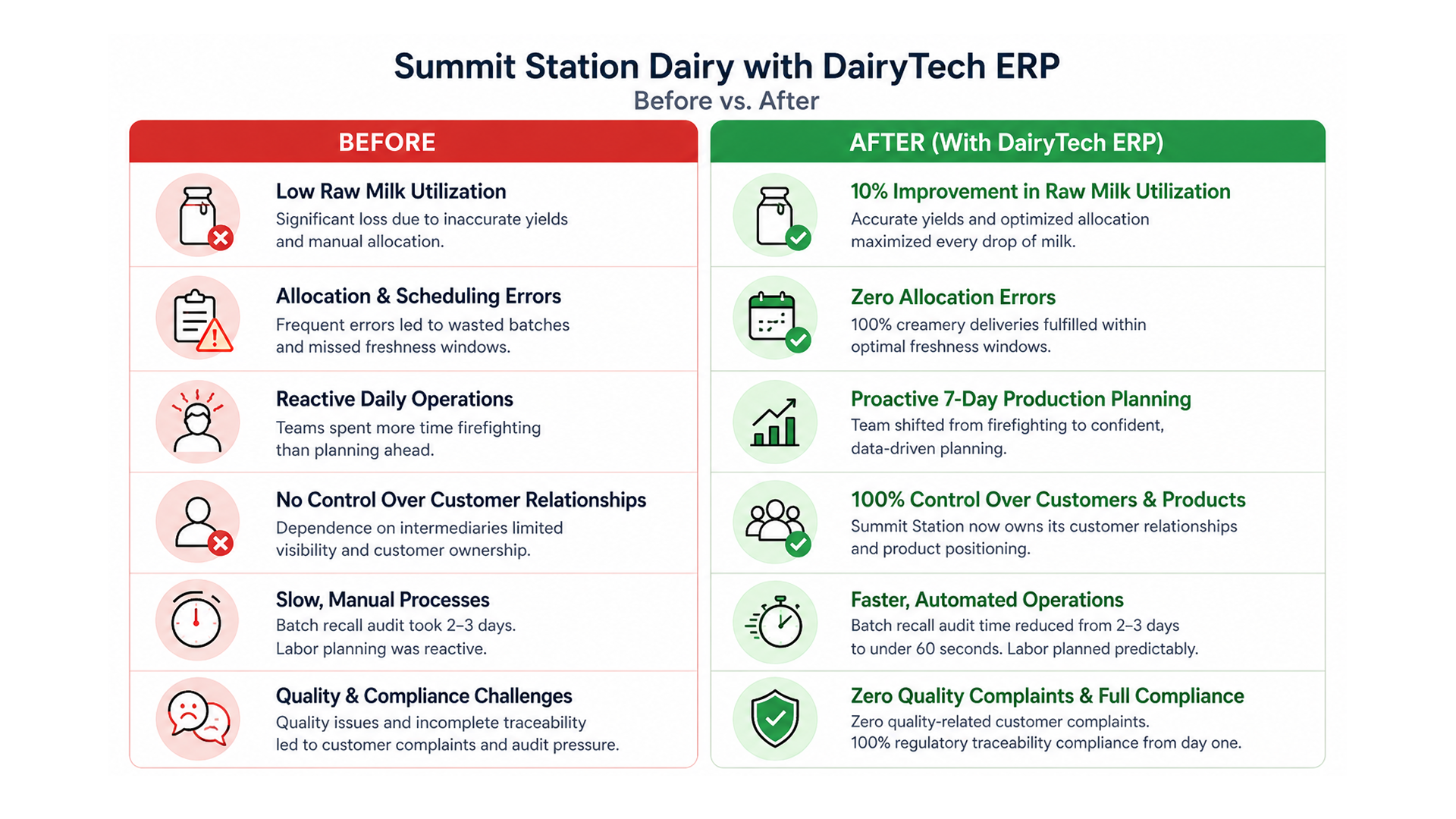
- Raw milk utilization improved by an estimated 10%, allocation errors were effectively eliminated, and the production team shifted from reactive daily firefighting to confident 7-day planning.
- Summit Station now controls 100% of its customer relationships and product positioning.
- 100% of creamery product deliveries fulfilled within optimal freshness windows, zero wasted batches due to scheduling errors, and creamery labor hours planned predictably rather than reactively.
- A repeatable, retention-driven revenue model with zero manual admin overhead.
- Batch recall audit time reduced from an estimated 2–3 days to under 60 seconds, zero quality-related customer complaints attributable to production parameter errors, and full regulatory traceability compliance achieved from day one of ERP go-live.