Running a dairy farm or dairy business means managing a complex web of operations, from milk production and herd management to compliance tracking and financial reporting. While many dairy enterprises adopt ERP systems to streamline operations, they often hesitate due to one critical concern: what happens to their existing accounting system?
Most dairy businesses already depend on reliable accounting platforms such as Xero, QuickBooks, and MYOB. These systems hold years of financial data, established workflows, and trained teams.
With DairyTech, you don’t have to choose. Our dairy ERP platform integrates directly with leading accounting systems, so you can continue working in the tools your team knows while unlocking the full power of purpose-built dairy management.
While DairyTech ERP includes a built-in, AI-driven accounting module, businesses that prefer to retain their existing accounting systems can seamlessly integrate them with the ERP, ensuring continuity without compromising on functionality.
Why Integration Matters for Dairy Businesses
Dairy operations are complex, encompassing milk procurement, production, inventory management, cold-chain logistics, and compliance. Financial data sits at the core of all these processes. Without integration, businesses often face the following:
- Disconnected systems and data silos
- Manual data entry across platforms
- Increased risk of errors and duplication
- Delayed financial visibility
Integrating your accounting system with DairyTech ERP eliminates data silos, reduces manual entry, and ensures real-time synchronization between financial and operational workflows. It creates a unified digital ecosystem where operational and financial data flow seamlessly, enabling better decision-making, improving accuracy, and enhancing scalability.
What Does This Mean in Practice
- Milk procurement entries are automatically reflected in your accounting books
- Sales invoices are generated in ERP sync instantly with your accounting software
- Expense tracking aligns with production and logistics activities
- Financial reports reflect real-time operational performance
This level of synchronization ensures that decision-makers always work with accurate, up-to-date information.
Flexible Integration With Your Existing Accounting System
DairyTech ERP is designed for flexibility. Whether you are using cloud-based or on-premise accounting software, our platform supports seamless integration.
Supported Accounting platforms
In addition to Xero, QuickBooks, and MYOB, DairyTech can integrate with a wide range of accounting systems, including:
- Sage: Widely used for enterprise financial management
- Zoho Books: Popular among growing businesses
- Tally: A dominant choice in Indian dairy businesses
- FreshBooks: Ideal for service-oriented accounting workflow
- Wave Accounting: Suitable for small-scale operations
This ensures that no matter which platform you currently rely on or what dairy business type you are in (cooperative, private dairy, or large-scale processor), DairyTech ERP can connect with it efficiently.
Also Read: Why Traditional Dairy Operations Need Modern ERP Systems
How the Integration Works
DairyTech ERP uses a robust integration framework built on secure APIs, connectors, and middleware layers to connect with accounting systems.
Core Integration Mechanism
- API-based Connectivity: Real-time data exchange between ERP and accounting platforms
- Data Mapping: Alignment of ERP fields (e.g., invoices, ledgers) with accounting structures
- Automated Syncing: Scheduled or real-time synchronization of financial data
- Error Handling: Validation checks to ensure data accuracy and consistency
Key Integration Capabilities of ERP-Integrated Accounting System
Automation
Connecting ERP and accounting systems enables the automatic generation of financial documents based on operational activities. These financial documents may include:
Invoices: When milk, dairy products, or by-products are sold and recorded in the ERP, corresponding sales invoices are instantly generated in the accounting system.
Credit Notes: If there are returns, quality issues, or pricing adjustments, the ERP system triggers automatic credit notes without manual intervention.
Journal Entries: Backend financial transactions, such as depreciation, inventory adjustments, or accruals, are automatically posted.
This eliminates duplicate data entry, reduces human error, and ensures that financial records reflect real operational transactions.
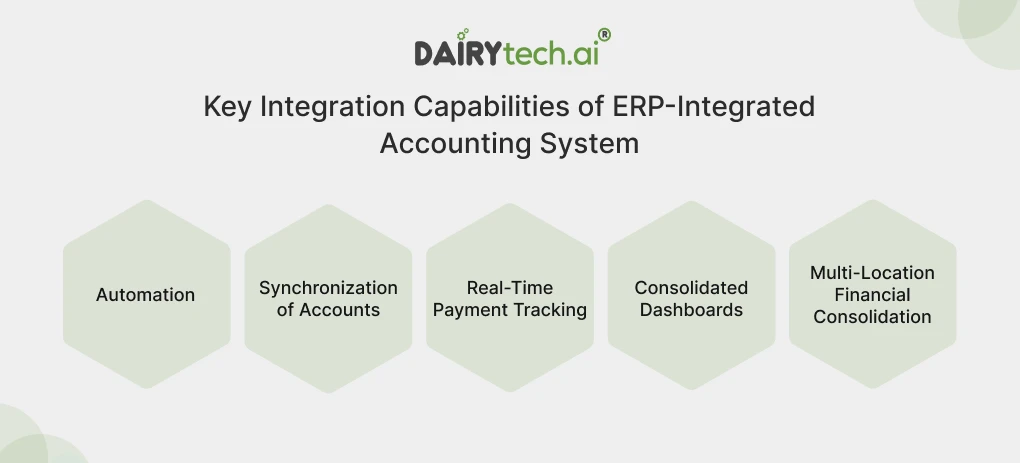
Synchronization of Accounts
Integration ensures continuous alignment among operational, transactional, and financial obligations.
Accounts Receivable: Customer invoices generated in ERP are synced with the accounting system, tracking how much distributors, retailers, or institutional buyers owe.
Accounts Payables: Payments owed to vendors, suppliers, or farmers (for milk procurement) are automatically reflected in the accounting platform.
This provides the finance teams with a real-time, accurate view of incoming and outgoing cash flows without reconciling multiple systems.
Real-time Payment Tracking
- With integration, payment status is updated dynamically across both systems.
- When a payment is received (e.g., from a distributor), it is reflected instantly in both ERP and accounting software
- Outstanding balances are continuously updated, showing exactly who owes what and what payments are pending
- Alerts or dashboards can highlight overdue payments or delayed vendor payouts
This improves cash flow management, reduces payment delays, and strengthens financial control.
Consolidated Dashboards
Integrating an accounting platform with an ERP enables a unified view of business performance by combining financial and operational data.
- ERP contributes operational metrics (milk collection volume, production output, inventory levels)
- Accounting systems contribute financial metrics (revenue, expenses, margin, profitability)
These are merged onto single dashboards, allowing management to:
- Analyze profitability per product or region
- Track cost vs output efficiency
- Make faster, data-driven decisions
Leaders no longer need to switch between systems; they get a holistic, real-time business overview in one place.
Multi-Location Financial Consolidation
Dairy businesses often operate across multiple locations, including collection centers, processing plants, warehouses, and distribution hubs. Integration enables
- Automatic consolidation of financial data from all branches into a central accounting system
- Standardized reporting across locations
- Inter-branch transaction tracking (e.g., stock transfers, internal billing)
For example, milk procured in one region and processed in another can be financially tracked without manual reconciliation.
This ensures accurate enterprise-level reporting, simplifies audits, and supports scalable growth across geographies.
This architecture ensures that your systems operate as one cohesive unit rather than isolated tools.
Use Cases in Dairy Operations
Integration is not just a backend IT feature; it actively drives efficiency, accuracy, and transparency across the entire dairy value chain, from milk collection to final sales and compliance.
Milk Procurement Management
Milk Procurement is the basis of any dairy operation, involving daily transactions with farmers or cooperative societies. When ERP is integrated with accounting:
- Milk collection data (quantity, fat/SNF content, and pricing) recorded in ERP automatically translates into payable entries in the accounting system
- Payments made to farmers, whether daily, weekly, or periodic, are reflected instantly in financial ledgers
- Advances given to farmers (e.g., loans and feed supply credits) and deductions (transportation or quality penalties) are automatically adjusted and recorded
This eliminates manual bookkeeping, ensures transparency in farmer payments, and reduces disputes by maintaining accurate, synchronized financial records.
Production and Processing
Dairy processing involves multiple cost components, including raw milk, additives, labor, utilities, and packaging. With integration:
- All input costs are captured automatically in the ERP, including milk intake, chemicals, and packaging materials, into the accounting system
- Processing costs are linked to specific production batches (e.g., milk -> curd -> cheese)
- Batch-wise costing flows into financial reports, enabling precise cost analysis.
Integrating a dairy production component with an accounting system provides product costing, helps identify inefficiencies, and supports margin optimization across multiple products.
Sales and Distribution
Dairy distribution is fast-paced and often involves multiple channels — distributors, retailers, and direct sales. With ERP-accounting integration:
- Sales invoices are automatically generated at dispatch (e.g., milk packets, butter, and paneer) in the accounting system
- Returns, discounts, and scheme adjustments are reflected via credit notes
- Payments received from distributors are synced in real-time
- Outstanding balances and credit limits are continuously updated
This ensures accurate revenue tracking, improves receivables management, and provides real-time visibility into cash inflows.
Inventory & Cold Chains
Dairy inventory is highly sensitive due to perishability and temperature requirements. Its integration enables the following:
- Real-time inventory valuation (raw milk, finished goods, and by-products) to align with accounting records
- Automatic financial impact of stock movement (inward, outward, or transfers)
- Recording of wastage, spoilage, or expiry losses as financial adjustments in the accounting system
It improves inventory accuracy, reduces financial discrepancies, and ensures that losses are properly accounted for in profitability analysis.
Audit and Compliance
Dairy businesses operate under strict regulatory frameworks, especially in taxation and food compliance. With an integrated system:
- The system logs every transaction, from procurement to sales, and ensures food compliance
- ERP automatically compiles the financial data required for GST/VAT filings from synchronized records
- Teams can quickly generate audit reports (internal or external) with consistent data across all systems
It reduces compliance risk, simplifies audit processes, and ensures adherence to regulatory standards without last-minute data reconciliation
Bottom-Line
Adopting DairyTech ERP doesn’t require you to replace the accounting systems your business already depends on. Instead, it allows you to enhance and extend their value by integrating them into a unified dairy management ecosystem.
Whether you rely on Xero, QuickBooks, MYOB, or any other accounting platform, DairyTech ensures seamless, secure connectivity between your financial and operational workflows. The result is a tightly integrated system where data flows automatically, real-time insights back every decision, and your team operates without disruption.
Ultimately, integration is not just a technical layer; it’s a strategic enabler that connects your current systems with your future growth, without forcing a complete overhaul.
If you’re looking to modernize your dairy operations without disrupting your existing financial setup, DairyTech ERP is built for you. Get in touch with our dairy ERP team today to explore how we can integrate your current accounting system with DairyTech and create a seamless, efficient, and scalable ecosystem for your business.
Case Study: Summit Station Dairy Improves Milk Yield by 10% with DairyTech ERP
Frequently Asked Questions
Q1. Will I need to stop using my current accounting software?
A1. No. DairyTech ERP is designed to work alongside your existing accounting system. You can continue using your current platform without interruption.
Q2. How complex is it to integrate DairyTech with my existing systems?
A2. The complexity depends on your existing setup, but most integrations use APIs or connectors to streamline the process. DairyTech provides implementation support to ensure a smooth transition with minimal operational disruption.
Q3. Can DairyTech customize the integration to fit my business workflow?
A3. Yes, you can configure data flows, field mappings, and synchronization rules based on your specific processes, whether it’s milk procurement, distributor billing, or multi-branch operations.
Q4. How frequently does data sync between ERP and accounting systems?
A4. You can choose between real-time synchronization or scheduled intervals (e.g., hourly or daily), depending on your operational and reporting needs.
Q5. What types of data does DairyTech sync?
A5. Common data includes:
- Sales invoices and credit notes
- Purchase entries and vendor payments
- Farmer payments and deductions
- Ledger entries and journal postings
- Customer and vendor master data
Q6. Will integration affect my historical accounting data?
A6. No, your existing historical data remains intact in your accounting system. Integration only syncs new and relevant transactional data going forward.
Q7. How secure is the integration?
A7. DairyTech uses secure APIs, encryption protocols, and access controls. This ensures the protection of all financial and operational data during transmission and storage.
Q8. What happens if there is a sync error or data mismatch?
A8. The system includes validation checks and error logs. Integration flags these discrepancies immediately, allowing your team to review and correct them without impacting overall data integrity.
Q9. Can I integrate multiple branches or entities with one accounting system?
A9. Yes. DairyTech supports multi-branch and multi-entity setups, enabling centralized financial consolidation while maintaining branch-level visibility.
Q10. How does integration help during audits and compliance?
A10. Integration creates a clear audit trail and ensures consistent recording of all transactions across ERP and accounting systems. This simplifies GST/VAT filings, reconciliations, and audit reporting.
Q11. Is this suitable for both small dairies and large enterprises?
A11. Absolutely. The integration framework is scalable, making it suitable for small cooperatives as well as large, multi-location dairy enterprises.