Choosing an ERP for your dairy operation shouldn’t feel like navigating a minefield. But with accounting tools masquerading as operations platforms and enterprise systems that take a year to implement and a team of consultants to operate, that’s exactly what it is.
This is a direct, data-backed comparison of DairyTech.ai against the most common alternatives, so you can cut through vendor claims and make a confident, informed decision.
DairyTech.ai vs. SAP: When Enterprise Means Overkill
SAP S/4HANA is the undisputed king of enterprise resource planning for global conglomerates with dedicated IT departments, multi-year implementation budgets, and armies of consultants. For the vast majority of dairy processors, it’s architectural overkill dressed in a very expensive suit.
The cost reality is hard to ignore:
- $1.5M+ is the typical total cost of an SAP S/4HANA implementation for a mid-size food & beverage manufacturer, including licenses, consulting, customization, and first-year support (The Next Disruption, 2025)
- 18–36 months: Average SAP implementation timeline, during which your team runs the old system in parallel, doubling the workload with zero operational gain
- 55% of SAP projects that exceed their original budget (Testhouse, 2025)
DairyTech.ai implementations, scoped specifically for dairy operations, go live in 6–12 weeks at a fraction of the cost. No six-figure consulting retainer. No years-long customization project. No in-house SAP BASIS team required to keep the lights on.
What Are the Hidden Costs of Generic ERP (SAP)?
SAP’s food & beverage modules were built for broad applicability. Dairy-specific workflows, butterfat-based component pricing, affinage (cheese aging) inventory, somatic cell count tracking, and Grade A compliance all require expensive custom development on top of the base platform.
Average dairy-specific SAP customization adds $80,000–$250,000 to implementation cost
Custom code must be re-validated (and often rewritten) with every major SAP upgrade
Migrations from SAP ECC 6.0 to S/4HANA have cost some food manufacturers over $500,000 in fees alone
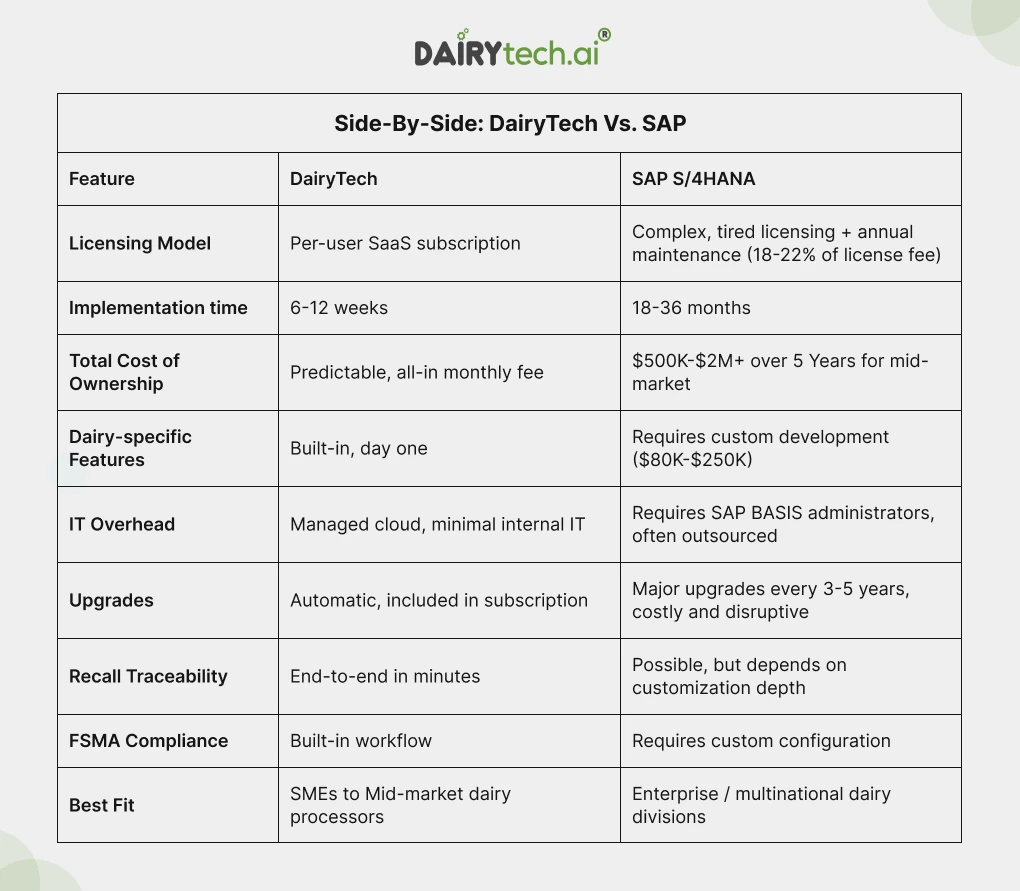
SAP is a credible choice for dairy divisions of multinational corporations that already have a company-wide SAP landscape. For independent dairy processors generating $5M to $500M in annual revenue, DairyTech.ai delivers 90% of the capability at 10–15% of the cost with a go-live timeline measured in weeks, not years.
Skip the $1.5M price tag. DairyTech.ai goes live in 6–12 weeks with all the dairy-specific features you need built in from day one; no customization required. Schedule Your Meeting
DairyTech.ai vs. QuickBooks: The Right Tool for Dairy
QuickBooks is excellent bookkeeping software. It tracks invoices, reconciles bank statements, and generates P&L reports. It was never designed to be an operations platform for a regulated food manufacturer.
Yet 73% of food & beverage companies under $50M in revenue still use QuickBooks or similar accounting-only tools as their primary business system.
What QuickBooks Does Well
QuickBooks handles the financial ledger, and it does this well: accounts payable and receivable, payroll processing, bank reconciliation, basic financial reporting, invoicing, and purchase orders.
Where QuickBooks Hits its Ceiling
The moment milk hits your receiving dock, QuickBooks runs out of road.
It cannot handle:
- Lot-level traceability from raw milk intake to finished SKU
- Batch yield tracking — knowing exactly how many pounds of cheddar you got from 10,000 lbs of milk
- Somatic cell count, butterfat, and protein test result management
- Cold chain temperature compliance logging
- FSMA-compliant food safety plan documentation
- Automated component-based milk pricing (butterfat, protein, other solids)
- Real-time WIP inventory by batch or lot
- Recall readiness — identifying affected lots in minutes, not days
- SKU-level margin analysis including actual production costs
The result of relying on QuickBooks for operations is a patchwork of spreadsheets, whiteboards, and institutional knowledge. When an FSMA audit arrives, a customer triggers a recall, or a key employee walks out the door, that patchwork unravels fast.
The right division of labor
DairyTech.ai and QuickBooks aren’t competitors; they’re complementary. DairyTech.ai manages every operational and compliance workflow from milk intake to shipment. QuickBooks (or your accounting software of choice) continues to handle the general ledger. DairyTech’s two-way QuickBooks sync pushes invoices, bills, and financial transactions automatically, eliminating double-entry and keeping your books accurate without replacing a tool your finance team already knows.
Already on QuickBooks? Keep It.
DairyTech.ai connects directly to QuickBooks: no disruption to your finance team, no double-entry, and no migration headache. You add operational power without losing what’s already working. See How the QuickBooks Integration Works
DairyTech.ai vs. Generic ERP’s
Between the QuickBooks tier and the SAP tier sits a category of “Food ERP” platforms — systems like Aptean Food & Beverage ERP, SYSPRO, Infor, and NetSuite with food add-ons. These are legitimate manufacturing platforms with real lot traceability, recipe management, and compliance modules.
The question is whether food is specific enough for dairy.
The Dairy Gap in Generic Food ERP
A platform that must also serve a bakery, a beverage company, and a snack food producer cannot be optimized for the specific workflows of dairy processing. Common gaps include:
Butterfat & Protein Accounting
Most food ERPs use fixed- or average-cost models for raw material inputs. Dairy requires dynamic component-based pricing, such as class pricing, PPD, & butterfat differentials that change weekly with USDA announcements. Generic platforms typically require custom development to handle this.
Affinage / Aging Curves Inventory
Tracking cheese wheels by cave, aging days, target moisture loss, and rind development is not a standard module in any generic food ERP. Dairy processors either buy expensive add-ons or manage aging separately in spreadsheets.
Grade A Facility Compliance
USDA Grade A Pasteurized Milk Ordinance (PMO) record-keeping, pasteurizer time-temperature logs, and somatic cell count thresholds are dairy-specific requirements not found in generic food ERP compliance modules.
Co-/by-product Management
Dairy production generates multiple simultaneous outputs, including whey, cream, and skim. Generic ERPs often model this poorly, leading to inaccurate yield calculations and distorted material costs.
Customization: A Long-Term Liability
When a generic food ERP is customized for dairy, that custom code creates a fragile dependency. Every platform upgrade must be tested against the custom modules. If the vendor changes an API or data model, the customization may break, leaving customers effectively maintaining a bespoke software product inside their ERP, at ongoing cost and risk.
DairyTech.ai is built dairy-first. The features generic ERPs charge extra to build are standard from day one: no customization surcharge, no breakage risk on upgrades, and no consultant retainer to maintain bespoke code.
Why Pay Extra for What Should Be Standard?
Butterfat pricing, affinage tracking, Grade A compliance, co-product costing: all built into DairyTech.ai at no extra charge. No custom development. No breakage risk on upgrades. Explore DairyTech’s Full Feature List
DairyTech.ai vs Excel & Manual Processes
Excel is not your ERP. It’s a calculation tool that has been stretched, duct-taped, and heroically over-engineered to serve as a production scheduler, inventory tracker, compliance log, and cost model for countless dairy operations. It works. Until it doesn’t.
The Statistics Are Damning
- 88% of spreadsheets contain at least one significant error (Forbes). In a dairy operation, a single error can mean a mislabeled lot, an unreported test failure, or a missed allergen declaration.
- $10M is the Average total cost of a food recall in the US. Traceability failures, almost always rooted in manual record-keeping, are the leading cause of delayed or incomplete recalls.
- 71% of food companies report that manual data entry errors have caused a compliance issue or near miss in the past two years.
The Hidden Costs of Spreadsheet Operations You Don’t See in the Budget
The real cost of managing dairy with spreadsheets is rarely captured in a budget line:
- A production supervisor spends 45–60 minutes per shift reconciling batch logs by hand; that’s 300+ hours annually of highly skilled time doing data entry
- A lot tracing takes hours or days to assemble across multiple spreadsheets, email threads, and paper records
- Yield variance isn’t visible in real-time; a processing problem costing $15,000 in milk loss may not be detected until month-end, if at all
- Spreadsheets have no access controls; a formula changed in error, a row accidentally deleted, a version saved over can corrupt records you need for an FSMA audit
- When a key employee leaves, their spreadsheet expertise leaves with them
What Switching to DairyTech.ai Actually Looks Like
DairyTech.ai customers consistently report the following improvements within 12 months of go-live:
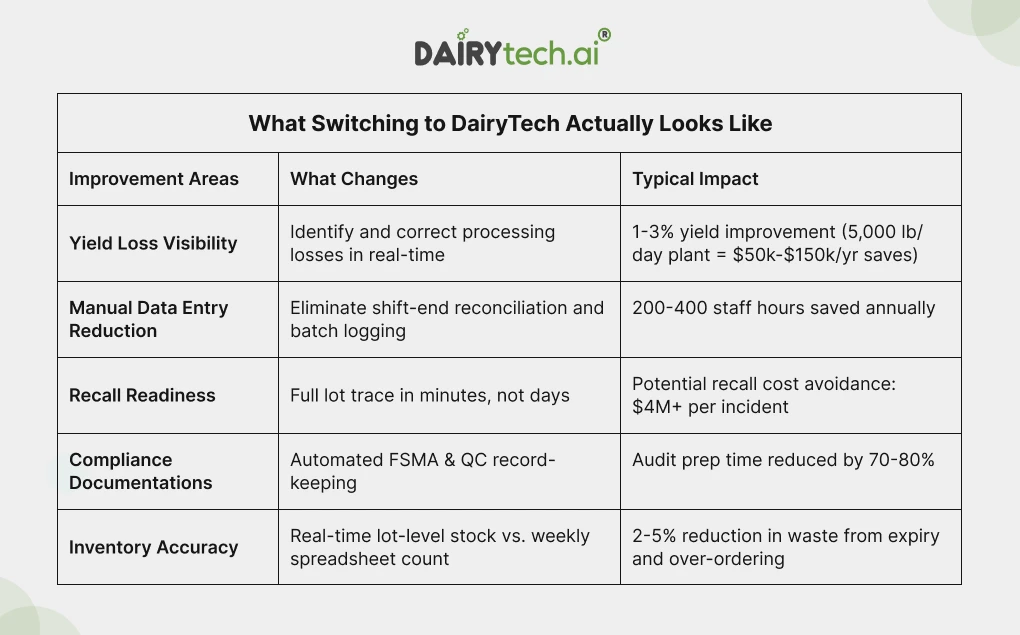
For most dairy processors running on Excel, the ROI on a purpose-built ERP typically pays back within 12–18 months, driven by labor savings and yield improvements alone, before accounting for the risk-reduction value of recall readiness and compliance documentation.
Find Out What Your Spreadsheets Are Really Costing You
300+ hours of manual data entry. Invisible yield losses. A recall you can’t trace fast enough. Use our free ROI calculator to see your numbers in under 5 minutes. Calculate My ROI
Why DairyTech.ai Is Purpose-Built For This Segment
DairyTech.ai was architected from the ground up for independent dairy processors. Unlike scaled-down versions of enterprise platforms, DairyTech.ai does not ask small operations to navigate menus and modules built for a multinational. The system is intentionally scoped to the workflows that matter most to a growing dairy business:
- One-click lot trace, from finished product back to the farm batch, in seconds
- The batch yield dashboard is visible on any device on the production floor
- Built-in FSMA food safety plan and corrective action templates
- Farmer payment runs with butterfat and component differentials calculated automatically
- SQF and organic certification record-keeping out of the box
- QuickBooks sync — no disruption to existing accounting workflows
- Onboarding in weeks, not months, with a dedicated dairy implementation specialist
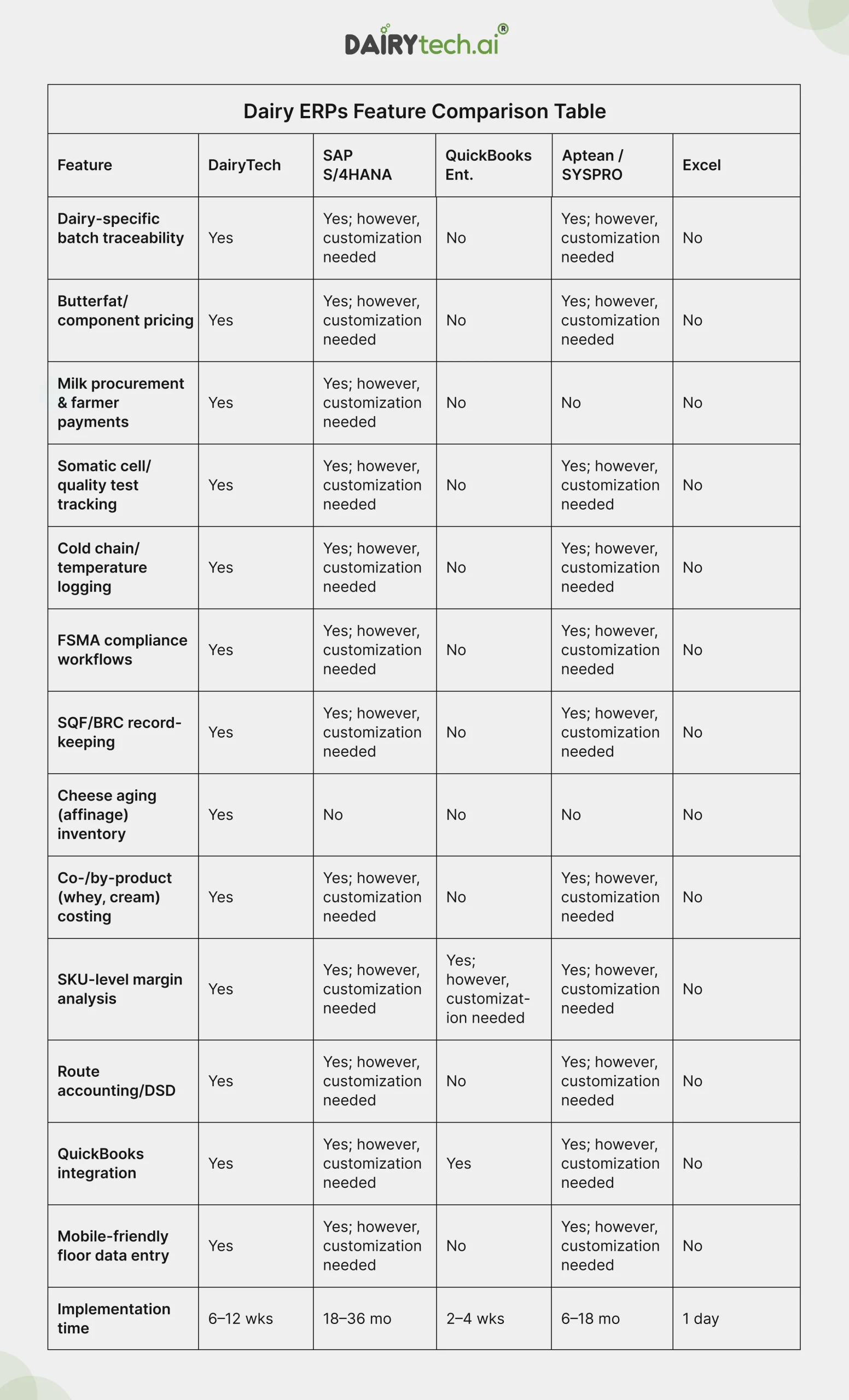
Feature Comparison Table: Top Dairy Software Options
Use this table as a quick reference when evaluating vendors.
Want a Side-by-Side Tailored to Your Operation?
Tell us your production volume, product lines, and current software setup, and we’ll show you exactly how DairyTech stacks up against what you’re using today. Get a Personalized Comparison
Bottom Line
The ERP market is full of options that weren’t built for dairy — and the gap between what they promise and what they deliver gets expensive fast. Whether you’re drowning in spreadsheets, outgrowing QuickBooks, or evaluating whether a six-figure SAP project is really worth it, the answer for most independent dairy processors is the same: purpose-built beats generic every time.
Ready to see DairyTech.ai in action? Book a demo and go from evaluation to go-live in weeks, not years.
Frequently Asked Questions
How long does DairyTech.ai take to implement?
Most DairyTech.ai implementations go live in 6–12 weeks, with small operations (under 50 employees) often onboarded in under 8 weeks. This compares to 18–36 months for SAP and 6–18 months for generic food ERP platforms. Every implementation includes a dedicated dairy specialist who works alongside your team throughout the process.
Does DairyTech.ai work with QuickBooks?
Yes, DairyTech.ai has a native, two-way QuickBooks sync. Invoices, bills, and financial transactions flow automatically between the two systems, eliminating double-entry and keeping your books accurate. Your finance team keeps using the tool they know; DairyTech.ai handles everything on the operations side.
Is DairyTech.ai suitable for small and medium dairy operations?
DairyTech.ai was built specifically for independent dairy processors, including small and artisan operations with 10–50 employees and revenues from $500K to $15M. Unlike scaled-down enterprise platforms, DairyTech.ai doesn’t ask small operations to navigate menus designed for multinationals. Pricing is per-user SaaS with no large upfront license cost and no per-module fees.
How does DairyTech.ai handle FSMA compliance?
FSMA compliance workflows are built into DairyTech.ai from day one — no custom configuration required. This includes food safety plan documentation, corrective action templates, lot-level traceability records, and audit-ready reporting. FSMA Subpart S record-keeping that would take days to assemble manually can be produced in minutes.
Can DairyTech.ai handle cheese aging (affinage) and co-products like whey?
Yes, both are standard features. DairyTech.ai tracks cheese wheels by cave, aging days, target moisture loss, and rind development. Co-products and by-products (whey, cream, & skim) are costed accurately in real-time, giving you true yield and margin visibility. These are features no generic food ERP includes out of the box.
How does DairyTech.ai handle farmer payment and butterfat pricing?
Farmer payment runs, including butterfat differentials, protein premiums, and component-based calculations tied to USDA announcements, are automated within DairyTech.ai Component pricing updates weekly without manual re-entry, and payment summaries are generated automatically for each farm.
What happens to my data when I switch from Excel?
DairyTech’s onboarding team handles data migration as part of implementation. Historical batch records, lot data, and inventory figures are imported and validated before go-live. Your team doesn’t start from scratch, and you don’t lose the records you need for traceability or audits.
How does DairyTech’s cost compare to SAP or generic food ERPs?
DairyTech.ai is priced as a per-user SaaS subscription with a predictable all-in monthly fee. A typical mid-market SAP implementation runs $1.5M+ over five years; a generic food ERP with dairy-specific customization typically adds 30–45% to implementation costs. DairyTech.ai customers generally see ROI within 12–18 months, driven by labor savings and yield improvements alone, without the upfront capital commitment or ongoing consultant fees.
What if I’m currently evaluating multiple ERP vendors?
That’s exactly the right approach. We’d recommend asking every vendor on your shortlist the same questions: Does butterfat/component pricing work out of the box? Can I run a lot trace in under 5 minutes without consulting help? What does a dairy-specific implementation actually cost, all-in? DairyTech’s team is happy to walk through a live demo tailored to your product lines and compliance requirements so you can compare apples to apples.
Is DairyTech.ai a good fit if I am planning to grow significantly?
Yes. DairyTech.ai is designed to scale with independent dairy processors from early-stage creameries through mid-market operations. As you add product lines, production volume, or distribution channels, the platform grows with you, without the “rip and replace” cycle that comes with outgrowing an entry-level system.
Have a question that isn’t answered here? Contact our team; we’ll get you an answer from someone who actually knows dairy.