Enhancing Yield Accuracy and Loss Reduction With Dairy ERP Software
With raw milk prices fluctuating, labor and energy costs rising, and regulatory expectations tightening, even small inefficiencies can significantly impact margins. A fraction of a percentage point loss in yield might not seem major on a single batch. However, across thousands of production runs, it unnoticeably converts into a significant financial leakage.
Many dairy businesses still accept a defined level of yield loss as unavoidable and normal. But now the question arises: how much is actually lost and how much is visible?
When yield data is delayed, inconsistent, or manually calculated, losses tend to hide in averages and end-of-month reports. This is what shifts this conversation from tolerance to control. Modern dairy ERP solutions enable real-time yield measurement across the entire production lifecycle. It offers a shared, data-driven view of where the product is going, where it is being lost, and why.
This blog explains why yield accuracy and loss reduction are crucial for dairy businesses and discusses yield management in ERP software.
Understanding yield loss in dairy manufacturing
In dairy manufacturing, yield is how much finished product you get from the milk and raw material you put in. Yield loss is the difference between what you should get and what you actually get. This loss can be due to spills, rework, overfilling, or product that never made it into a saleable package.
Yield loss doesn’t happen at a single point but can occur at multiple points in the process. This may include:
- When milk is received and transferred into tanks.During processing, such as heating, separating, or blending.
- As lines are cleaned and flushed, switching between products results in additional loss.
- Clean-in-place (CIP) cycles can push usable products out of the supply chain.
- One common source of loss is overfilling to prevent underweight packages, which can lead to spills.
The amount of yield loss also depends on the product being produced. Fluid milk often differs from the loss patterns of cheese, yogurt, or butter. For instance, cheese and yogurt involve more complex processing steps, creating more opportunities for loss. Butter and other fat-based products can be sensitive to small process changes that affect yield.
Understanding the theoretical yield and actual yield is also crucial. Theoretical yield is what you expect to produce based on recipes, formulas, and standard assumptions. Actual yield is what you really produce based on the floor. Between the theoretical and actual yield gaps is where the loss is found.
Without accurate and timely data, these losses can go unnoticed and, over time, can quietly erode profitability.
How does inaccurate yield data impact your business?
When yield data is incomplete, delayed, or unreliable, losses don’t just disappear but go unnoticed. Over time, these hidden issues increase, making it difficult to control costs, trust reports, or improve performance. Inaccurate yield data creates problems across operations, finance, and planning. Here is how inaccurate yield data can impact your dairy business.
Reliance on manual and disconnected data
Many dairy businesses still rely on handwritten logs, spreadsheets, or multiple systems that do not communicate with each other. This makes data entry time-consuming and prone to errors. When information is transferred manually, inconsistencies appear, and teams lose confidence in data.
Lack of timely visibility into yield loss
When yield performance is reviewed only at the end of a shift, day, or month, problems are identified too late. By the time losses are visible, the product is already gone. This forces teams to react after the fact instead of preventing losses as they occur.
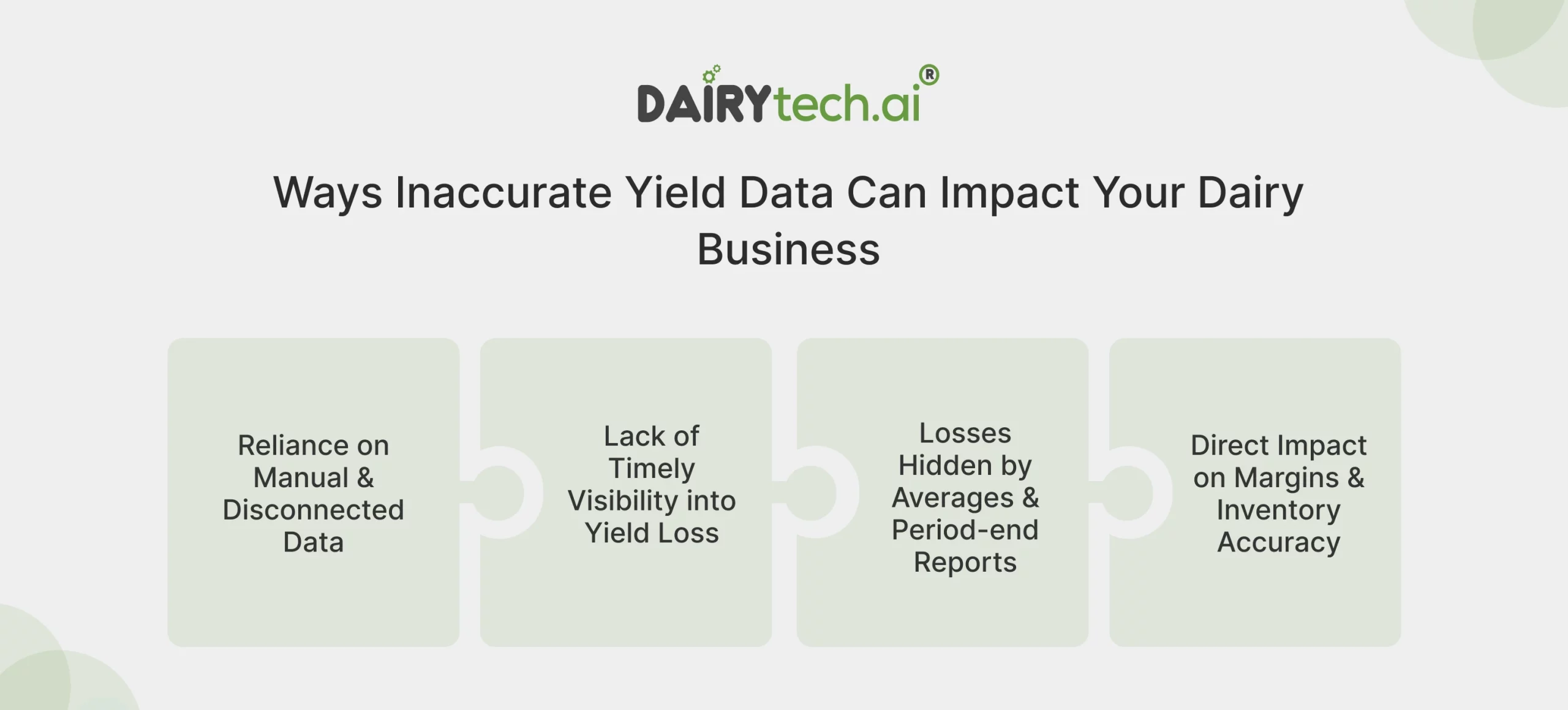
Losses hidden by averages and period-end reports
Averaged data can make performance look acceptable even when specific runs, lines, or shifts are underperforming. Good batches can cover for poor ones on paper, masking recurring issues. Period-end reporting explains what happened, but not where or why it happened.
Direct impact on margins and inventory accuracy
Inaccurate yield data constricts margins without being immediately obvious. Inventory records become unreliable, leading to shortages, excess stock, or unexpected write-offs. Over time, this weakens financial reporting and limits the ability to plan with confidence.
Features of dairy ERP software that improve yield accuracy
Dairy ERP software replaces estimates and after-the-fact reporting with consistent, real-time data, improving yield accuracy. It provides your teams with a clear view of how much product is used, produced, and lost at every stage, making it easier to spot issues early and take corrective actions. Here are the features of the dairy ERP system that help improve yield accuracy.
Real-time material tracking
A dairy ERP system tracks milk and ingredients as they move through the plant, from receiving and storage to processing and packaging. This means teams can see exactly how much material goes into the batch and how much finished product comes out. With real-time tracking, losses become visible as they happen, not days or weeks later.
Standardized yield calculations
With standards, different teams may calculate yield and loss in distinct ways. ERP software applies the same rules and formulas across the organization. Yield, waste, rework, and byproduct losses are predefined consistently, ensuring that everyone works from the same numbers. This removes confusion and makes performance comparisons meaningful.
Integration with production, quality & inventory data
The dairy ERP software connects production data with quality results and inventory records. When these areas share the same system, yield calculations are more accurate because they reflect what actually happened on the floor. This integration also helps identify whether losses are related to quality holds, rework, or inventory discrepancies.
Automated data capture from the shop floor
Where equipment and systems allow, ERP software can automatically capture data from scales, meters, and production equipment. This reduces manual data entry and minimizes errors. More accurate input data leads to more reliable yield calculations and greater confidence in reported results.
How do ERP-driven insights help identify and reduce loss?
Once the yield data is accurate and visible, the next step is to utilize the data to create strategies to reduce loss. Dairy ERP software transforms raw production data into insights that help teams to identify the causes, locations, and solutions for losses before they become routine.
Batch-level and lot-level yield analysis
ERP software allows teams to review yield for individual batches and lots, not just overall averages. This makes it easier to see which specific runs performed well and which didn’t. Instead of guessing the source of losses, teams can point to exact batches and investigate what happened during those runs.
Variance tracking against standards or targets
ERP systems compare actual yields against expected standards or targets. When performance falls outside acceptable ranges, the variance is clearly visible. This helps teams quickly identify when a process is drifting off track, rather than discovering issues weeks later in summary reports.
Root-cause analysis by line, product, shift, or operator
With detailed ERP data, losses can be analyzed from multiple angles. Teams can see if yield issues are related to a specific production line, product type, shift, or operating crew. This level of detail helps move conversations away from assumptions and toward facts, making corrective actions more effective and fair.
Early detection of abnormal loss patterns
ERP software makes it easier to spot unusual loss patterns early, such as a gradual increase in waste or repeated underperformance on a specific product. Catching these trends early allows teams to correct issues before they become costly habits or require major interventions.
Financial and strategic benefits of improving yield accuracy
Accurate yield data does more than improve production reports. It has a direct effect on the organization’s operational and long-term improvements, financial performance, and planning accuracy. When yield and loss are visible and reliable, the benefits extend well beyond the plant floor. Here are the benefits of improving yield accuracy with the dairy ERP software.
Improved gross margin and cost per unit accuracy
When yield data is accurate, businesses know exactly how much it costs to produce each unit of product. Losses are no longer hidden inside averages or assumptions. This leads to more reliable gross margin calculations and a clearer understanding of true profitability by product, customer, or plant.
Better inventory valuation and demand planning
Accurate yields ensure that what is shown in the system closely matches what is on hand in production, improving inventory records. This reduces surprises such as shortages or excess inventory. With more reliable inventory data, planning teams can forecast demand more accurately and schedule production with greater confidence.
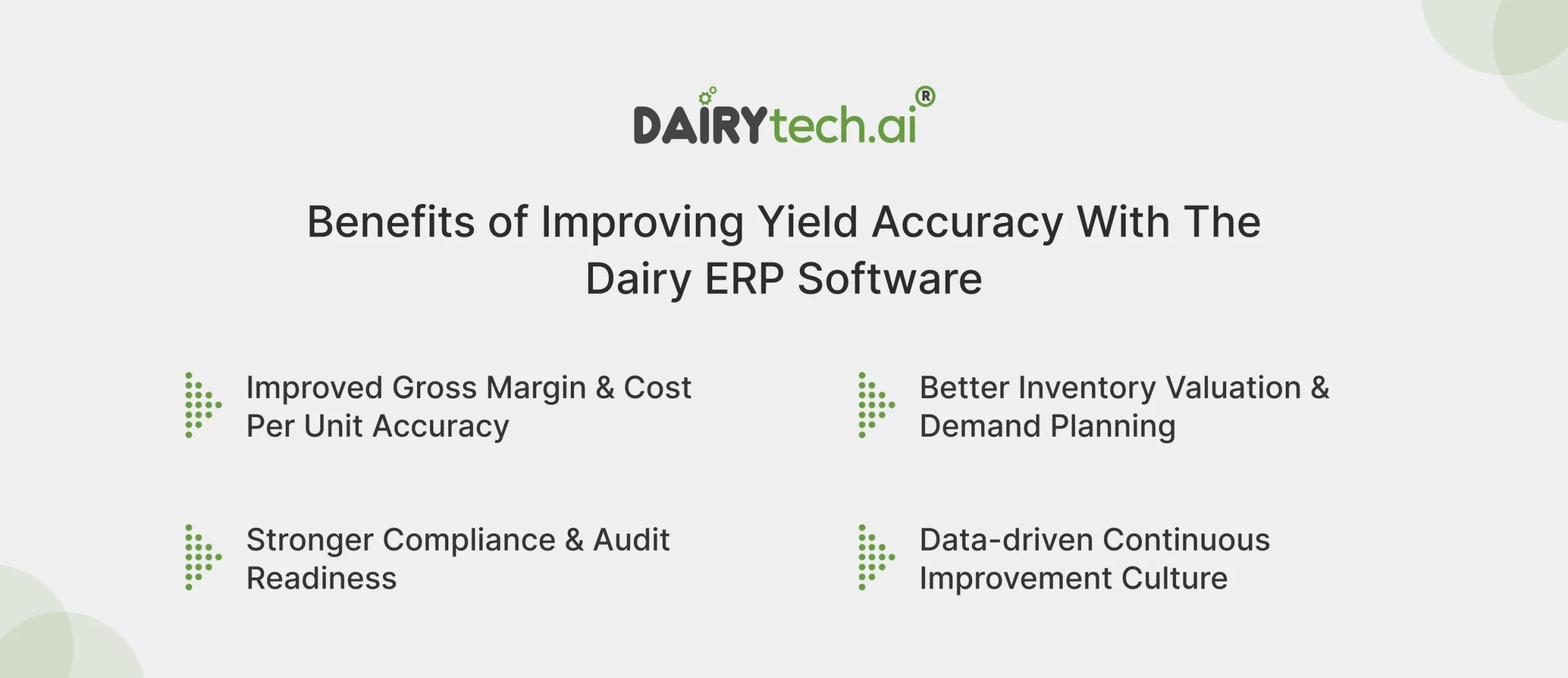
Stronger compliance and audit readiness
Consistent, system-driven yield and loss tracking creates a clear audit trail. Data is captured automatically and stored in a centralized system, making it easier to support regulatory requirements, internal audits, and customer reviews. This reduces manual effort and lowers the risk of compliance issues.
Data-driven continuous improvement culture
When teams trust the data, conversations shift from opinions to facts. Clear yield and loss metrics help teams identify improvement opportunities, measure the impact of changes, and sustain gains over time. This supports a culture of continuous improvement where decisions are based on evidence rather than assumptions.
Conclusion
Improving yield accuracy and reducing loss is about gaining control and being able to see where the product is going, where it is being lost, and why it is happening. This data enables dairy manufacturers to plan strategies to overcome the issue. The dairy ERP software provides reliable, real-time data that teams can trust, replacing estimates, spreadsheets, and delayed reports.
This results in better decisions on the plant floor, more accurate financial reporting, and sustained margin improvement over time. Yield analysis becomes a daily operational metric that supports accountability, continuous improvement, and profitability.
DairyTech.ai helps dairy processes to achieve this shift seamlessly. Our ERP solutions are tailored for dairy operations with deep functionality for yield tracking, loss analysis, production visibility, and financial integration. We work with dairy processors to uncover hidden losses, standardize yield management, and turn data into actionable insights, without adding complexity to daily operations.
Schedule a consultation with us to understand where yield is being lost in your operations and how our ERP can help you recover it.