How Dairy ERP Software Improves Quality Control Across the Supply Chain?
Are you confident in the quality of every dairy product you deliver? One quality lapse is all it takes to trigger recalls, regulatory penalties, and loss of consumer trust. In the dairy industry, products are highly perishable, and quality standards are non-negotiable. Here, manual checks and fragmented systems can no longer guarantee consistent quality control.
This is the reason why dairy businesses are adopting dairy ERP software. The dairy enterprises aim to gain real-time visibility, automate quality checks, and ensure compliance at every stage of the supply chain.
This blog explains how a Dairy ERP system strengthens quality control, reduces risk, and enables dairy businesses to deliver safe, high-quality products.
Understanding quality control in the dairy industry
Quality control in the dairy industry focuses on ensuring that milk and dairy products meet strict safety, hygiene, and quality standards at every stage of the supply chain. Each step, from raw milk collection and testing to processing, packaging, storage, and distribution, must be closely monitored to prevent contamination and maintain product integrity.
Key quality parameters include fat and SNF levels, microbial counts, temperature control, shelf-life, and packaging integrity. Because dairy products are highly perishable, even a single quality deviation can impact safety and quality. Effective quality control enables dairy businesses to comply with regulatory requirements, reduce waste, protect consumers, and maintain consistent product quality in a competitive market.
Challenges of traditional quality control methods
Traditional quality control approaches in the dairy industry often struggle to meet modern food safety regulations and operational demands.
As dairy supply chains become more complex and quality standards tighten, manual and fragmented systems are no longer appropriate. Conventional quality control methods limit responsiveness, increase risk, and hinder consistent quality assurance. Here are the challenges faced by the dairy business with traditional quality control methods.
Manual data collection and disconnected systems
Many dairy operations still rely on paper-based records, spreadsheets, or isolated software for capturing quality data. Milk quality results, production parameters, and inspection reports are often recorded separately across departments. This fragmentation leads to data silos, inconsistencies, and human errors. Without a centralized system, teams lack real-time visibility into quality performance, making it difficult to identify trends, compare results, or take proactive actions.
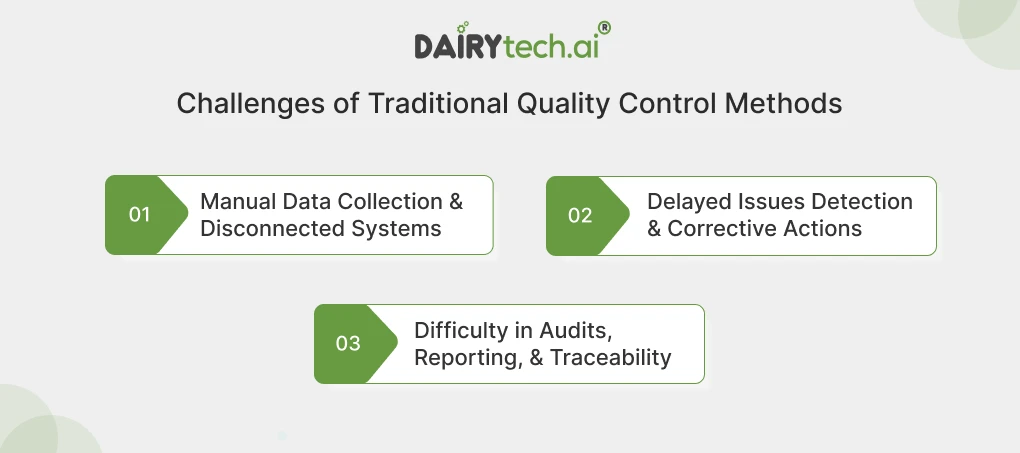
Delayed issues detection and corrective actions
In traditional setups, quality issues are typically found after periodic reviews or manual inspections. By the time deviations are identified, affected products may have already been processed, stored, or distributed. This delay increases the scope of recalls, raises operational costs, and heightens food safety risks. The absence of automated alerts and real-time monitoring prevents timely corrective and preventive actions.
Difficulty in audits, reporting, and traceability
Regulatory audits require accurate, well-documented records of quality checks, process controls, and corrective actions. With a manual system, compiling this information is time-consuming and prone to errors. Tracing a quality issue back to its source, such as a specific milk batch, process step, or supplier, becomes complex and unreliable. This increases compliance risk and puts additional pressure on operational teams.
What is dairy ERP software?
Dairy ERP software is an industry-specific enterprise resource planning system designed to manage and integrate all core dairy operations within a single platform. It connects processes such as milk procurement, quality testing, production, inventory management, cold chain monitoring, distribution, and compliance.
Unlike a generic ERP system, the ERP for the dairy industry addresses the unique challenges, including perishability, quality variability, regulatory requirements, and complex supply chains. Centralizing real-time data and automating workflows enables better decision-making, improved quality control, end-to-end traceability, and operational efficiency across the entire dairy value chain.
Role of dairy ERP software in efficient quality control
Dairy ERP software plays a critical role in strengthening quality control. It embeds quality checks and compliance processes into every stage of dairy operations. Centralizing data and enabling real-time monitoring ensures consistent product quality, faster issue resolution, and compliance with regulatory bodies. Here are the ways dairy ERP software plays a crucial role in quality control.
Farm-level milk quantity testing and validation
Dairy ERP systems capture milk quality and quantity data at the point of collection, including fat, SNF, temperature, acidity, and adulteration results. This data is validated against predefined quality standards, enabling immediate acceptance, rejection, or segregation of milk. Early validation prevents substandard raw material from entering production and ensures accurate supplier payments.
Batch-wise quality tracking during production
During processing, the ERP links quality parameters to specific batches and lots. Each production run is monitored for yield, composition, and compliance with quality specifications. This batch-wise tracking enables full traceability, ensuring that quality deviations can be traced back to specific raw materials or process steps.
In-process quality checks and deviation alerts
Dairy ERP software enables real-time monitoring of critical control points such as pasteurization temperature, processing time, and equipment performance. Automated alerts notify teams immediately when parameters fall outside acceptable limits, allowing prompt corrective action and minimizing product loss.
Cold chain and shelf-life monitoring
The ERP tracks storage conditions, temperature, and shelf life across warehouses and transportation. Continuous monitoring helps prevent spoilage, ensures product integrity, and supports compliance with cold chain regulations.
Automated quality documentation and compliance reporting
All quality data, inspections, test results, and corrective actions are automatically recorded within the system. This creates a complete audit trail and enables quick generation of compliance reports, simplifying regulatory audits and ensuring consistent adherence to food safety standards.
Key features of the dairy ERP system for quality management
A dairy ERP system provides specialized features that enable structured, consistent, and compliant quality management across dairy operations. These features allow businesses to maintain high-quality standards while reducing risk and operational complexity. Here are the key features of the dairy ERP system for quality management.
Quality parameter tracking and standards management
The system defines and monitors quality standards for raw milk, in-process products, and finished goods. Parameters such as fat, SNF, microbial limits, temperature, and shelf life are tracked in real-time, ensuring consistent adherence to predefined quality benchmarks.
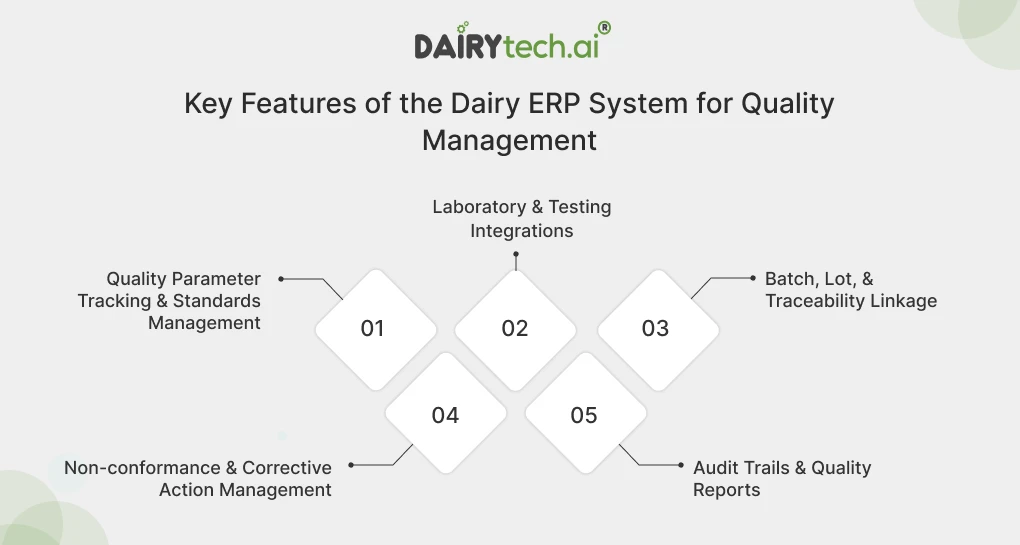
Laboratory and testing integrations
Dairy ERP software integrates with laboratory systems and testing equipment to automatically capture test results. This eliminates manual data entry, reduces errors, and ensures faster validation of quality outcomes.
Batch, lot, and traceability linkage
Every quality control record is linked to specific batches and lots, enabling full backward and forward traceability. This allows the quick identification of affected products in the event of deviations or recalls.
Non-conformance and corrective action management
The system records quality deviations, initiates corrective and preventive actions, and tracks resolution status. This structured approach ensures accountability and continuous improvement.
Audit trails and quality reports
All quality-related activities are automatically logged, creating complete audit trails. Real-time reports support regulatory audits, internal reviews, and data-driven quality decisions.
Benefits of ERP-driven quality control
ERP-driven quality control transforms how dairy businesses manage food safety, compliance, and operational efficiency. It integrates quality checks into every process and enables real-time visibility. Here are the benefits of ERP-driven quality control.
Improved food safety and risk reduction
The dairy ERP system monitors quality parameters from milk collection through distribution, helping businesses detect deviations early and prevent unsafe products from reaching consumers. This proactive control significantly reduces food safety risks and regulatory exposure.
Faster issue resolution and recalls
With batch-wise traceability and real-time data access, quality issues can be quickly traced to their source. This enables targeted corrective actions and recalls, minimizing disruption, costs, and brand impact.
Reduced waste and operational costs
Early detection of quality issues, optimized inventory control, and better process monitoring reduce spoilage, rework, and product loss, lowering operational costs.
Consistent product quality and customer trust
Standardized quality processes and continuous monitoring ensure consistent product quality. Reliable quality performance builds customer confidence, strengthens brand loyalty, and enhances long-term market competitiveness.
How does DairyTech.ai enable efficient quality control?
DairyTech.ai combines deep dairy industry experience with tailored ERP consulting and implementation, enabling efficient quality control. DairyTech.ai, an ERP consulting company, assists dairy businesses in designing and implementing quality-focused ERP solutions that meet their operational and regulatory requirements.
We work with Odoo and Microsoft Dynamics to deliver custom ERP implementations that integrate milk procurement, production, quality management, inventory, and distribution into a single, unified system. These solutions enable real-time quality monitoring, batch-level traceability, automated compliance reporting, and faster corrective actions across the supply chain. Connect with us today to explore our customized ERP solution to see how we can support your quality and compliance goals.