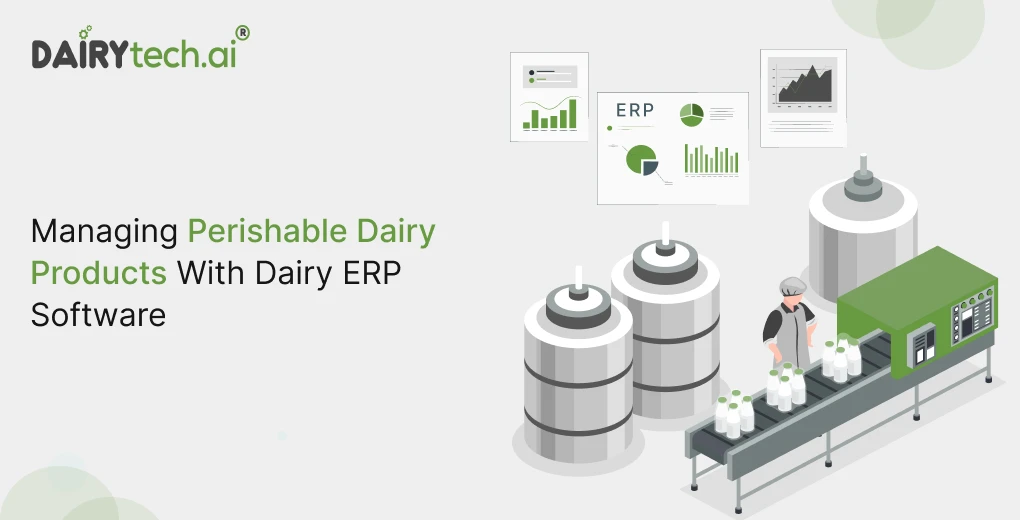
Managing Perishable Dairy Products With Dairy ERP Software
How many cartons of milk, tubs of yogurt, or blocks of cheese are available in your inventory? Do you know the products that are about to expire?
In the dairy industry, every hour spent in production, storage, or transportation affects the quality, freshness, compliance, and profitability. A single missed temperature deviation, an inaccurate batch record, or a delayed shipment can quickly turn high-quality dairy products into costly losses or even trigger recalls.
This is where dairy ERP software changes the equation. The system provides real-time visibility into batches, expiration dates, inventory management, and quality control. This helps businesses to shift their approach from reactive to proactive control, enabling them to plan smartly, respond faster, and protect product integrity and brand trust.
This article examines how the dairy ERP system can manage perishable dairy products and use perishability as a strategic advantage.
Key challenges faced in managing perishable dairy products
The dairy industry presents unique challenges due to its highly perishable nature, strict quality standards, and dynamic market conditions. Here are the challenges dairy processors, manufacturers, and distributors in the dairy industry face.
Shorter shelf-life and expiration date sensitivity
Dairy products have shorter shelf lives, which makes it essential for businesses to track expiration dates to avoid spoilage, waste, and customer dissatisfaction. Small delays in production, warehousing, or distribution can result in unfit products for sale. Without accurate, real-time visibility into expiry dates and inventory management, businesses risk losing revenue and compromising food safety.
Temperature-controlled storage and transportation
Unnoticed temperature deviations during storage, loading, or transit can accelerate spoilage and lead to non-compliance. Businesses with multiple storage locations, third-party logistics providers, and distribution routes can further increase the complexity. Any lapses in cold chain monitoring can result in product rejection, recalls, or damage to reputation.
Batch variability and yield fluctuations
The composition of raw milk, processing conditions, and seasonal factors all influence dairy production yields, fat content, and product consistency. The fluctuations can complicate production planning, inventory management, and cost control. Inaccurate batch records or limited visibility into yields can lead to inefficient resource utilization, inconsistent quality, and financial discrepancies.
Regulatory compliance and traceability requirements
The dairy industry operates under complex and strict regulatory frameworks that govern food safety, labeling, and traceability. Organizations must maintain detailed records for lot and batch tracking, quality inspections, and supplier information for seamless audits. Being able to trace products quickly from source to customers in the case of a quality issue or recall is crucial. Manual or fragmented systems increase the risk of audit failures, delayed recalls, and regulatory penalties.
Demand volatility and forecasting inaccuracies
Customer demand for dairy products is influenced by seasonality, promotions, changing consumption patterns, and retail dynamics. Inaccurate demand forecasts can lead to overproduction, excess inventory, or stockouts. Businesses need to balance production schedules with fluctuating demand while minimizing waste.
Core dairy ERP features that address perishability
Dairy ERP software is a custom-built system to manage the operational realities of perishable dairy products. Unlike generic ERP systems, it offers specialized features and functionalities to help businesses maintain product quality, reduce waste, and ensure regulatory compliance across the entire value chain.
Lot, batch, and expiry date management
Effective lot, batch, and expiry date management is essential for controlling dairy perishability. The system enables businesses to track dairy products at the ground level, from raw milk intake through processing, packaging, and distribution. This helps you to accurately perform FIFO or FEFO inventory handling, ensuring products with the shortest shelf life are dispatched first. The system offers real-time visibility into expiry dates, reducing the risk of shipping outdated products, minimizing write-offs, and supporting quick product recalls.
Cold chain and quality control integration
Consistent temperature control throughout storage and transportation is crucial for maintaining product integrity. The ERP for the dairy industry integrates quality management and cold chain data, enabling organizations to monitor storage conditions, record quality checks, and identify deviations in real time. Automated alerts and quality holds prevent compromised products from entering the supply chain, ensuring compliance with food safety standards while protecting your brand’s reputation and consumer trust.
Production planning and yield optimization
Dairy processing involves variable yields that are influenced by raw milk components, seasonal changes, and processing parameters. The dairy ERP system incorporates yield tracking and production planning tools to align output with shelf-life limitations and demand requirements. The system captures actual yields at the batch level, enabling more accurate cost calculations, precise utilization of raw materials, and reduced production losses caused by overprocessing or misaligned schedules.
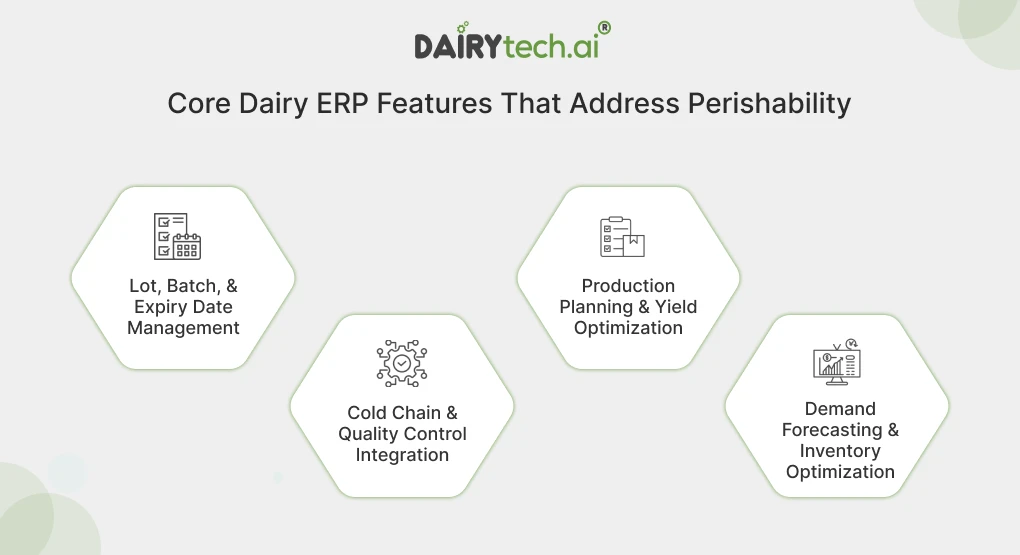
Demand forecasting and inventory optimization
Accurate demand forecasting is critical for perishable dairy products. The dairy ERP for the dairy industry utilizes historical sales data, seasonal patterns, and real-time inventory levels to improve forecast accuracy. Advanced planning capabilities help balance production, inventory, and distribution, reducing overproduction and stockouts. Optimized inventory levels ensure that fresh products reach customers while minimizing waste and carrying costs.
Improving traceability and food safety compliance
Traceability and food safety can not be compromised in the dairy industry. Given the perishable nature of dairy products and the strict regulatory environment, businesses must be able to track products accurately, respond quickly to issues, and demonstrate compliance at all times. Dairy ERP software plays a central role in enabling these capabilities.
End-to-end traceability from farm to shelf
The dairy ERP system provides full traceability across the dairy supply chain, from raw milk collection at the farm or collecting centre to finished product delivery at the retail or distribution point. The system records every step, including milk intake, processing, batching, packaging, storage, and shipment. Each step is linked through lot and batch identifiers, providing a complete product genealogy and allowing businesses to trace both upstream suppliers and downstream customers within seconds. Such supply chain visibility enhances transparency, strengthens supplier accountability, and supports consistent product quality.
Faster, more precise recall management
In the case of a product quality issue or contamination risk, speed and accuracy are critical. The system enables businesses to quickly identify affected lots and batches and separate the products that are affected, rather than issuing broad recalls. Automated recall workflows, detailed audit trails, and instant access to distribution data significantly reduce the response time. This minimizes financial losses, protects consumer safety, and protects brand reputation.
Meeting regulatory standards
Dairy operations must adhere to strict food safety and quality regulations, including requirements related to traceability, labeling, documentation, and reporting. The dairy ERP software supports compliance with regulatory bodies, such as FSMA, HACCP, ISO, and local regulations. Maintaining centralized, audit-ready records and implementing standardized processes simplifies inspections, reduces compliance risk, and ensures that businesses comply with regulatory obligations.
Reducing waste and improving margins with ERP automation
In the dairy industry, waste directly erodes profitability. Shorter shelf lives, shifts in demand, and stringent quality requirements leave little scope for mistakes. Automation with the dairy ERP system enables businesses to switch from reactive decision-making to proactive control, reducing waste while improving operational margins.
Automated alerts for expiring inventory
The system continuously monitors inventory age, shelf life, and expiration dates across warehouses and distribution points. Automated alerts notify teams when products are approaching expiration, enabling timely action such as priority dispatch, targeted promotions, or redistribution to faster-moving locations. This proactive visibility reduces the chances of expired stock, lowers disposal costs, and ensures fresher products reach customers.
Smarter replenishment and distribution decisions
ERP-driven automation supports data-informed replenishment and distribution plans. The system aligns inventory levels with real-time demand and shelf-life constraints. It also enables FEFO-based picking, optimized routing, and dynamic allocation of products across channels. This helps businesses to reduce overstocking, prevent stockouts, and improve service levels while minimizing the risk of spoilage during storage and transit.
Cost savings from reduced write-offs and recalls
Improving traceability, forecasting accuracy, and quality control can significantly lower the financial impact of write-offs and recalls. Precise lot tracking ensures that only the affected products are withdrawn when quality issues arise. Over time, reduced waste, fewer recalls, and improved inventory turnover translate into measurable cost savings and stronger operating margins.
Future trends in dairy ERP
Evolving technological advancements in the dairy ERP systems have further opened the market scope for businesses. These advancements focus on implementing artificial intelligence, integrating IoTs, enhancing business sustainability, and waste reduction analytics.
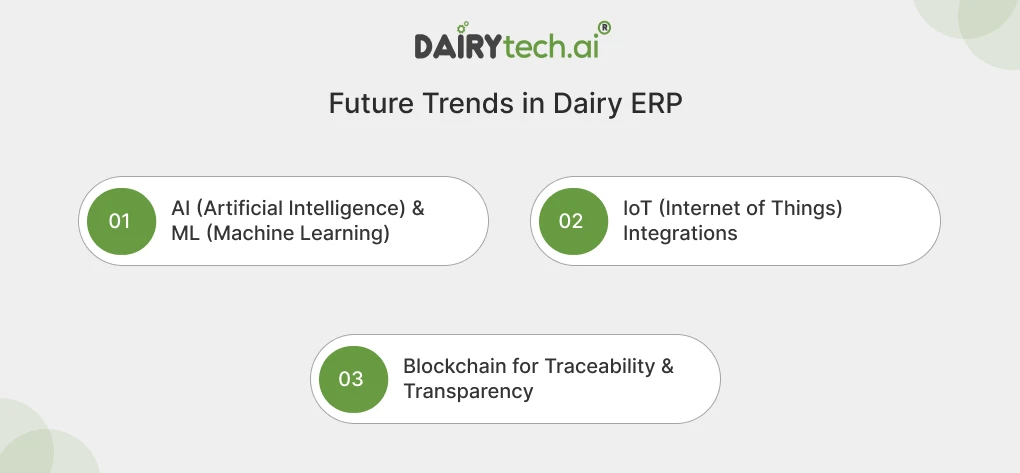
AI (Artificial Intelligence) & ML (Machine Learning)
Artificial intelligence and machine learning have emerged as the foundations of AI-driven ERP systems, transforming data into actionable insights for smart decision-making. AI-driven demand forecasting leverages historical sales data and past patterns to identify trends and accurately forecast demand. It enables businesses to optimize planning and minimize overproduction or stockouts.
AI helps in proactive equipment maintenance, reducing downtime and sudden breakdowns. The system can also plan the most efficient delivery route to save fuel costs and ensure on-time deliveries.
IoT (Internet of Things) integrations
The system supports integration with RFID tags, IoT sensors, and smart devices to provide real-time data on critical parameters for products with a short shelf life. Integrating sensors in milk tankers, cold storage, and production units with the ERP system enables businesses to monitor temperature and humidity, ensuring product freshness and safety, and triggering automatic alerts during deviations.
Devices like milk analyzers automatically record fat, SNF (Solids-not-fat), and other quality parameters, ensuring compliance with food safety regulations and reducing errors during manual checks.
Blockchain for traceability & transparency
Blockchain integration with ERP systems creates a secure, tamper-free digital ledger for every step in the supply chain. This provides end-to-end traceability both backward and forward, building customer trust, and allows quick and precise product recalls if a product issue arises.
Conclusion
With the right ERP system, dairy businesses can gain real-time visibility, tighter control over shelf life, and the agility needed to respond to changing demand, quality risks, and regulatory requirements. The modern ERP solutions enable businesses to protect product quality, reduce losses, and improve margins while strengthening food safety and compliance.
DairyTech AI helps dairy businesses achieve this transformation. Our dairy ERP software is specifically designed to address the unique challenges of dairy businesses. It offers end-to-end visibility, automation, and intelligence across production, inventory, quality, and distribution. At DairyTech.ai, we aim to empower dairy businesses to operate more efficiently, sustainably, and profitably. If you are looking to reduce waste, improve traceability, and gain better control over your dairy operations, we can help. Contact us today to schedule a consultation and learn how our dairy ERP solution can help.