Improving Production Planning With Dairy ERP Software
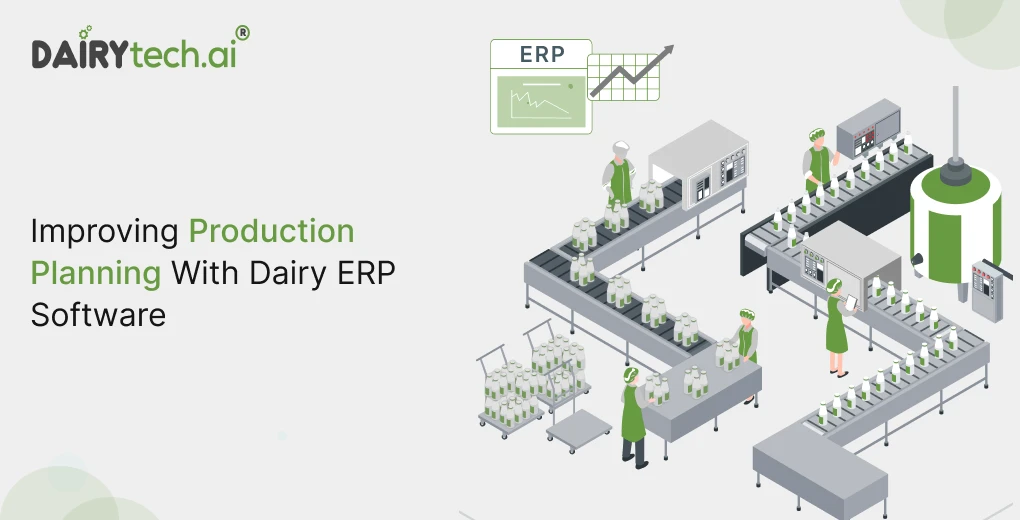
Is your production capable of handling milk supply and demand? Production planning in the dairy industry leaves little room for mistakes due to frequently fluctuating milk supply, short shelf life, and constantly changing demand. Yet many processors still rely on disconnected tools and manual adjustments to keep operations running.
Dairy ERP software connects milk collection, demand forecasts, capacity, and shelf-life considerations into one single system. This enables planners to shift from reactive scheduling to proactive, data-driven decision-making.
This blog explains how dairy ERP software can help businesses improve efficiency, reduce waste, and ensure consistent on-time delivery.
Production challenges in the dairy industry
Dairy manufacturing operates under a unique set of constraints that make production planning significantly more complex than in many other food industries. Perishability, biological variability, and regulatory oversight all directly impact how production must be scheduled, executed, and controlled. Here are the production challenges the dairy industry faces.
Short shelf life and strict freshness windows
Many dairy products, such as fluid milk, cream, and fresh yogurt, have limited shelf lives and must be produced, packaged, and distributed within defined timeframes. Once production begins, the production expiration clock starts immediately. Even small delays in processing, packaging, or distribution can result in product write-offs and lost revenue. This creates many planning challenges:
- Production schedules must align precisely with demand forecasts to avoid overproduction.
- Inventory buffers are limited, increasing the risk of stockouts or waste.
- First-expiry-first-out (FEFO) handling is critical to preventing spoilage.
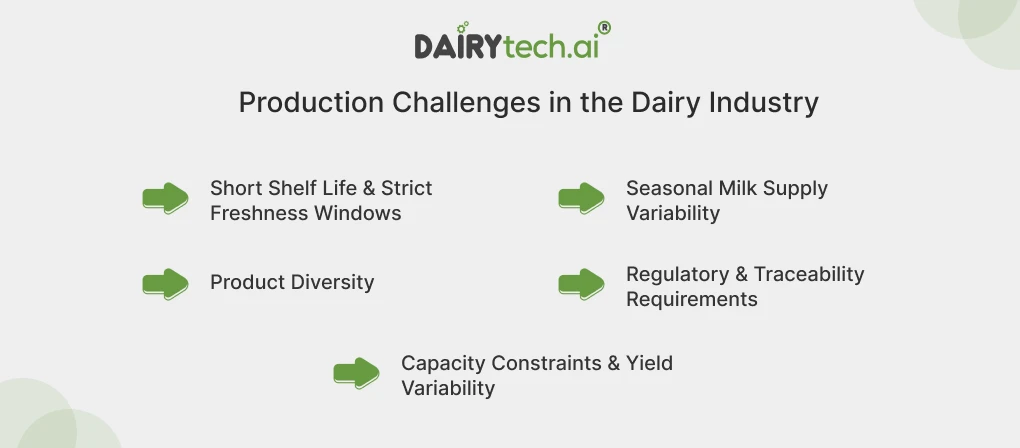
Seasonal milk supply variability
Milk supply is seasonal and affected by factors such as weather, feed quality, herd health, and farming practices. Peak milk production often does not coincide with peak consumer demand. Planners must continuously adjust production plans to balance supply availability with market demand. This variability complicates planning in several ways:
- Excess milk during peak seasons must be redirected into products with longer shelf life, such as cheese or powders.
- Supply shortages can disrupt production schedules and customer commitments.
- Intake volumes and milk composition (fat and protein) fluctuate, which affects yields and recipes.
Product diversity (fluid milk, cheese, yogurt, powders)
Most dairy processors manufacture a wide range of products, such as fresh milk, cultured products, aged cheese, and milk powders, often within the same facility. Each product category has different processing times, equipment requirements, and storage conditions. Managing this diversity requires careful sequencing and capacity planning to avoid disruptions. The key challenges include:
- Frequent changeovers between products, increasing downtime, and cleaning requirements.
- Competing priorities for shared equipment and labor.
- Coordinating short-life products with long-cycle items, such as aged cheese.
Regulatory and traceability requirements
The dairy industry is subject to strict food safety, quality, and regulatory standards. The manufacturer must ensure full traceability from raw milk supply to finished product distribution. Compliance requirements have a direct impact on the production plan and execution. This all adds complexity to production operations:
- Every batch must be tracked by lot, supplier, and quality parameters.
- Production plans must incorporate testing, approvals, and quality holds.
- In the event of a recall, rapid and accurate traceability is essential to limit exposure.
Capacity constraints and yield variability
Dairy processing relies on capital-intensive equipment, such as pasteurizers, separators, evaporators, and packaging lines. These assets have limited capacities and are often shared across multiple products. Without accurate capacity and yield visibility, production plans can quickly become unrealistic and difficult to execute. Additional challenges arise from:
- Changes in milk composition and processing conditions lead to variability in yield.
- Bottlenecks at specific stages, such as packaging or aging rooms.
- Labor and shift constraints limit available production hours.
What is dairy ERP software?
Dairy ERP (Enterprise Resource Planning) software is a specialized, industry-specific system designed to manage and integrate the core operational processes of dairy manufacturing. Unlike generic ERP platforms, dairy ERP software is developed to address the unique complexities of dairy operations, including milk collection management, yield variability, shelf-life constraints, quality control, and regulatory compliance.
At its core, dairy ERP provides a single source of truth by connecting data across production planning, procurement, inventory, quality, sales, finance, and logistics. This integration enables dairy processors to plan, execute, and monitor operations in real-time while maintaining full traceability from raw milk collection to finished product distribution.
Features of the dairy ERP system
- Milk collection and supply management: Manages raw milk volumes, compositions, supplier data, and quality results, allowing planners to align production with actual supply conditions
- Production planning and scheduling: Supports shelf-life-aware, capacity-constrained planning tailored to dairy processes, including co-products and by-products.
- Recipe, BOM, & yield management: Handles variable recipes, dynamic yields, and multi-output production common in dairy manufacturing.
- Quality, compliance, and traceability: Ensures end-to-end lot tracking, quality testing, and regulatory reporting to meet food safety and industry standards.
- Inventory and self-life control: Tracks product age, expiry dates, and storage conditions to reduce waste and improve order fulfillment.
Key production planning capabilities in dairy ERP
Dairy ERP software provides production planners with integrated, data-driven tools designed specifically to manage the complexity and variability of dairy operations. These capabilities enable more accurate planning, better execution, and faster response to change. Here are the functionalities of production planning in the dairy ERP system.
Demand forecasting and sales integration
Dairy ERP systems connect sales orders, historical demand, and forecasts directly to production planning. This integration ensures that production plans are driven by real market demand rather than assumptions or disconnected spreadsheets. Linking sales and planning enables dairy processors to align supply with demand while maintaining high service levels.
The key benefits include
- Improved forecast accuracy through historical and seasonal demand analysis.
- Alignment of production volumes with customer orders and promotions.
- Early visibility into demand spikes or shortfalls.
- Reduced risk of overproduction and expired inventory.
Milk intake and supply planning
Milk intake is the foundation of dairy planning. Dairy ERP software captures real-time data on milk volumes, quality parameters, and supplier deliveries, allowing planners to make informed decisions based on actual supply conditions. Effective collection planning ensures that raw milk is directed to the most suitable products at the right time.
These capabilities support:
- Alignment of raw milk collection with production schedules.
- Planning based on milk composition (fat, protein, & solids).
- Flexible product mix decisions during supply surpluses or shortages.
- Better utilization of available milk with minimal waste.
Finite capacity planning
The system utilizes finite capacity planning to reflect real operational constraints. Production schedules are created by taking into account equipment, labor, and shift availability. This approach increases the schedule reliability and improves overall operational efficiency.
Key aspects include
- Accurate modeling of production lines, equipment, and labor resources.
- Identification and management of disruptions.
- Realistic production schedules that can be executed on the plant floor.
- Improved line utilization and reduced overtime.
Recipe, BOM, and yield management
The variable recipes, co-products, and by-products commonly used in dairy production necessitate accurate management. Dairy ERP systems support dynamic recipes and Bills of Materials (BOM) that reflect real-world yield variability. This visibility helps planners optimize output while controlling costs and waste.
The capabilities include
- Management of multiple recipes and product variants.
- Tracking expected vs. actual yields.
- Handling co-products such as cream, whey, and skim.
- Continuous yield analysis to identify losses and improvement opportunities.
Shelf-life-aware scheduling
Shelf-life constraints are critical in dairy planning. Dairy ERP software incorporates expiry dates and freshness requirements directly into the scheduling process. Planning with shelf life in mind maximizes product freshness while minimizing write-offs.
This enables
- Production sequencing based on product shelf life.
- First-expiry-first-out (FEFO) inventory handling.
- Reduced risk of expired or discounted products.
- Improved customer satisfaction through fresher deliveries.
How does a dairy ERP improve production planning outcomes?
Dairy ERP software integrates demand, supply, capacity, and execution data into a single platform, enabling more accurate planning and more reliable execution. This alignment directly improves operational performance across multiple dimensions. Here are the ways dairy ERP helps improve production planning outcomes.
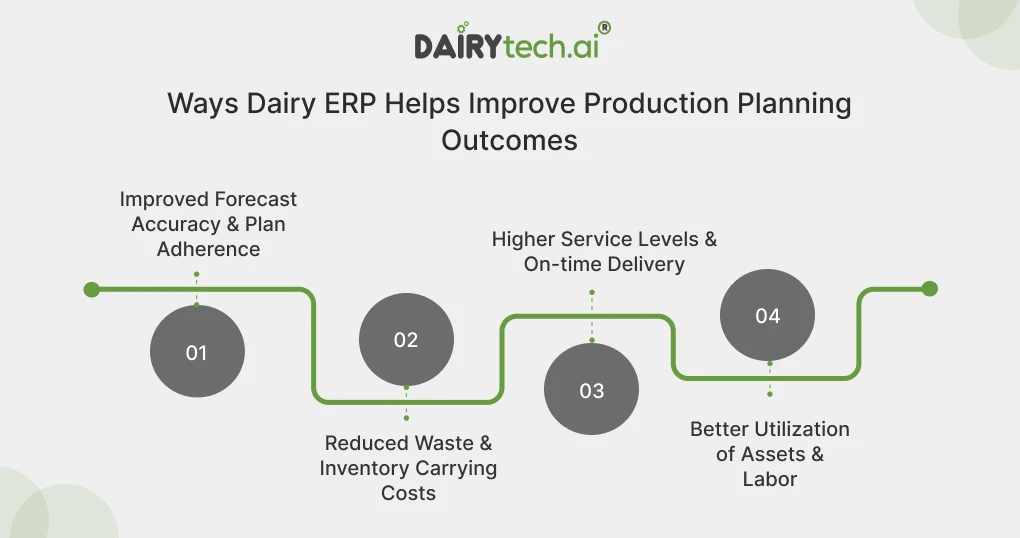
Improved forecast accuracy and plan adherence
A dairy ERP system integrates historical sales data, real-time orders, and seasonal demand patterns directly into the production planning process, improving forecast accuracy. Because planners work with a single, consistent dataset, production plans are more realistic and better aligned with actual market demand. This reduces the need for last-minute schedule changes, improves coordination between planning and operations teams, and increases adherence to the approved production plan.
Reduced waste and inventory carrying costs
Incorporating shelf-life, expiry dates, and FEFO logic into planning and inventory management helps manufacturers produce closer to actual demand. This minimizes overproduction, reduces expired or discounted inventory, and lowers the need for excess safety stock. As a result, dairy processors experience less product waste, lower storage and handling costs, and improved working capital efficiency.
Higher service levels and on-time delivery
Dairy ERP systems provide real-time visibility into demand, inventory availability, and production capacity, enabling more reliable order fulfillment. Planners can commit to delivery dates with greater confidence, while operations teams can respond more quickly to changes or disruptions. This improved coordination leads to higher on-time delivery performance, fresher products reaching customers, and stronger overall service levels.
Better utilization of assets and labor
Dairy ERP systems allow for finite capacity planning and accurate modeling of equipment and labor constraints, ensuring that production schedules are realistic and efficient. This reduces disruptions, minimizes idle time, and supports more balanced workloads across shifts and production lines. Improved asset and labor utilization allows dairy manufacturers to increase throughput and productivity without requiring additional capital investment.
Integration with quality, compliance, and traceability
In the dairy industry, production planning cannot be separated from quality control and regulatory compliance. Variations in raw milk quality, strict food safety standards, and traceability requirements all have a direct impact on how the product is handled. A dairy ERP system brings together quality data, compliance controls, and traceability processes on a single platform, ensuring that production decisions are both operationally efficient and fully compliant.
Real-time quality data impacting production decisions
A dairy ERP system integrates real-time quality data, such as milk test results, in-process checks, and finished product inspections, directly into production planning and execution. This enables planners and operators to make immediate, informed decisions when quality parameters fall outside specifications. Production can be adjusted, diverted, or held before issues escalate, reducing the risk of waste, rework, or non-compliant product entering the supply chain.
Lot tracking from farm to finished goods
Dairy ERP software enables end-to-end traceability by linking raw milk intake from individual farms or suppliers to all stages of production and distribution. Each batch, ingredient, and finished product is tracked through processing, packaging, storage, and shipment. This complete visibility ensures rapid root-cause analysis, accurate product recalls if required, and full transparency across the supply chain.
Audit readiness and regulatory reporting
Compliance with food safety and dairy industry regulations requires accurate documentation and consistent reporting. A dairy ERP system automatically captures production, quality, and traceability data, creating a reliable audit trail without the need for manual intervention. This supports faster regulatory reporting, reduces audit preparation time, and helps manufacturers demonstrate compliance with local and international standards while minimizing the risk of penalties or disruptions.
Key metrics to track production efficiency with dairy ERP
Measuring production efficiency is essential for maintaining profitability and operational control in dairy manufacturing. A dairy ERP software provides real-time visibility into production, inventory, and process performance, enabling manufacturers to track key metrics, help planners and operations teams identify inefficiencies early, support continuous improvement, and make data-driven decisions that improve overall performance. Here are key performance indicators to track production efficiency.
Plan vs. actual production
This metric compares planned production volume and schedules against what is actually produced. A dairy ERP system captures real-time production data, making it easy to identify variance caused by supply issues, capacity constraints, or quality holds. Monitoring plan vs. actual performance helps planners refine forecasts, improve schedule accuracy, and increase confidence in future production plans.
Yield variance
Yield variance measures the difference between expected output and actual output, often driven by changes in milk composition, processing conditions, or equipment performance. Dairy ERP systems track yields at each production stage, providing visibility into losses or inefficiencies. Consistently analyzing yield variance enables manufacturers to optimize recipes, improve process control, and reduce raw material losses.
Inventory freshness and expiry
Inventory freshness metrics track product age, remaining shelf life, and expiry risk across warehouses and distribution points. A dairy ERP system supports FEFO-based inventory management and real-time expiry monitoring, helping planners prioritize production and shipments based on freshness. This reduces expired inventory, improves product quality at delivery, and supports better inventory turnover.
Schedule adherence
Schedule adherence measures how closely actual production follows the planned schedule, including start times, quantities, and sequencing. Dairy ERP software highlights deviations in real-time, allowing teams to address disruptions quickly. High schedule adherence indicates stable operations, effective planning, and strong coordination between planning and plant execution.
Waste and shrinkage
Waste and shrinkage metrics capture product losses due to spoilage, overproduction, quality failures, or handling issues. Tracking waste at each stage of production and inventory management provides actionable insights into root causes. Reducing waste and shrinkage directly improves margins and supports sustainability goals.
Conclusion
Production planning in the dairy industry can impact profitability, service levels, and compliance. With short shelf life, variable milk supply, complex product portfolios, and strict regulatory requirements, relying on disconnected systems or manual planning methods creates unnecessary risk and inefficiency.
A dairy ERP system brings demand forecasting, milk collection planning, capacity constraints, quality controls, and shelf-life management into a single, integrated platform. This enables dairy manufacturers to shift from reactive firefighting to proactive, data-driven planning, reducing waste, improving plan adherence, and better using assets and labor.
DairyTech.ai offers dairy ERP consulting and implementation services to address these challenges. We combine dairy-industry expertise with advanced ERP and analytics capabilities, helping dairy manufacturers gain real-time visibility across production, quality, and inventory, enabling smarter planning decisions and more resilient operations. Contact us today to discuss your dairy manufacturing process and how we can assist.