What is Dairy ERP Software? Features, Benefits, and Future Trends
The dairy supply chain is one of the most complex supply chains due to its highly perishable nature and stringent regulatory compliance. This makes the adoption of advanced technologies, such as an ERP system, crucial. Dairy businesses are now embracing ERP solutions to streamline operations, from milk collection and quality control to inventory management and distribution.
This blog covers the ins and outs of the dairy ERP system, its features, benefits, and what the future holds for it.
What is dairy ERP software?
A dairy ERP (Enterprise Resource Planning) software is a comprehensive platform, especially designed for dairy enterprises to integrate, automate, and streamline the entire dairy supply chain. Our dairy ERP software has various business applications, also known as modules, that enable businesses to manage their core processes, including milk collection, processing, quality control, packaging & labeling, and distribution.
Core modules of dairy ERP software
The dairy ERP software offers various business modules that are integrated to provide real-time visibility into processes. The core dairy ERP software modules are
Procurement
The procurement module enables you to track and manage milk collection, farmer payments, and quality analysis. It allows businesses to manage end-to-end sourcing of inputs required for dairy operations.
Production
The production module is the core operational module that converts raw milk and materials into finished products. It ensures yield optimization, quality compliance, and full traceability. This module of the dairy ERP software handles perishability, variable raw milk quality, and regulatory controls.
Quality control
The quality control (QC) module enables businesses to record quality findings. These checks can be implemented at multiple points throughout the entire dairy supply chain. The system can manage audit documents, making them accessible during inspections. It also enables you to record packaging and labeling quality checks.
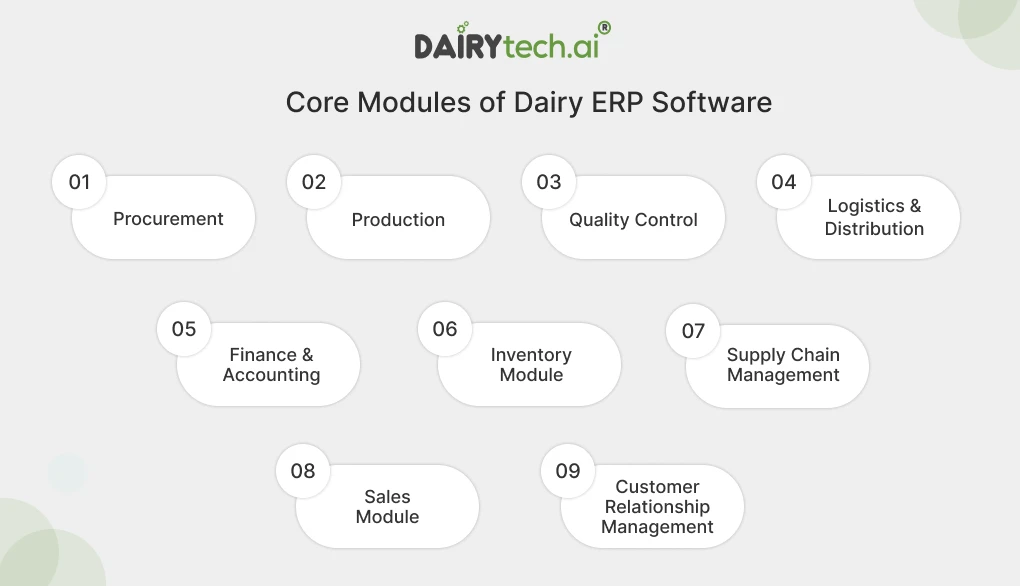
Logistics and distribution
The logistics and distribution module of the dairy ERP system enables businesses to plan deliveries, optimize delivery routes, and manage delivery scheduling. It also supports subscription and on-time order deliveries. The system offers flexible subscription management, allowing you to pause/resume deliveries, edit, and cancel them.
Finance & accounting
The finance and accounting module is integrated with other dairy ERP modules, consolidating all the finance-related data in real-time. It helps manage General Ledger, Accounts Payable, Accounts Receivable, and milk procurement accounting. The system allows you to track and calculate product costing, inventory valuation, and profitability analysis. It helps businesses with budgeting and financial planning, fixed asset accounting, and taxation and statutory compliance.
Inventory
The inventory module in the dairy ERP system manages the movement, storage, valuation, and traceability of raw materials, work-in-progress, finished products, and indirect inventory (packaging materials). It addresses the unique dairy business issues, including perishability, cold-chain dependency, and regulatory compliance. The system manages perishable stock with features like batch/lot tracking, expiry management (FIFO/FEFO), multi-location stock visibility, cold chain monitoring (via IoT), and alerts for low stock or spoilage. You can also define minimum and maximum stock levels to initiate automated replenishment.
Supply chain management
The supply chain management module integrates and automates your entire dairy value chain, from raw milk procurement from the farmer to final product delivery. It offers end-to-end visibility, real-time tracking (crucial for dairy products due to their shorter shelf life), optimized logistics, efficient inventory control, supplier management, and demand planning within a single platform. The module reduced waste and ensured freshness and compliance.
Sales module
The sales module enables businesses to manage subscription orders and rental subscription management for both B2C and B2B clients. It allows you to manage the entire order-to-cash cycle. The key features of the sales module include mobile apps for field agents, automated order processing, detailed sales reporting, and integration for quick invoicing and payment collection.
Customer relationship management
The CRM (Customer Relationship Management) module centralizes customer data to improve service, boost loyalty, and drive sales. The system enables your team to manage leads, track orders, automate communication, including invoices and feedback, and provide real-time insights to offer personalized experiences and implement targeted marketing.
Unlike a generic system, dairy ERP software is designed to handle the unique challenges of milk-based businesses.
Challenges dairy businesses face without a dairy ERP system
Dairy enterprises struggle to manage operations due to the intricacies of the dairy supply chain, the shorter shelf life, strict quality standards, and subscription-driven demands, which are challenging to manage. Here are the challenges dairy businesses face without a dairy ERP system.
Unpredictable milk procurement
The daily fluctuations in milk quantity, quality, and pricing make it difficult to manage procurement and ensure only high-quality milk enters the supply chain. Calculating individual farmers’ payments based on the quantity and quality of the milk is time-consuming and prone to errors. Manual calculations are prone to inaccuracy, resulting in wrongful payment transactions, strained farmer relationships, and induced business loss. Manual milk quality and quantity checks are prone to errors, which can lead to reconciliation mistakes and delay the process.
Difficulty managing perishable products
Milk and dairy products are highly perishable and can spoil quickly, making it crucial for businesses to ensure timely sales and utilization of the product. Without real-time visibility, it is difficult to track and manage wastage and missed sales. Inability to manage products can lead to product spoilage and significant financial losses.
Lack of end-to-end traceability
Without an ERP system, it is difficult for a business to trace finished products back to the source. Traceability plays a crucial role in identifying the source of quality issues and initiating timely product recalls. The dairy industry has strict regulatory compliance, making traceability an essential aspect for audits.
Manual and error-prone quality control
Paper-based or disconnected quality checks are inefficient and prone to errors, exposing regulatory compliance risks. Inaccurate quality control can lead to the use of low-quality raw milk in processing, resulting in product spoilage, product recalls, and spiking costs. This exposes your business to civil lawsuits, damages your business reputation, and increases your customer churn rate.
Inefficient production planning
Inability to accurately forecast demand leads to inefficient production planning, resulting in overproduction, underproduction, and yield losses. All these factors contribute to product spoilage, lost sales, and capital loss. Overproduction can increase the storage costs, and prolonged storage of dairy products can lead to spoilage.
Poor yield visibility and loss control
Manually operating dairy businesses struggle to track actual yield versus expected output, resulting in hidden losses and reduced margins. The perishable nature of dairy products leaves very little room for margin, making yield management a crucial process. Even a little disruption in the dairy supply chain can significantly impact a business’s profitability.
Complex distribution and last-mile delivery
Timely deliveries of milk and other dairy products are important owing to their shorter shelf life. Manually managing routes, vehicles, and deliveries is prone to errors. This results in delayed deliveries and hampered customer experience.
Lack of subscription-based demand management
Dairy businesses are generally operated on a subscription-based, scheduled delivery model due to the daily usability of the dairy products in households. Manually managing daily subscription changes, such as order modifications, pausing/resuming deliveries, or canceling deliveries, is prone to errors and can result in inaccurate order fulfillment. This can reduce your customer satisfaction scores.
Poor financial visibility and margin control
Manually managed businesses or those using fragmented systems often rely on manual data entry, which can lead to data silos, errors, and delayed financial reporting and insights. Without real-time reporting, making informed decisions is difficult. Inaccurate financial data can lead to incorrect cost analysis, forecasting, and yield analysis.
Features of an ERP software for dairy businesses
The ERP software for the dairy industry offers various features and functionalities that help businesses automate and streamline their operations. The system enables your team to focus on strategic tasks rather than on operations. The features of ERP software for dairy businesses are
Procurement & farmer management
The system enables daily milk collection tracking by centre and route. Your field representatives can record the quantity and quality (fat, SNF, CLR) of the milk in the system. The system automatically calculates farmers’ payments and incentives and initiates farmer settlements based on the quality and quantity of milk provided. The system also generates procurement analytics and trend reporting, enabling businesses to adjust their processes accordingly.
Production and manufacturing
The ERP system enables businesses to plan and schedule milk or other dairy product production based on the sales orders and inventory levels. It supports batch-wise manufacturing, which provides complete end-to-end product traceability. The system enables you to manage Bill of Materials (BoM) and recipe management, ensuring products of higher quality. You can track production yield, loss, and by-products that are produced from the primary product (milk). The ERP system provides real-time production reporting, empowering businesses to identify and rectify production issues before the production batch is completed.
Quality control & compliance
You can implement quality control checks at multiple points and record the quality of the milk and other dairy products. The system enables lab testers to approve or reject the forward movement of products through the supply chain. It also sends alerts in the case of any quality deviation from the predefined parameters. The system can generate and store compliance documentation and audit-ready reports.
Inventory management
Integrated inventory management with sales, finance, and production modules enables you to get real-time inventory across locations. The system supports cold storage and a bin-level tracking of the stock. You can also implement FIFO/FEFO inventory management strategies to ensure no stock remains stagnant on the shelf, preventing stock spoilage and financial losses. The system enables you to manage and track milk, dairy products, packaging materials, and other raw materials. The system can also create purchase orders based on predefined minimum and maximum inventory counts for automated inventory replenishment.
Sales, distribution, & logistics
You can manage business-to-consumer (B2C) and business-to-business (B2B) customers. You can offer them different pricing, set minimum and maximum ordering quantities, and apply sales benchmarks (for B2B). The system enables you to plan delivery routes, vehicles, and dispatch, ensuring timely order fulfillment. The delivery manager can assign drivers to the delivery vehicles and track deliveries in real-time. As a business owner, you can track delivery performance, costs, and driver performance, allowing you to implement strategies to improve them.
Subscription & scheduled delivery
The system supports subscription orders and scheduled deliveries. Your customers can place subscription orders, select a preferred delivery schedule, and select the required product quantity. The customers can pause, modify, & resume deliveries when they are unavailable to receive the orders. The ERP system enables you to plan demand dynamically based on the subscriptions. The system automates billing and wallet management.
Finance and accounting
The ERP system integrates accounting with core dairy operations. The entire financial transaction data, including farmer payments, accounts receivable, accounts payable, tax management, cash management, losses, and fixed asset management.
Analytics and dashboards
You can track and manage the costs of products, batches, and routes. The system provides financial reports and analyzes margin and profitability. The system removes manual data entry, errors, and time-consuming repetitive tasks. It provides real-time insights into financial health and yield, empowering businesses to make strategic decisions.
Benefits of implementing dairy ERP software
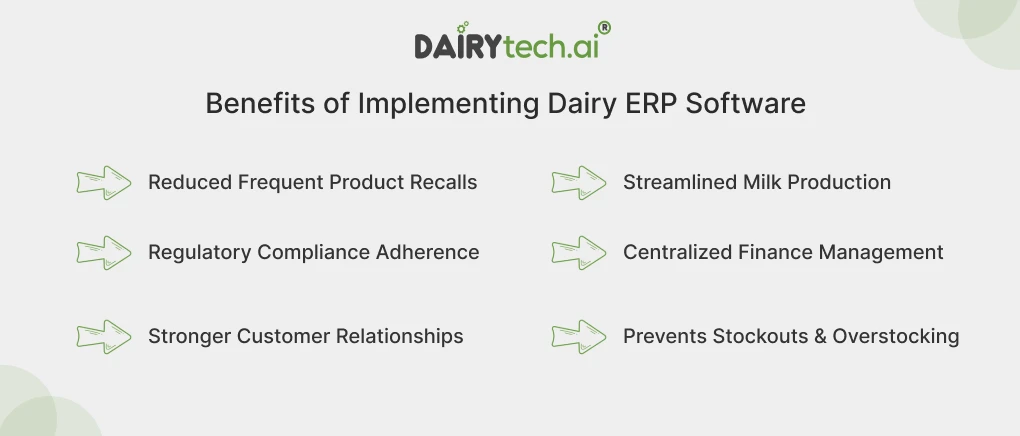
The dairy ERP for the dairy industry offers robust functionalities that automate, optimize, and streamline the entire dairy supply chain. The centralized database provides real-time visibility into operations, enabling you to identify and resolve issues before they lead to financial losses. Here are the benefits of implementing dairy ERP software.
Reduced frequent product recalls
Real-time quality checks enable you to identify any kind of contamination or spoilage, minimizing the chances of product recalls. It safeguards product quality at every stage, ensuring only high-quality products reach consumers and improving customer trust. Reduced product recalls prevent fines and legal problems while improving regulatory compliance.
Streamlined milk production
Milk and dairy products are highly perishable, and even small delays or inefficiencies can lead to product spoilage, missed delivery deadlines, and customer dissatisfaction. The system offers features to automate and streamline the production process, ensuring on-time production, reducing wastage, improving customer satisfaction, lowering operational costs, and boosting profits.
Regulatory compliance adherence
The integrated ERP system provides a centralized database to store audit documents and automate record-keeping, seamless audits, and traceability. This accelerates audit preparation, improves regulatory visibility, lowers risks & penalties, and strengthens market credibility.
Centralized finance management
The ERP system automates accounting processes and provides real-time insights into profits, expenses, and cash flow, streamlining financial management. It centralizes transaction tracking and automates payables & receivables, eliminating data silos and improving liquidity. The system generates reports that compare revenue against operational costs, helping identify profitable product lines and areas of cost leakage. Real-time cash flow visibility enables businesses to strategize working capital management and investment planning. These features all contribute to faster closures, improved accuracy, better cash flow management, cost control & profitability, and boosted regulatory compliance.
Stronger customer relationships
The system provides a 360-degree customer view, enabling businesses to understand customer needs and buying patterns. Personalized customer service increases repeat purchases and boosts customer lifetime value. Customized engagement, consistent services, and order accuracy enhance customer retention rates and customer satisfaction scores (CSAT).
Prevents stockouts and overstocking
The system offers real-time inventory visibility of raw materials, work-in-progress goods, and finished products. The demand forecasting feature of the system ensures businesses always have optimal stock levels to cater to customer demands. Efficient inventory tracking reduces wastage, lowers inventory costs, improves inventory turnover, and enhances customer satisfaction.
Bottom line
Dairy supply chain management is highly intricate and requires powerful tools, such as dairy ERP software, to navigate through the unique business challenges. DairyTech.ai is an ERP consulting and implementation company with expertise in the dairy industry. We provide tailored dairy ERP solutions to cater to different dairy business models, enabling them to compete, grow, and thrive in the evolving market competition.
Contact us today to discuss your business challenges and tech requirements and see how we can help.