If you run or own a dairy manufacturing business, you already know the feeling. Milk arrives at the plant faster than your lines can process it. Or you’ve committed to a procurement contract only to find your key product line is underperforming, leaving you with a surplus you don’t know what to do with. Either way, money walks out the door quietly, consistently, and often without anyone being fully accountable for it.
This is the Production vs. Procurement Alignment problem. And it’s one of the most underestimated sources of loss in dairy manufacturing today.
Let’s break it down and, more importantly, talk about what you can actually do about it.
Procurement-Production Alignment Problem
Procurement in dairy refers to how much raw milk you buy from farmers and cooperatives. Production means how much your processing facility can actually handle and convert into sellable products, such as milk, cheese, butter, ghee, UHT, yogurt, and so on.
In an ideal world, these two numbers match perfectly every single day. In reality? They rarely do. Here’s why:
Milk doesn’t follow a schedule.
Cows produce more during flush seasons (typically post-monsoon or spring, depending on your region) and less during lean seasons. That seasonal swing in raw milk supply can be 20–40% between peak and trough, and your processing lines, your storage tanks, and your workforce can’t flex that dramatically.
Procurement contracts are rigid; demand is not.
Many dairy processors lock in volumes with farmers weeks or months in advance. But retail demand, institutional orders, and export offtake shift constantly. When a big buyer pulls back an order or a product line underperforms, you’re still receiving the same volumes of raw milk with nowhere efficient to send it.
Planning lives in silos.
Procurement teams are talking to farmers. Production planners are scheduling shifts and downtime. Sales is taking orders. Finance is watching margins. Without a shared, real-time picture, each function makes decisions based on incomplete information, and the gaps between those decisions become expensive.
What Does Misalignment Actually Cost You?
This is where it gets uncomfortable but important.
When procurement outpaces production capacity, you’re looking at raw milk spoilage, emergency diversion to low-margin products (like SMP or commodity butter), overtime costs, and rushed logistics. When production capacity sits idle because procurement fell short, you’re absorbing fixed costs, including depreciation, labor, and energy, against lower output volumes.
Industry estimates suggest that dairy processors lose anywhere from 3% to 8% of revenue annually due to supply-demand misalignment. For a mid-sized plant processing 200,000 liters per day, even the conservative end of that range is a significant hit to the bottom line every year.
And that’s before you account for the less visible costs, such as strained relationships with farmers when you can’t lift committed volumes, customer service failures when you can’t fulfill orders, and management time spent firefighting instead of growing the business.
How Does Dairy ERP Help Solve Procurement-Production Gap Issues?
Ready to see what aligned dairy operations actually look like? Book a free demo with DairyTech
A modern dairy ERP system doesn’t just digitize your paperwork; it creates a single connected nerve centre for your entire operation. Here’s how it specifically addresses the procurement–production gap:
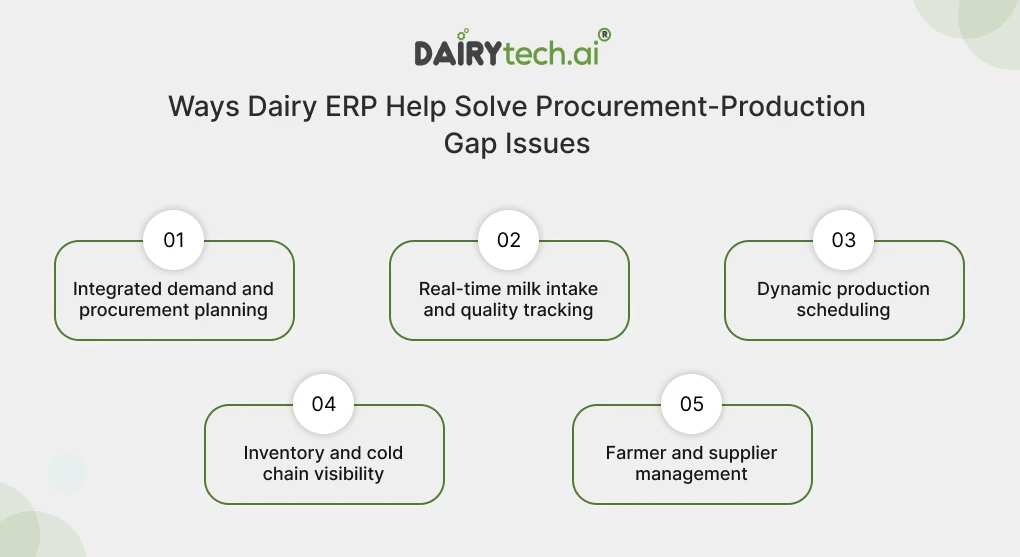
Integrated demand and procurement planning
Instead of your procurement team working on a spreadsheet and your sales team working off a CRM, a dairy ERP pulls both into one planning environment. When sales forecasts update, procurement plans adjust automatically. When a farmer confirms or revises a delivery volume, production scheduling can react in real time. The result is fewer surprises at the dock.
Real-time milk intake and quality tracking
Every tanker arrival is logged, such as volume, fat percentage, SNF, temperature, and any quality flags. This data feeds directly into your production scheduling engine, so your plant knows exactly what it’s working with before the milk even hits the silo. No more discovering quality issues mid-shift or building a production plan on assumed composition figures.
Dynamic production scheduling
When incoming milk volumes or quality shift unexpectedly, a good dairy ERP can help you model alternate product mixes on the fly. Got more cream than planned? Shift capacity toward butter or ghee. Running short on raw milk? Deprioritize bulk commodity production and protect your value-added lines. These are decisions that used to take hours of back-and-forth with ERP, they’re guided by data and take minutes.
Inventory and cold chain visibility
Misalignment doesn’t just happen at the raw milk stage. It happens in finished goods inventory too, including overproducing one SKU while running short on another or holding product too long because dispatch isn’t synchronized with production. A dairy ERP connects your cold storage, dispatch planning, and sales order management so inventory doesn’t pile up in the wrong place.
Farmer and supplier management
Good procurement alignment starts with good supplier relationships. Dairy ERP systems with built-in farmer management modules let you track individual farmer performance, manage tiered pricing, process payments accurately, and flag delivery deviations early so you can have proactive conversations with suppliers rather than reactive ones.
Strategic Shift ERP Implementation Brings
Here’s the real shift that dairy ERP enables, and it’s the one that matters most to business owners and leadership teams.
Right now, a significant portion of your management bandwidth is probably being consumed by operational firefighting: resolving today’s milk surplus, explaining this week’s yield variance, and chasing a quality claim. ERP doesn’t eliminate exceptions, but it dramatically reduces their frequency and ensures they’re caught earlier when they’re still manageable rather than costly.
That frees your leadership team to focus on what actually brings business value, such as expanding farmer networks, entering new product categories, negotiating better procurement contracts from a data position, and making capital allocation decisions based on real operational performance rather than gut feel.
Dairy businesses that have implemented integrated ERP solutions consistently report not just cost savings, but a meaningful improvement in their ability to plan and grow with confidence.
Curious how DairyTech ERP handles your specific production mix? Our team works with dairy manufacturers of all sizes, from single-plant operations to multi-site processors. Talk to a DairyTech expert today
Conclusion
The dairy industry is under more margin pressure than ever; input costs are rising, consumers are more demanding, and competition is intensifying. In that environment, the businesses that win are the ones that eliminate internal inefficiencies before they compound into strategic disadvantages.
Production–procurement misalignment is one of the most common and most fixable sources of loss in dairy manufacturing. It’s not a people problem. It’s a systems problem. And the right systems, built specifically for how dairy businesses work, can close that gap faster than most owners expect.
DairyTech’s dairy ERP is purpose-built for manufacturers like you. Not a generic ERP adapted for dairy, but a platform that understands fat testing, batch yields, farmer payments, cold chain logistics, and multi-product scheduling out of the box.
If you’re serious about protecting your margins and scaling with control, the conversation starts here. Book a Consultation with Our Dairy Experts
Frequently Asked Questions
Q1: What is production–procurement alignment in dairy, and why does it matter?
A1. Production–procurement alignment refers to how well a dairy processor’s raw milk intake (procurement) matches its processing capacity and finished goods demand (production). When these are misaligned, businesses face spoilage, idle capacity, margin loss, and strained supplier relationships. Getting alignment right is one of the most impactful operational improvements a dairy manufacturer can make.
Q2. How much milk loss is “normal” in a dairy plant?
A2. Some level of process loss is unavoidable; typical acceptable ranges are 0.5% to 2%, depending on product mix and processing technology. However, losses driven by procurement–production misalignment (spoilage, emergency diversion, expired inventory) can push total losses to 5–8% of raw material value. A dairy ERP helps identify and reduce the avoidable portion.
Q3. Can a dairy ERP help with seasonal milk flush?
A3. Yes, this is one of the most valuable applications. A dairy ERP with demand forecasting and scenario planning tools lets you model flush season volumes in advance, adjust product mix toward storable commodities (butter, powder & cheese), and pre-position storage and logistics capacity before the surge arrives rather than reacting to it.
Q4. How is a dairy ERP different from a generic ERP like SAP or Tally?
A4. Generic ERPs require heavy customization to handle dairy-specific workflows: milk composition testing, fat-based pricing, batch yield tracking, cold chain management, and farmer payment processing. A purpose-built dairy ERP like DairyTech has all of this built in, which means faster implementation, lower customization costs, and a system that actually matches how your plant works.
Q5. How long does it take to implement a dairy ERP and see results?
A5. Implementation timelines vary by plant size and complexity, but most dairy manufacturers see initial operational benefits, including improved visibility, reduced manual reconciliation, and faster planning cycles, within the first 60–90 days of go-live. ROI in the form of reduced losses and improved utilization typically becomes measurable within 6–12 months.
Q6. Is DairyTech ERP suitable for smaller dairy plants or only large processors?
A6. DairyTech is designed to scale with your business. Whether you’re processing 20,000 liters per day or 500,000, the core alignment and visibility tools are equally valuable. Smaller plants often see proportionally faster ROI because they have fewer dedicated planning resources and benefit most from automation.
Ready to close the gap between procurement and production? DairyTech’s dairy ERP is purpose-built for manufacturers who want to grow without losing control. Get started at dairytech.ai.