Choosing an ERP platform for your dairy operation is one of the highest-stakes decisions you’ll make in a decade. Get it right, and it transforms how you produce, stay compliant, and grow. Get it wrong, and you’re looking at a multi-year distraction that costs more than it saves in money, team morale, and operational risk.
The problem? Most dairy operators go into software evaluations underprepared. Vendors are polished. Demos are curated. And the price on the website is rarely the price you’ll actually pay.
This guide gives you the framework to cut through the noise, the exact questions to ask, the real cost model to build, the red flags to catch before you sign, and the playbook to get your operations, IT, and finance teams aligned.
Ready to see what a native ERP looks like in practice? Book a live DairyTech demo. We’ll walk you through a real lot trace, live, from finished SKU back to farm and tank in under 10 minutes.
Whether The ERP Is Actually Built for Dairy
A software demo is a performance. Vendors show you what the system does best. Your job is to uncover what it does worst and whether the platform is genuinely built for dairy or is a generic system dressed up with dairy-flavored marketing.
Does the System Offer Bi-directional Traceability?
Traceability is your most important evaluation criterion. A credible answer should be demonstrable in the live system right now, not promised for a future release.
Ask every vendor these questions directly:
- “Can you show me a one-click lot trace from a finished product SKU back to the raw milk delivery, including farm and tank number, right now, in the demo environment?”
- “How long does a mock recall take? Can you identify every affected unit across all channels within 10 minutes?”
- “How does the system handle split lots, where one raw milk delivery is split across multiple batches?”
- “What happens when a QC test fails mid-batch? Walk me through the automated hold and quarantine workflow.”
- “Can you trace co-products and by-products, including whey, cream, and skim, on the same lot number as the primary product?”
The average food manufacturer using manual records takes 4 hours to respond to an FDA traceability request. With a purpose-built dairy ERP, the same trace should take under 10 minutes. If a vendor can’t demonstrate this live, that’s your first red flag.
How Compliant is the ERP Software?
Press vendors on specifics, not promises:
- Which version of FSMA, Subpart C, G, or S, are the workflows built around, and when were they last updated to reflect current FDA guidance?
- Does the system generate FSMA-compliant food safety plan documentation automatically, or does it require manual record-keeping alongside it?
- Have any dairy customers passed an SQF Level 2 or BRC Global Standard audit using this system as the primary record?
- Does the system support Grade A PMO (Pasteurized Milk Ordinance) pasteurization log records?
Implementation Is Where Projects Succeed or Die
The best software fails if the data migration is botched or your team is handed a 400-page user manual and left to figure it out. Ask:
- Who actually handles the data migration? Are they the vendor’s own specialists or a third-party integrator?
- What is your go-live support model? Is there a dedicated person available during our first week of live production?
- What are the most common causes of implementation delays for operations our size?
What is The Complete ERP Pricing?
The price on a vendor’s pricing page is rarely the price you pay. For any dairy ERP investment, you need to model the full five-year total cost of ownership (TCO), not just the monthly subscription.
Here’s every cost category to include in your model:
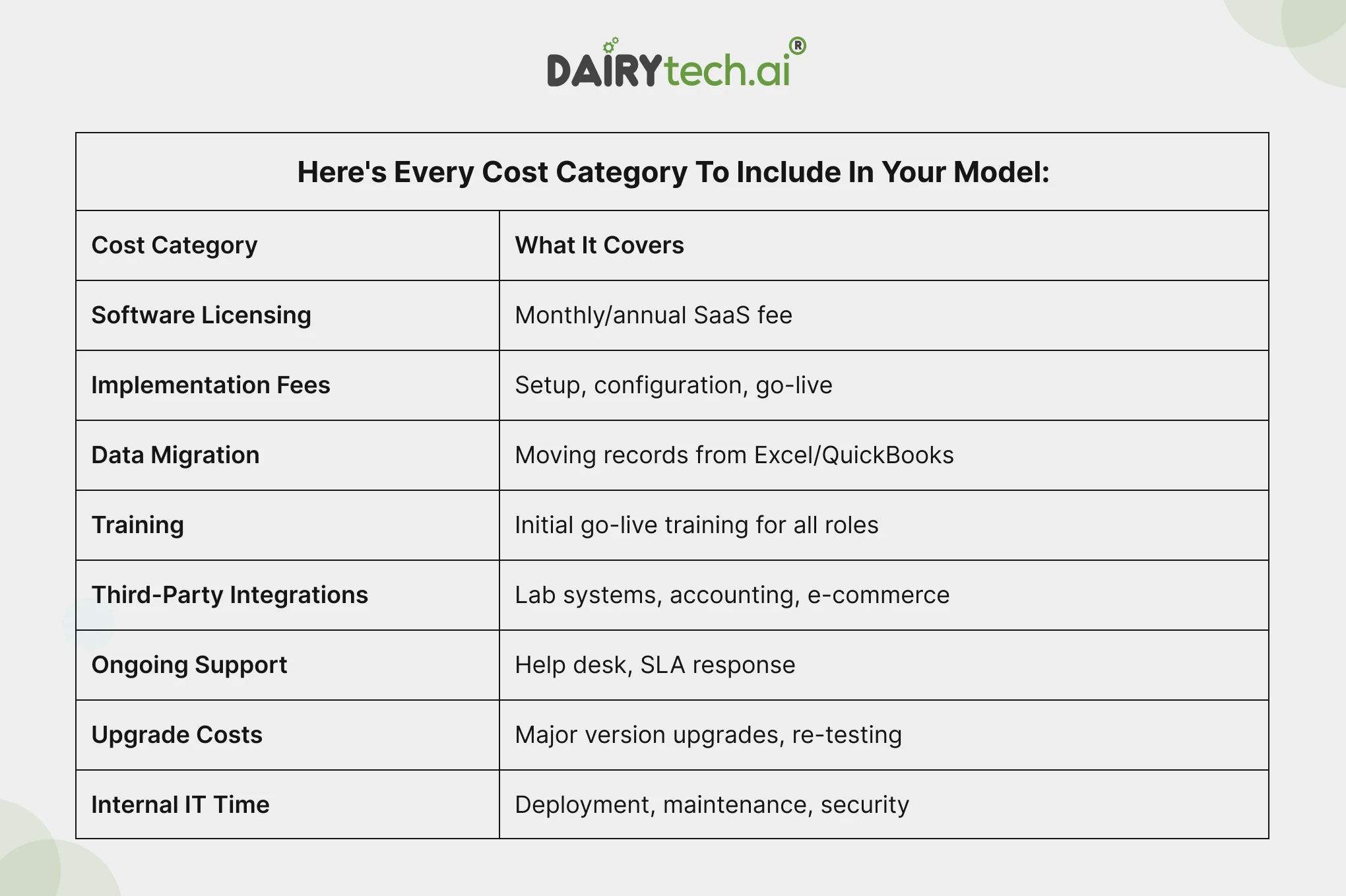
The number that should stop you in your tracks: 43% of ERP buyers report their first-year total cost exceeded the initial quote by more than 40%, primarily due to unbudgeted customization, integration, and training costs.
Four Costs That Almost Always Get Underestimated
Data migration is almost always more complex and expensive than vendors forecast. Historical batch records, lot histories, and supplier pricing tables rarely import cleanly from Excel. Budget 1.5–2× the vendor’s estimate.
Ongoing training isn’t a one-time event. Floor staff turns over. Processes change. Budget for annual refresher training and onboarding of new hires, not just the initial go-live package. Third-party integrations for connecting your ERP to lab systems, accounting software, e-commerce platforms, or 3PL partners typically add $5,000–$30,000 per integration.
Parallel operation: the shadow systems that don’t disappear automatically. Expect 3–6 months where staff maintain old spreadsheets alongside the new system. This real productivity cost rarely appears in ROI calculations.
Don’t guess at your five-year cost. Book a Consultation to see your all-in cost with no hidden per-module fees, no implementation surcharges for dairy-specific workflows, and a fixed-scope go-live package.
Red Flags to Catch Before You Sign Anything
A well-run demo can make almost any software look capable. Here are the warning signs — subtle and glaring — that experienced dairy buyers have learned to spot.
In the Demo
- The vendor uses sample data from a generic “food manufacturer,” not a dairy operation. If they can’t demo with milk lots, butterfat percentages, and cheese batches, ask why.
- They switch to a slideshow when you ask to see a specific workflow. A live system should handle any reasonable request; if they leave the application, that feature likely doesn’t exist.
- The lot trace demo requires five or more screens and two export steps to get a complete result. Recall readiness should be fast and intuitive.
- They cannot show the butterfat or component pricing module working in the live demo. This is table-stakes functionality for any dairy ERP.
In the Sales Process
- “That’s on our roadmap” is said more than twice in a single demo. This phrase means the feature does not yet exist. Budget your decision on what exists today.
- Pricing is not disclosed until after multiple meetings and a discovery call. Vendors are confident in their value-share pricing, clearly and early.
- The salesperson cannot name three dairy customers in your size range that you could call as references today.
- The contract includes significant auto-renewal clauses, data portability restrictions, or fees for exporting your own data.
In the Implementation Plan
- Implementation is handled entirely by a third-party reseller with no direct vendor involvement. When something goes wrong post-go-live, you’ll quickly discover which company is actually responsible.
- There is no fixed-price implementation option, only time-and-materials billing. This puts all cost-overrun risk on you.
- The go-live support window is fewer than 5 business days. The first week of live operation is when issues surface; you need a dedicated contact available.
According to a recent survey by Gartner, 75% of ERP strategies are not strongly aligned with overall business strategy, leading to confusion and lackluster results.
Cloud vs. On-Premise: Which is Right?
Ten years ago, this was a genuinely complex debate. Today, for the vast majority of dairy processors, the answer is cloud, but the nuances matter.
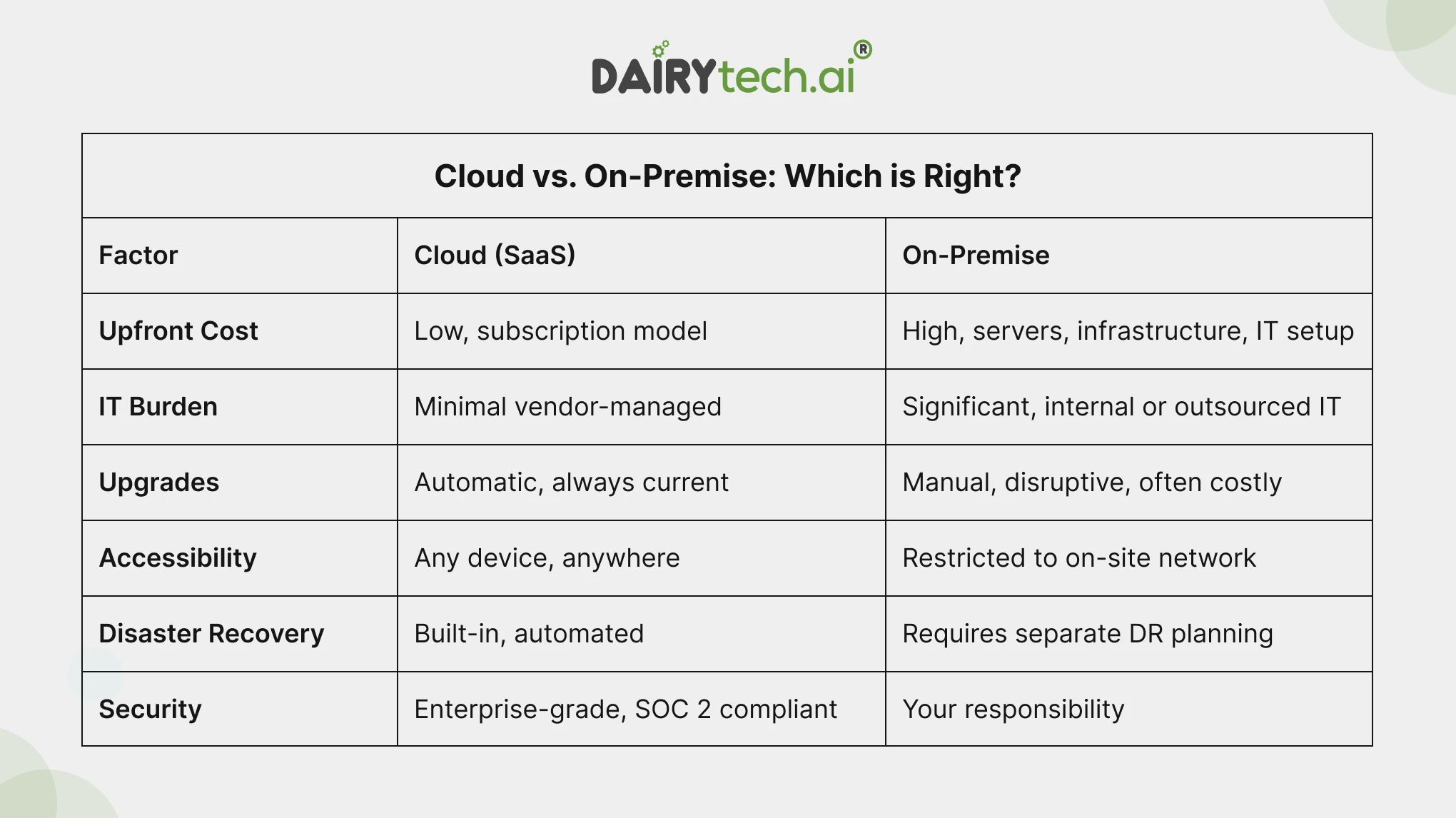
On-premise still makes sense in a narrow set of circumstances: facilities with unreliable internet connectivity, strict data sovereignty policies, or organizations mandated to align with an existing enterprise on-premise infrastructure.
A note on rural connectivity: DairyTech’s offline-capable mobile mode lets floor staff capture batch records, QC test results, and milk intake data on tablets even when connectivity is interrupted — with automatic sync when the connection is restored. It’s the most common objection to cloud ERP in rural dairy environments, solved.
According to a report, over 65% of new ERP deployments are now cloud-first, and manufacturing is one of the fastest adopters due to operational complexity.
How to Get Your Team to Say Yes
Selecting the right dairy ERP is half the battle. Getting operations, IT, and finance aligned and keeping them committed through implementation is the other half.
Operations teams have seen technology projects come and go. Win them over by running a working session, not just a demo. Bring your production supervisor in and let them try the batch entry interface. Identify one painful daily task, like end-of-shift batch reconciliation, and show exactly how the system eliminates it.
IT teams in small-to-mid-size dairy operations are often one person or a shared resource. Their concern is not adding to an already-stretched workload. Choose a cloud SaaS vendor to immediately remove hardware, patching, and uptime responsibility. Request the vendor’s SOC 2 Type II report before the final leadership presentation.
Finance and ownership evaluate every investment through payback period and risk. Build a one-page ROI case using four buckets:
- Labor savings: Hours eliminated from manual batch logging and compliance reporting. A 20-person operation typically saves 15–25 hours per week.
- Yield improvement: Even a 0.5% yield improvement on 10,000 lbs/day of milk equals $30,000–$80,000/year saved.
- Waste reduction: Typical dairy operations see a 2–4% reduction in expired inventory write-offs with accurate expiry tracking.
- Risk avoidance: Model recall probability against the average recall cost of $4.3M to quantify compliance risk.
The median payback period reported by DairyTech customers, combining yield improvement, labor savings, and waste reduction, is 14 months. Use this as your benchmark, then stress-test it with conservative assumptions. Finance trusts pessimistic projections more than best-case ones.
The Bottom Line
Buying dairy ERP software is not a procurement exercise; it’s a strategic decision that affects every part of your operation for years. The operators who get it right invest the time upfront: asking hard questions in demos, modeling the full five-year cost, watching for red flags in contracts, and building internal alignment before they sign.
DairyTech is built specifically for dairy processors who need more than a generic platform with a dairy logo slapped on it. Purpose-built traceability. All-in, transparent pricing. A fixed-scope go-live package. And an offline-capable mobile mode for plant floors where connectivity isn’t guaranteed.
The next step is a 30-minute live demo, no slides, no decks, just the live system. Book your DairyTech demo today. Bring your hardest traceability question. We’ll show you the answer in the system, live.
Frequently Asked Questions
Q1. How long does a typical dairy ERP implementation take?
A1. Implementation timelines vary by operation size and complexity, but most mid-size dairy processors should plan for 3–6 months from contract signing to go-live. The most common causes of delay are data migration complexity, scope changes mid-project, and insufficient internal resource allocation during rollout. DairyTech provides a written implementation plan with milestones and a go-live date before you sign.
Q2. What’s the real difference between dairy-specific ERP and a generic food ERP?
A2. A generic food ERP handles inventory, production, and compliance at a surface level. A dairy-specific platform is built around the workflows unique to your industry: USDA Class pricing and weekly component price changes, butterfat and protein differentials per supplier, multi-step batch chains from pasteurization through aging, yield variance by batch, and co-product traceability for whey, cream, and skim. The difference shows up in demos — and in audits.
Q3. How do I know if a vendor’s compliance features are actually current?
A3. Ask them to specify which version of FSMA their workflows are built around, when those workflows were last updated to reflect FDA guidance, and whether any of their dairy customers have passed an SQF Level 2 or BRC audit using their system as the primary compliance record. Ask to speak with one of those customers directly.
Q4. What should I do if the vendor won’t share pricing until after a discovery call?
A4. Treat it as a yellow flag at minimum. Vendors who are confident in their value share pricing clearly and early. If they won’t disclose even a pricing range before investing hours in calls and demos, factor that into how you assess their partnership approach. DairyTech publishes transparent, all-in pricing with no per-module fees.
Q5. We’re a smaller operation. Is enterprise ERP even right for us?
A5. Yes, if your operation is dealing with FDA traceability requirements, multi-step production, or multiple SKUs and suppliers, the risk of staying on spreadsheets outweighs the cost of the right system. The key is finding a platform built to scale with you, not one that charges you for enterprise features you don’t need today. Look for modular pricing and a go-live package sized to your actual operation.
Q6. How do we migrate years of batch records and lot history from Excel?
A6. This is one of the most underestimated parts of any ERP project. Historical data rarely imports cleanly, and the complexity depends on how consistently your records were maintained. Always ask the vendor who handles the migration (their team or a third-party integrator), request an example of migrated dairy dataand a budget of 1.5–2× the vendor’s initial migration estimate as a contingency.
Q7. What happens to our data if we decide to switch platforms later?
A7. Before signing any contract, confirm the data portability terms in writing. You should be able to export your complete operational data, such as batch records, lot histories, and compliance documentation, in a standard format at any time, without fees. Any contract that restricts data export or charges for it is protecting the vendor’s interests, not yours.