The dairy industry operates under pressures that most other food sectors don’t face at the same intensity: short product shelf lives, strict regulatory compliance, complex supplier networks, and a supply chain that begins before sunrise every single day. Choosing the right ERP to manage all of this isn’t just a technology decision; it’s a business-critical one.
Enterprise resource planning systems have come a long way, and they have genuinely transformed how dairy businesses operate, whether you’re a processor, a cooperative, a distributor, or a farm-to-doorstep delivery service. But with so many ERP options on the market, finding the right fit for your dairy operation takes more than a few demos and a price comparison.
This guide walks you through the seven key factors to evaluate when choosing the best ERP for your dairy business, so you invest in a system that actually works for the way your operation runs.
Why ERP Selection Matters More in Dairy Than Other Industries
Most industries can afford to run a new ERP in parallel with existing systems for a few months while they iron out the kinks. Dairy businesses rarely have that luxury. The combination of perishable products, time-sensitive procurement, daily distribution runs, and regulatory traceability requirements means that when your ERP doesn’t perform, the impact is immediate and operational, not just administrative.
Getting the selection right from the start isn’t caution; it’s efficiency. The seven factors below are the ones that separate a successful dairy ERP implementation from a costly one.
Not sure where to start? Talk to a DairyTech specialist who understands your business before you evaluate a single vendor. Book a Free Consultation
Factor 1: Identify Your Business Requirements
Before you evaluate any ERP system, you need a clear picture of what your business actually needs, not what a vendor tells you that you need. Start by mapping your existing business processes end to end.
- Where are the bottlenecks?
- Where does data get lost between teams?
- Where are people relying on spreadsheets, WhatsApp messages, or manual records to fill gaps that a system should be handling?
The answers to these questions define the features and functionalities your ERP must deliver.
If you’re migrating from an existing system, document what that system does well and, more importantly, where it falls short. Your new ERP needs to solve the problems your current one hasn’t.
It’s also worth being clear about your delivery model. Dairy businesses operate across a range of structures: subscription-based recurring delivery, farm-to-doorstep direct supply, on-demand ordering, B2B wholesale, or a combination of these. Each model has different workflow requirements, and not every ERP handles all of them equally well.
DairyTech’s ERP is built around a subscription-based, scheduled delivery model with modular functionality that can be tailored to meet the specific needs of your operation, whether you’re running a single depot or managing multi-location distribution.
Questions to ask yourself before vendor conversations:
- Which processes currently create the most manual effort or error?
- What data do I need to capture that I’m currently missing or doing manually?
- What does my delivery model look like, and does this ERP support it natively?
- Are there compliance requirements I need the system to manage?
Factor 2: Define Your Goals
Knowing your requirements tells you what the system needs to do. Defining your goals tells you what success looks like once it’s live.
- Are you implementing an ERP primarily to reduce manual effort and free your team for higher-value work?
- To gain real-time visibility into procurement, production, and delivery?
- To scale from one location to five without adding headcount proportionally?
- To get audit-ready for a major retail buyer?
Each of these goals shapes which ERP capabilities matter most and how you should prioritize them during evaluation.
Without defined goals, ERP selection becomes a feature-comparison exercise that ends in choosing the most impressive demo rather than the best fit. With defined goals, you have a clear benchmark against which every vendor either qualifies or doesn’t.
Write your goals down. Share them with every vendor you evaluate. The responses you get will tell you a lot about whether they’re the right partner.
DairyTech works with dairy businesses to map requirements and define ERP goals before a single line of configuration is written. Book a Consultation
Factor 3: Consider Your Budget
ERP investment is not a single line item. The total cost of ownership includes upfront licensing, implementation fees, data migration, customisation, training, ongoing support, and the cost of any integrations you need to build or maintain.
Set a realistic budget, one that accounts for all of these components, not just the headline implementation quote. Vendors who present a low upfront price but charge separately for every module, every integration, and every support call can end up significantly more expensive than a higher-quoted competitor who includes these as standard.
That said, budget discipline matters too. Implementing the wrong system purely because it’s within budget is a false economy. The cost of a poorly fitting ERP in lost productivity, remediation work, and eventual replacement far exceeds the savings made at the point of purchase.
What to ask every vendor about cost:
- What is included in the quoted price and what isn’t?
- What does a three-year total cost of ownership look like?
- How are annual license or subscription fees structured, and is there a cap on price increases?
- What are the typical additional costs that clients incur after go-live?
A note on deployment: cloud-based ERP deployments typically carry lower upfront costs than on-premise installations, with infrastructure and maintenance managed by the vendor. On-premise deployments may offer more control but require greater internal IT resources. Clarify which model suits your business before comparing pricing.
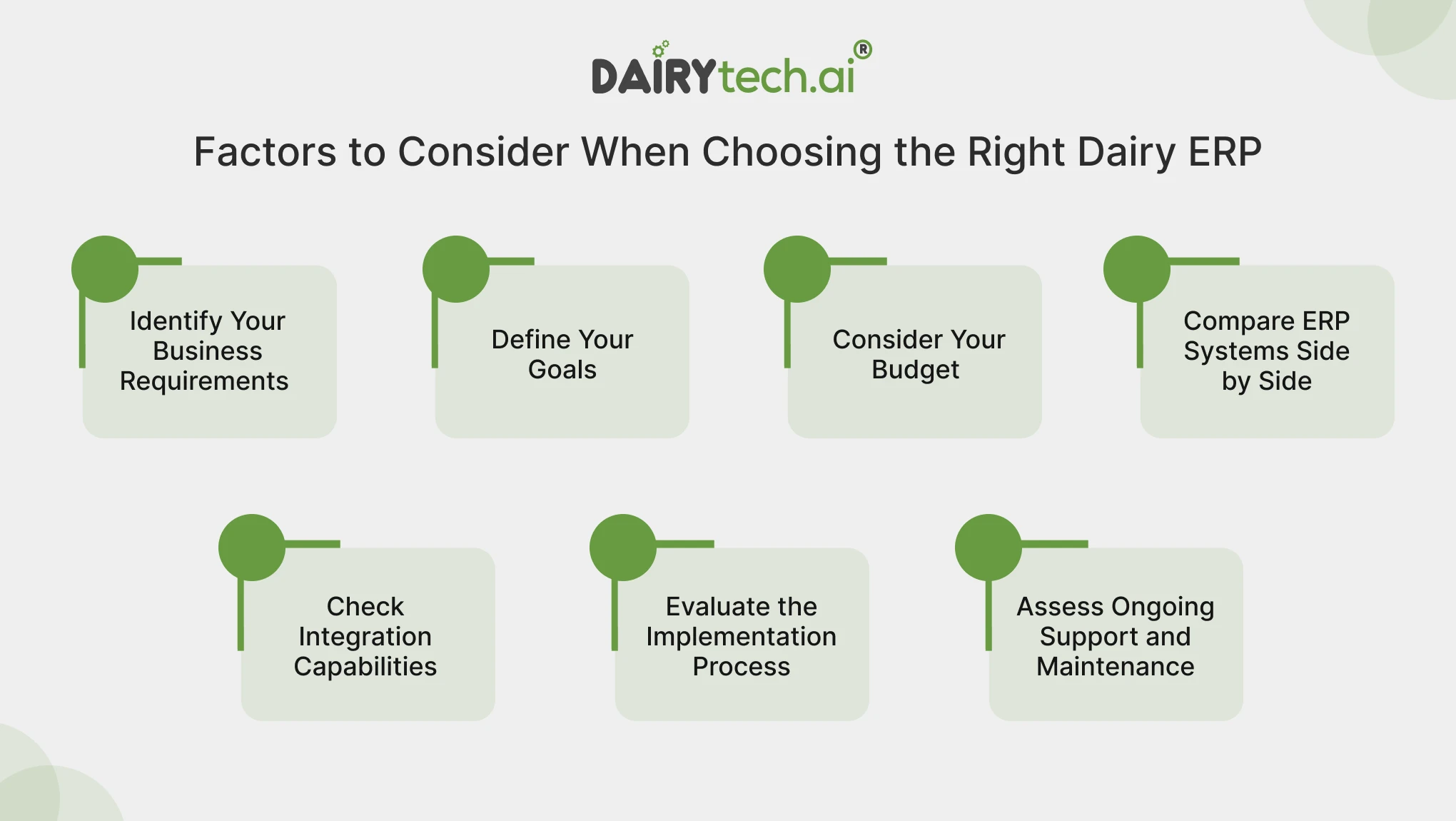
Factor 4: Compare ERP Systems Side by Side
Once you have your requirements, goals, and budget defined, you’re ready to evaluate vendors, but evaluate them systematically, not impressionistically.
A polished demo is not a measure of product quality. What matters is how the system performs against your specific workflows, not a vendor’s curated showcase scenarios. Ask every vendor to demonstrate the same set of scenarios, ideally drawn from your actual business processes, so you’re comparing like with like.
What to assess in every comparison:
- Does the system handle dairy-specific workflows natively (milk procurement, component-based pricing, lot traceability, FEFO), or does it require significant customisation?
- How does it scale as your volume, locations, and product range grow?
- What does the user interface actually look like for your frontline staff, not just for management dashboards?
- What do real customers say? Ask for references, and call them.
Shortlist two to four vendors for serious evaluation. Too few and you risk tunnel vision; too many and the process becomes unmanageable.
Want a structured side-by-side comparison of ERP options for your dairy business? Request a DairyTech Demo Tailored to Your Workflows
Factor 5: Check Integration Capabilities
A dairy ERP rarely operates in isolation. It needs to connect with the tools and systems your business already runs, and the list is often longer than people initially expect.
Common integration requirements for dairy businesses include e-commerce storefronts, point-of-sale systems, online ordering marketplaces, third-party logistics providers, milk quality analyzers, IoT cold chain monitoring systems, weighbridges at collection points, and accounting or payroll platforms.
Before you finalize any vendor, list every integration your business requires, both current and planned. Discuss each one explicitly with the vendor. Get clear answers on which integrations are pre-built, which require custom development, and what each will cost. Integration expenses that aren’t clarified upfront have a habit of appearing as unexpected line items mid-implementation.
Key integration questions:
- Which of our existing systems do you have pre-built integrations for?
- How do integrations with hardware (analyzers, weigh bridges, and sensors) work?
- What does the API documentation look like, and who manages integration maintenance?
- What happens to integrations when the ERP is updated?
Factor 6: Evaluate the Implementation Process
ERP software touches almost every part of your dairy business, including procurement, quality, production, warehouse, dispatch, finance, and customer management. This means the implementation process is not a background IT project; it is an operational transformation that requires active participation from your team and a structured, experienced delivery from your vendor.
Not all implementation partners are equal. Many ERP vendors are generalists who implement across industries, meaning their consultants will arrive at your dairy business without understanding milk procurement, fat/SNF pricing, cold chain compliance, or traceability requirements. You end up funding their education.
Choose a partner with demonstrated dairy industry expertise. Ask to meet the actual implementation team before signing, not just the sales team. Ask for a phased project plan scoped to your operation, with defined milestones, realistic timelines, and clear responsibilities for both sides.
What a credible implementation plan looks like:
- A discovery phase to validate and refine requirements
- A configuration phase with regular review points
- A data migration plan covering cleansing, validation, and reconciliation
- User acceptance testing (UAT) before go-live
- Role-based training for all user groups
- A defined go-live support window
DairyTech implements dairy ERP in structured phases, starting from a detailed understanding of your business requirements and goals, not from a generic template.
Concerned about implementation risk? Talk to a DairyTech consultant about our phased implementation methodology and what go-live actually looks like for a dairy business like yours. Discuss Your Implementation Plan
Factor 7: Assess Ongoing Support and Maintenance
Go-live is not the finish line; it’s the beginning of the operational relationship with your ERP partner. The quality of ongoing support you receive after implementation will shape how much value you extract from the system over the long term.
Look for vendors who offer structured, documented support agreements, not just a helpdesk email address. In dairy, where operations run from early morning to late evening and procurement issues at 5 AM can cascade through the entire day, response time commitments matter. Get SLAs in writing, and make sure they reflect the reality of your operating hours.
Good ongoing support also means proactive maintenance, such as continuous monitoring, bug identification and resolution, security patching, and regular communication about updates that affect your workflows. The right partner doesn’t wait for you to raise a problem; they identify it first.
Beyond break-fix support, the best ERP partners function as long-term advisors: flagging new platform capabilities, sharing regulatory updates relevant to your market, and helping you optimize the system as your business evolves.
What to look for in a support agreement:
- Documented SLAs by issue severity with response and resolution time commitments
- Coverage hours that align with your operating hours
- Named account management for escalations and strategic reviews
- A clear process for handling updates, patches, and new releases
- Proactive system monitoring, not just reactive ticket management
Making the Right Choice
Choosing the best ERP for the dairy industry isn’t about finding the most feature-rich system on the market; it’s about finding the system that fits your specific operation, is backed by a partner with genuine dairy expertise, and will still be serving your business well five years from now.
The seven factors above give you the framework to make that decision with confidence: starting from your own requirements and goals, moving through a rigorous vendor evaluation, and finishing with a clear picture of what implementation and long-term support will actually look like.
DairyTech provides ERP solutions for dairy businesses that are flexible, modular, and built to evolve with the changing demands of the industry. From subscription-based delivery to multi-location processing, our system is designed to fit your business, not the other way around.
Ready to see how DairyTech’s dairy ERP fits your specific operation? Book a Free Demo! No generic presentations. We demonstrate the system against your actual workflows.
Frequently Asked Questions
Q1. What is the best ERP for the dairy industry?
A1. There is no single “best” dairy ERP that suits every operation. The right choice depends on your business model (processor, cooperative, distributor, delivery service), the scale of your operation, your regulatory environment, and the specific workflows you need the system to support. That said, the best dairy ERP will handle milk procurement, component-based pricing, lot traceability, cold chain monitoring, and FEFO inventory natively without requiring significant customisation for these core workflows.
Q2. How long does it take to implement a dairy ERP?
A2. Implementation timelines vary depending on the size and complexity of the operation, the number of integrations required, and the quality of existing data. For small to mid-sized dairy businesses, a structured implementation typically takes between three and six months from project kick-off to go-live. Larger or more complex deployments can take six to twelve months. A phased approach, starting with core workflows and adding modules over time, can reduce initial go-live timelines and manage risk.
Q3. What is the difference between cloud-based and on-premise dairy ERP?
A3. A cloud-based ERP is hosted by the vendor on remote servers, accessed via a web browser or app, and maintained by the vendor. Upfront costs are lower, and infrastructure management is handled externally. An on-premise ERP is installed on servers at your own facility, giving you direct control over data and infrastructure but requiring greater internal IT resources and a higher upfront investment. For most dairy businesses, especially growing ones, cloud deployment offers a better balance of cost, flexibility, and scalability.
Q4. How much does a dairy ERP cost?
A4. Dairy ERP costs vary significantly based on the number of users, modules required, degree of customisation, deployment model, and the scope of ongoing support. Costs typically include implementation fees, license or subscription fees (annual or monthly), data migration, integration development, training, and support contracts. Rather than focusing on the upfront quote, ask vendors for a three-year total cost of ownership model; this gives a far more accurate picture of what you’ll actually spend.
Q5. Can a dairy ERP integrate with our existing equipment and software?
A5. Yes, a well-designed dairy ERP should integrate with the tools and equipment your business already uses, including milk quality analyzers (Milko-testers, infrared analyzers), IoT temperature monitoring systems, weighbridges, e-commerce platforms, point-of-sale systems, and accounting software. Always verify which integrations are pre-built and which require custom development, and get clarity on integration costs before signing any contract.
Q6. What happens if our business grows after ERP implementation, do we need a new system?
A6. A scalable dairy ERP should grow with your business without requiring replacement. When evaluating vendors, ask specifically how the system handles increases in transaction volume, expansion to additional locations or plants, and the addition of new product lines. Ask for references from clients who have scaled significantly on the platform, not just assurances.
Q7. Why should we choose DairyTech over other dairy ERP vendors?
A7. DairyTech specializes exclusively in dairy ERP implementation. Our consultants have hands-on dairy industry experience, not just software expertise, and we bring that knowledge to every engagement. We offer a modular, flexible ERP built on Odoo, preconfigured for dairy workflows, with structured implementation methodology, documented SLAs, and a long-term support model designed around the way dairy businesses actually operate. We’d rather earn your trust through a rigorous evaluation process than ask you to take our word for it. Book a free demo and put us to the test.
DairyTech delivers ERP solutions purpose-built for the dairy industry, from processors and cooperatives to distributors and subscription-based delivery services. If you’re in the process of evaluating dairy ERP systems, get in touch with our team today and let’s start with your requirements.