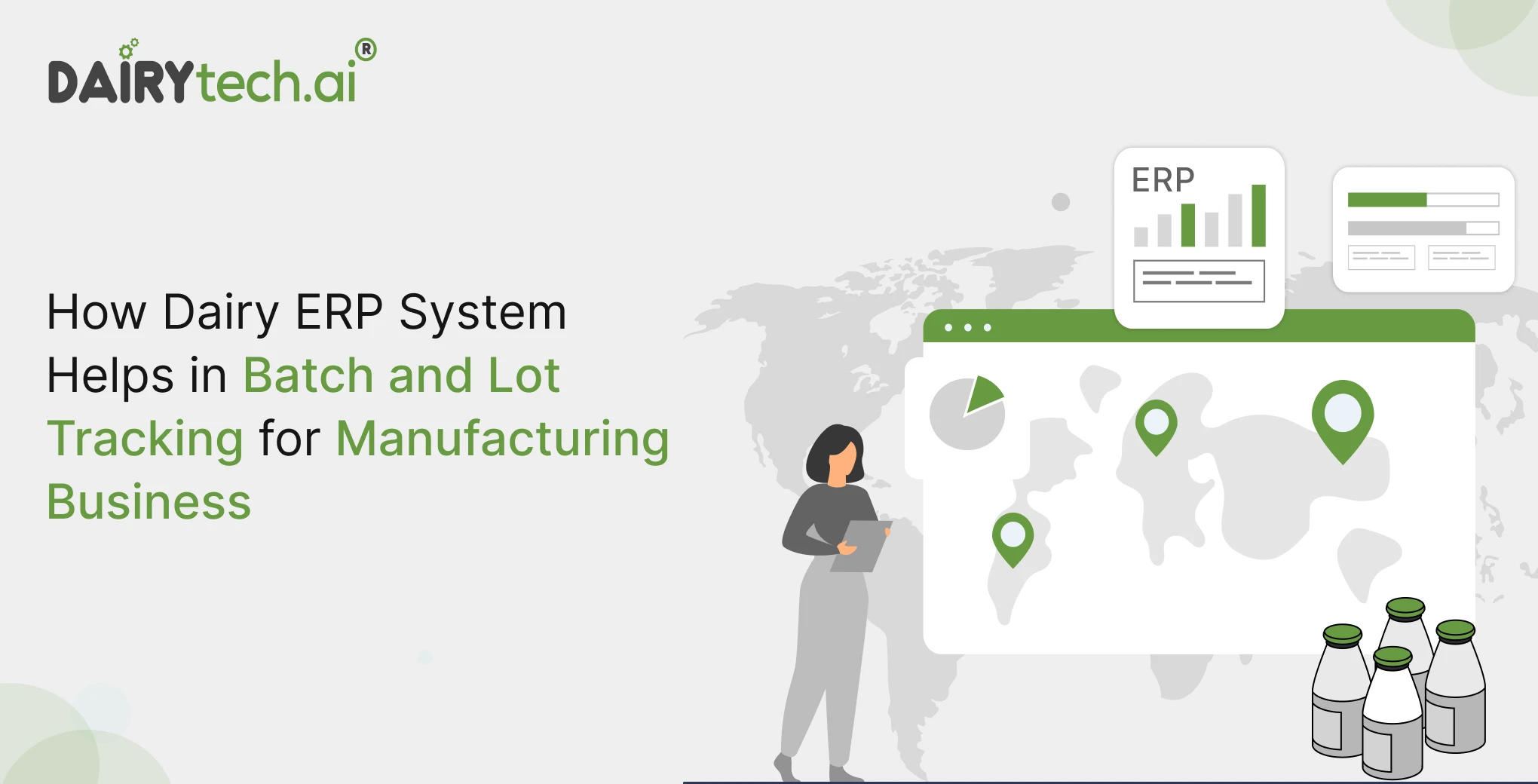
In the dairy industry, a single compromised batch can trigger costly recalls, damage brand trust, and expose your business to serious regulatory penalties. Yet many dairy manufacturers still rely on spreadsheets, paper logs, and siloed systems to track batches and lots. A modern dairy ERP system changes all of that.
Whether you’re processing fresh milk, manufacturing cheese, producing yogurt, or packaging butter, traceability isn’t optional; it’s the backbone of safe, compliant, and profitable dairy operations. This guide explores how an industry-specific ERP system, like the one built by DairyTech, transforms batch and lot tracking from a burden into a competitive advantage.
What Is Batch and Lot Tracking in Dairy Manufacturing?
“Batch tracking” refers to the ability to monitor and record every step of production, from raw ingredient sourcing to final packaging, for a defined group of products produced under identical conditions. Lot tracking assigns unique identifiers to groups of products sharing the same origin, production date, or process parameters. In a dairy context, this means tracking the following:
- Raw milk intake by farm, tanker, collection date, and quality test result
- Pasteurization and processing parameters per production run
- Ingredient and additive lot numbers (cultures, rennet, stabilizers)
- Packaging material batch linkage
- Finished product lots mapped to distribution destinations
Why Spreadsheets and Manual Methods Fall Short
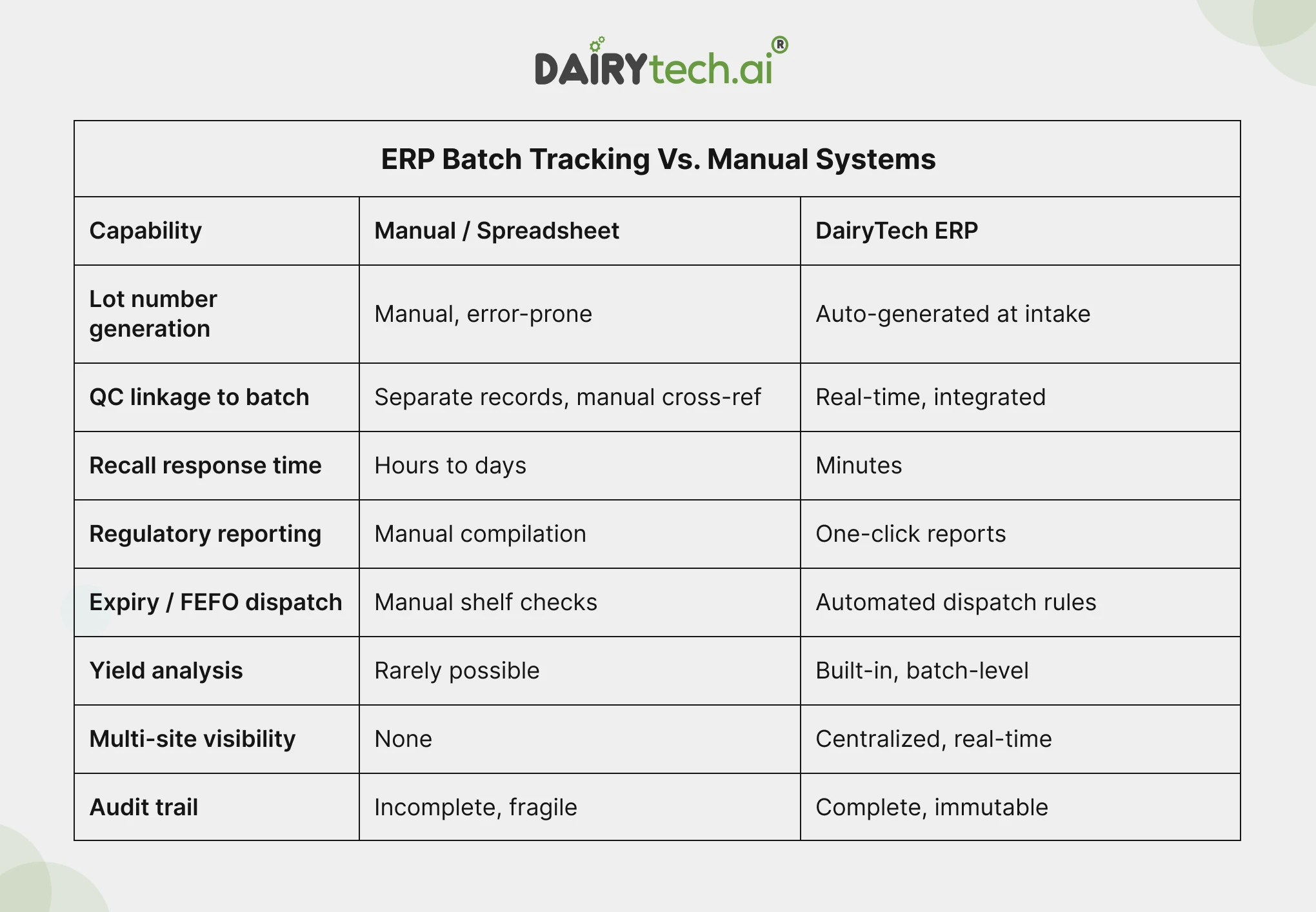
Manual tracking creates dangerous blind spots. When production volumes increase or regulatory audits arrive, paper-based systems fail to provide the one-click traceability that modern food safety frameworks demand. Data is scattered, entry errors are common, and cross-referencing takes days rather than minutes.
Ready to modernize your dairy operations? See how DairyTech ERP gives you complete batch-to-shelf visibility. Book a Free Demo
How a dairy ERP System Transforms Batch and Lot Tracking
A dairy ERP system built for dairy manufacturing doesn’t just digitize paperwork; it creates a connected, real-time data ecosystem that links every department: procurement, production, quality, warehousing, and distribution. Here’s how each layer adds value.

Automated Lot Number Generation at Intake
When raw milk arrives from a farm or collection center, a dairy ERP automatically generates a unique lot number linked to supplier details, test results, fat content, volume, and timestamp. This single action seeds a digital thread that follows the milk through every stage of transformation.
DairyTech Advantage: DairyTech’s ERP integrates directly with milk reception terminals and lab systems, capturing quality data at the point of intake, no manual entry required.
Production Batch Creation and Work Order Linkage
Every production run is tied to a Work Order that captures which raw material lots were consumed, which recipes or formulations were used, processing temperatures and durations, equipment used (and its sanitization records), and which operator or shift was responsible.
This forms an unbroken chain, from raw milk lot to finished cheese batch, that can be pulled up instantly during audits or recalls.
Ingredient and Additive Traceability
Dairy manufacturing often involves added ingredients: cultures, enzymes, stabilizers, flavorings, and packaging gases. A dairy manufacturing ERP software tracks the lot number of every ingredient consumed in each production batch. If a supplier issues an alert on a specific culture lot, you can immediately identify every product batch that used it and pull only those from distribution.
Real-Time Quality Control Integration
Quality tests are tied to batch records, not stored separately. pH levels, moisture content, microbiology results, and sensory evaluations all appear on the same batch record, with pass/fail status and hold triggers. Failed QC automatically places the batch on hold within the ERP, preventing it from moving to packaging or dispatch.
- Automated QC Holds: Failed tests instantly freeze batch movement across the system
- Live Dashboard Alerts: QC managers get real-time notifications for out-of-spec results
- Trend Analysis: Historical QC data by batch reveals patterns before problems escalate
- Digital Audit Trail: Every test entry is timestamped, user-attributed, and immutable
Packaging and Label Management
Lot tracking extends into packaging. Each container, whether a retail bottle, bulk drum, or export pallet, carries a unique barcode or QR code linking to its parent batch. Labels are generated directly from ERP data, eliminating transcription errors on best-before dates, weight declarations, and regulatory codes.
Finished Goods Inventory with Lot Segregation
Once packaged, finished products are stored in the warehouse under lot-specific inventory records. ERP-managed FEFO (First Expired, First Out) rules automatically direct pickers to dispatch the oldest lots first, reducing waste from expired product and ensuring freshness standards are met.
Regulatory Compliance Made Simple
Dairy is one of the most tightly regulated food categories globally. ERP systems help manufacturers meet requirements across multiple frameworks simultaneously.

Worried about your next compliance audit? DairyTech ERP generates audit-ready reports in minutes, not days. Let us show you how!
Recall Management: From Days to Minutes
A product recall is a manufacturer’s worst scenario. Without traceability, a recall often means pulling entire product lines from shelves costing millions and destroying brand equity. With ERP-based lot tracking, the response is surgical.
- Identify the affected lot: Search by lot number, production date, ingredient supplier, or quality parameter in seconds.
- Map downstream distribution: The ERP shows every customer, warehouse, and retail location where affected lots were shipped.
- Trace upstream ingredients: Identify which raw material lots, suppliers, and farm sources contributed to the batch.
- Trigger selective recall: Issue targeted recall notices only to affected customers, limiting scope and cost.
- Document for regulators: Generate complete recall documentation with full audit trail in a single ERP report.
Inventory Optimization and Waste Reduction
Beyond compliance, lot tracking provides operational intelligence that directly impacts profitability. When your manufacturing ERP software knows the exact expiry of every batch in every location, you gain the ability to proactively move stock, offer promotions on near-expiry lots, and optimize production schedules to match actual inventory consumption.
FEFO Dispatch Logic
FEFO (First Expired, First Out) dispatch rules are enforced automatically in DairyTech ERP. Warehouse staff receive pick lists that always prioritize the earliest-expiring lot without needing to manually check labels or dates. This alone typically reduces dairy waste by 15–25% in the first year of implementation.
Yield Analysis by Batch
ERP batch records capture the raw material input and finished goods output for every production run. This enables yield analysis, identifying which farms, which production lines, or which operators consistently deliver better conversion rates. Over time, this data transforms quality decisions from gut feelings to data-driven precision.
Production insight in practice: A mid-size cheese manufacturer using DairyTech ERP identified that milk from one particular farm region consistently produced 4% higher yield in aged cheddar, a discovery that shifted their procurement strategy and added significant margin.
Supplier and Farm-Level Traceability
Modern dairy traceability starts at the farm gate, not the factory floor. A robust ERP connects incoming milk quality data to supplier profiles, enabling farm-level scorecards that inform procurement decisions.
Key supplier traceability features in a dairy ERP include the following:
- Farm ID and collection route linkage to milk intake records
- Somatic cell count and bacteria count tracking by supplier over time
- Antibiotic residue test results stored against supplier lot
- Milk price calculation based on quality parameters and procurement rates
- Supplier performance dashboards for procurement team review
Track quality from farm gate to shelf! DairyTech ERP gives you complete supplier-to-consumer traceability, purpose-built for dairy. Start Your Free Trial
Track quality from farm gate to shelf! DairyTech ERP gives you complete supplier-to-consumer traceability, purpose-built for dairy. Start Your Free Trial
Implementing ERP Batch Tracking: What to Expect
Getting started with an ERP system designed for dairy doesn’t need to be a months-long disruption. DairyTech is built specifically for dairy manufacturers, which means the workflows, terminology, and data structures are pre-configured for your industry. You’re not adapting a generic ERP; you’re deploying a dairy-native system.
Typical Implementation Phases
Discovery and data mapping (Week 1–2)
Map your current intake, production, and dispatch workflows to the ERP structure.
Master data setup (Week 2–3)
Configure suppliers, products, formulations, warehouse locations, and QC parameters.
Pilot production run (Week 3–4)
Process one product line end-to-end in the ERP, validating lot tracking and QC flows.
Full go-live and training (Week 4–6)
Roll out across all product lines with live support from the DairyTech implementation team.
Bottom Line
In today’s dairy industry, batch and lot tracking isn’t a nice-to-have; it’s the difference between a brand that survives a product issue and one that doesn’t. The question is no longer whether to digitize traceability but how quickly you can do it.
An ERP system purpose-built for dairy manufacturing connects every touchpoint in your supply chain, from farm to shelf, giving you the visibility to prevent problems, the agility to respond when they arise, and the data to continuously improve your operations.
DairyTech ERP is built exclusively for dairy manufacturers, with traceability, quality management, production planning, and compliance reporting all in one platform. Book Your Free Demo Today
Frequently Asked Questions
Q1. What is the difference between batch tracking and lot tracking in dairy?
A1. Batch tracking follows a specific production run — what went in, what came out, and what conditions were used. Lot tracking assigns a unique identifier to a group of finished products that can be traced to those production records. In practice, most dairy ERP systems use both terms together to describe end-to-end traceability from raw milk intake to product dispatch.
Q2. Is ERP batch tracking mandatory for dairy manufacturers?
A2. While not all jurisdictions mandate ERP software specifically, traceability requirements in regulations like FSMA (US), EC 178/2002 (EU), and FSSAI (India) effectively require the kind of systematic, rapid, and complete records that only a digital ERP can reliably provide at scale. Manufacturers relying on manual records are increasingly exposed to audit failures and recall liability.
Q3. Can a small or mid-size dairy manufacturer afford an ERP system?
A3. Yes. DairyTech ERP is designed with scalable pricing for dairy manufacturers of all sizes — from a single-site cooperative to a multi-plant enterprise. Cloud-based deployment eliminates large upfront infrastructure costs, and the ROI from reduced waste, faster compliance, and prevented recalls typically outweighs the subscription cost within the first year.
Q4. How does lot tracking help during a product recall?
A4. With ERP lot tracking, you can identify in minutes exactly which customers received any specific batch, which raw material lots were used, and whether other batches are at risk. This precision allows you to issue a targeted recall rather than pulling entire product lines, dramatically reducing the financial and reputational impact of a recall event.
Q5. Does DairyTech ERP integrate with existing lab systems and weighbridges?
A5. Yes. DairyTech ERP offers integration APIs for laboratory information management systems (LIMS), milk reception terminals, weighbridge software, and cold chain monitoring equipment. This allows quality and weight data to flow automatically into batch records without manual re-entry.
Q6. How long does it take to implement batch tracking in DairyTech ERP?
A6. Most dairy manufacturers are operational with full batch and lot tracking within 4–6 weeks. Because DairyTech is purpose-built for dairy, there is no need to configure generic ERP modules for your industry — the system understands milk procurement, pasteurization, aging rooms, cold stores, and dairy-specific regulatory requirements out of the box.
Q7. What dairy product types does DairyTech ERP support for batch tracking?
A7. DairyTech ERP supports batch and lot tracking across all major dairy product categories, including fresh milk, pasteurized and UHT milk, cheese (fresh and aged), yogurt and fermented dairy, butter and ghee, milk powder, paneer, whey-based products, ice cream, and flavored milk beverages.