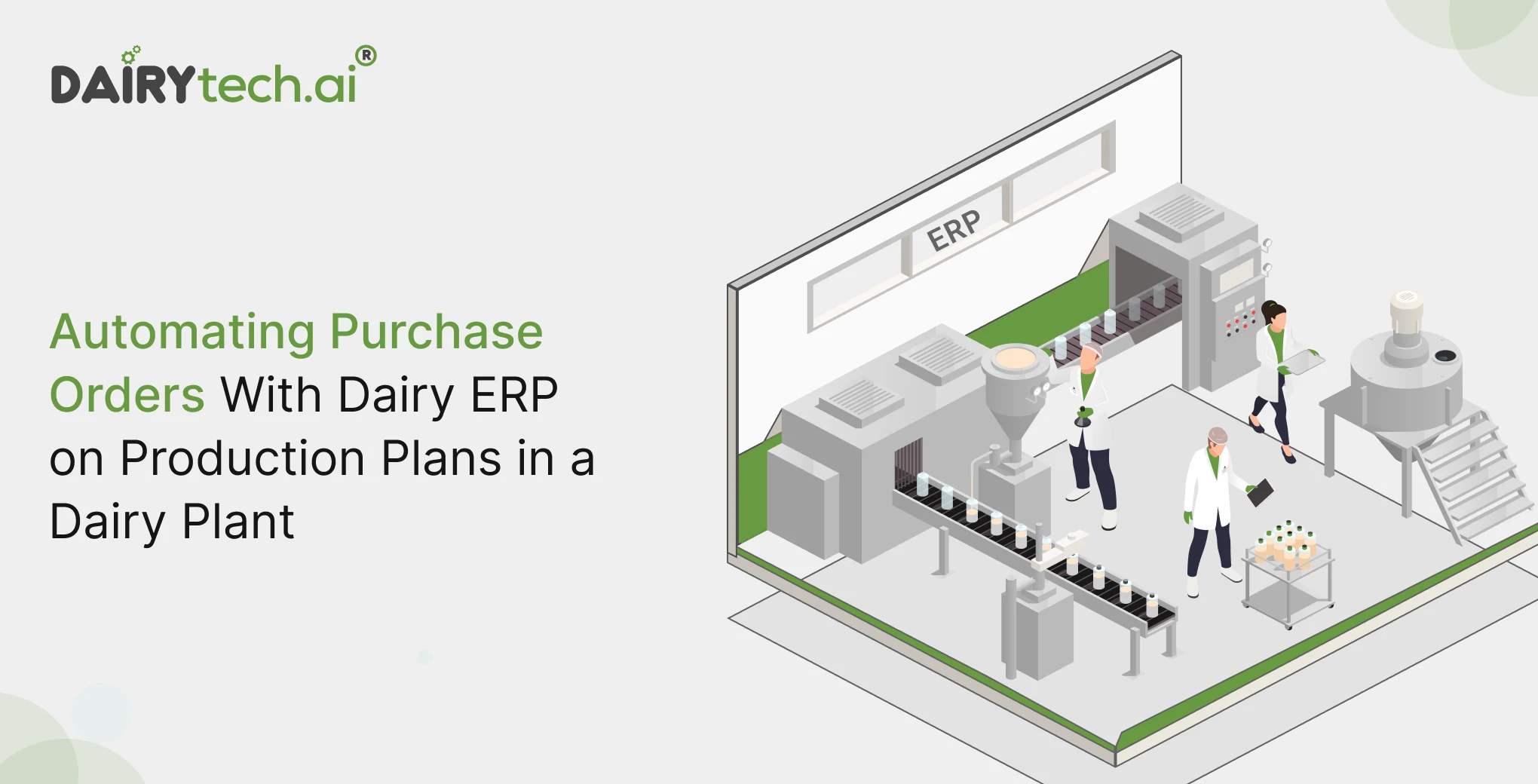
A dairy plant doesn’t run on milk alone. It runs on packaging film, starter cultures, cleaning chemicals, fuel, spare parts, and dozens of raw materials that need to arrive at exactly the right time, before production, not during it.
When procurement is managed manually, the cracks show fast: a delayed PO holds up a cheese batch; an over-order ties up cold storage; a missed reorder creates downtime that costs more per hour than the oversight was worth.
Dairy ERP changes this. By linking your production plans directly to purchase order generation, an ERP system closes the gap between “what we plan to make” and “what we need to order,” automatically, accurately, and in real time.
This guide breaks down exactly how that works, why it matters, and what your dairy plant needs to get there.
What Is Purchase Order Automation in a Dairy Plant?
Purchase order automation is the process of generating, routing, approving, and sending supplier POs without manual data entry at each step. Instead of a procurement officer reviewing production schedules and manually calculating material needs, the ERP system does it, based on confirmed production plans, current inventory levels, supplier lead times, and reorder rules.
In a dairy context, this means the system can automatically raise a PO for milk packaging pouches when a batch of pasteurized milk is scheduled, factor in what’s already in stock, apply the right supplier and pricing, and route the PO for approval, all before anyone picks up the phone.
The result is a procurement process that’s faster, more accurate, and tightly synchronized with what the plant is actually producing.
Why Manual PO Management Fails in Dairy Manufacturing
Before exploring the solution, it’s worth understanding why manual procurement consistently breaks down in dairy plants.
Dairy production is time-critical. Raw milk has a short processing window. Finished products have shelf lives measured in days or weeks. Unlike discrete manufacturing, you can’t pause a pasteurization run because the packaging film didn’t arrive.
Manual PO processes create several recurring failure points. Procurement teams rely on informal communication from production supervisors to know what’s coming. Spreadsheets lag behind real production changes. Approval chains slow down urgent orders. Supplier lead times aren’t consistently tracked. And when a gap appears, the fix is always reactive, an emergency order at a higher cost, or a production delay that cascades into delivery failures.
According to Rockwell Automation’s MRP best practices, even basic MRP implementation can reduce inventory carrying costs by 10-30% and significantly improve on-time delivery rates. For dairy manufacturers, the impact is amplified because the input materials are perishable and the production windows are tight.
How Dairy ERP Connects Production Plans to Purchase Orders
The core mechanism is Material Requirements Planning (MRP), the engine inside a dairy ERP that calculates what materials are needed, when they’re needed, and how much to order.
Here’s how the flow works in a purpose-built dairy ERP:
Step 1: Production Plan Confirmed
Your production planner creates or confirms a production schedule for the week: 10,000 liters of pasteurized milk in 500 ml pouches, 2,000 kg of paneer, and 500 kg of flavored yogurt.
Step 2: Bill of Materials Exploded
The ERP pulls the Bill of Materials (BoM) for each product. For pasteurized milk, that means milk intake volumes, pouch film, caps, crates, and cleaning agents. For example, paneer includes coagulants, pressing materials, and packaging. Every input is calculated to the required quantity.
Step 3: Inventory Check
The system checks real-time inventory against the requirements. If you have 8,000 pouches in stock and need 20,000, the net requirement is 12,000.
Step 4: Supplier and Lead Time Lookup
The ERP references your approved vendor list. Supplier A delivers a pouch film in 3 days, and Supplier B takes 5. It calculates the order date backward from the production date to ensure on-time arrival.
Step 5: Purchase Order Generated
A draft PO is raised automatically, pre-filled with the item, quantity, price (from the approved price list), delivery date, and supplier. It goes into the approval queue, or, if it falls within pre-approved thresholds, it’s sent directly.
Step 6: Supplier Confirmation and Tracking
Once sent, the ERP tracks the PO status, expected delivery, and receipt. When goods arrive, the PO is matched against the delivery and invoice, and inventory is updated.
This entire chain, from production plan to goods receipt, is tracked in a single system, with full traceability at every step.
Want to see how this works for your plant? Talk to a Dairytech ERP consultant to map your procurement workflow.
The Role of MRP in Dairy ERP Procurement Automation
MRP is the calculation layer that makes automated POs accurate rather than just automatic. Without MRP, a system might simply reorder when stock hits a threshold, a blunt instrument. Material resource planning calculates dynamic requirements based on what’s actually planned.
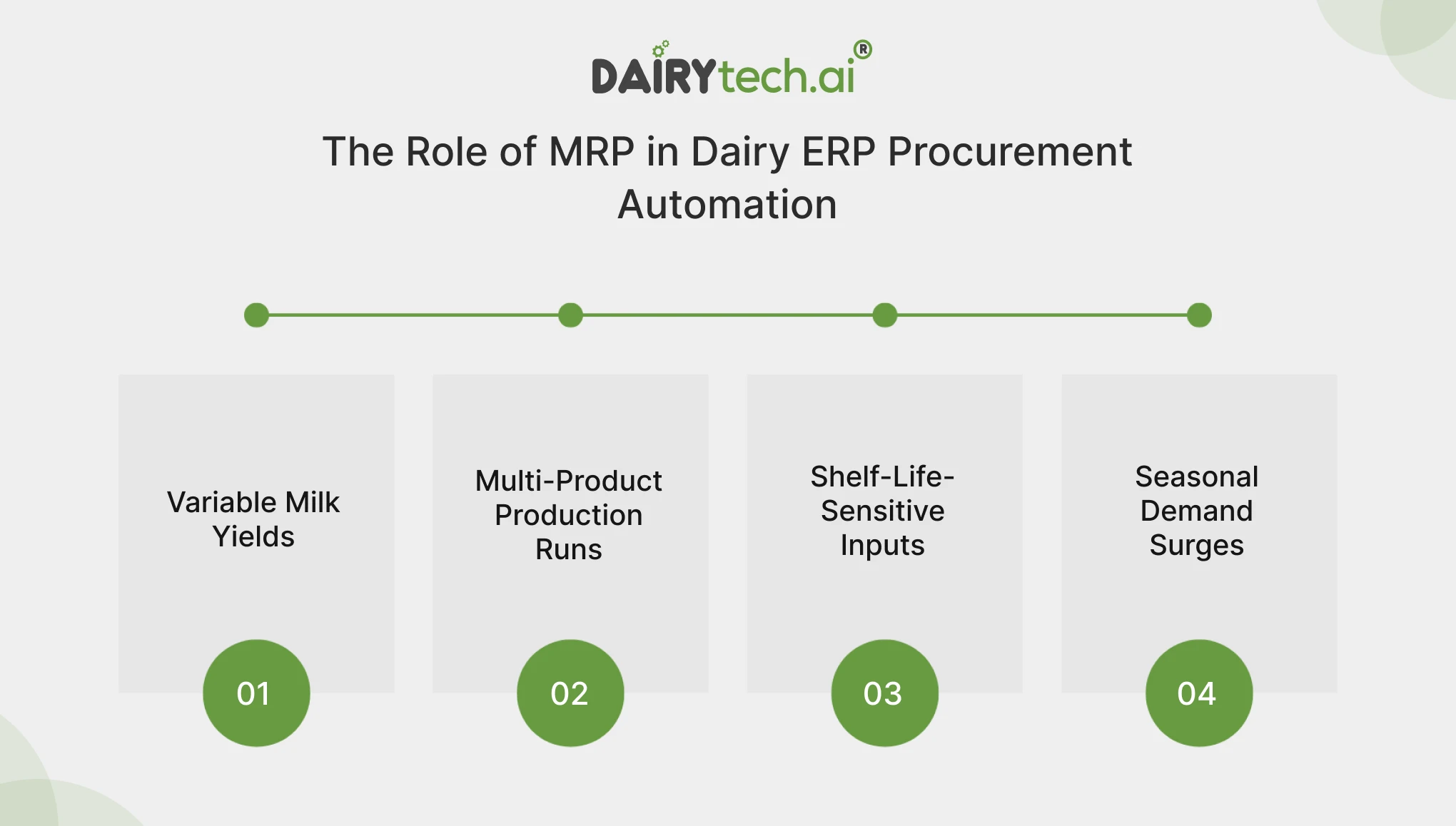
For dairy plants, MRP handles several variables that manual systems can’t manage simultaneously:
Variable milk yields
Raw milk intake fluctuates daily based on season, herd health, and farmer supply. MRP accounts for current intake volumes when calculating processing requirements.
Multi-product production runs
A single shift may produce full-fat milk, toned milk, and flavored milk, each with different packaging and ingredient requirements. MRP explodes all BoMs together and nets off shared inventory.
Shelf-life-sensitive inputs
Starter cultures, enzymes, and certain packaging materials have their own expiry dates. MRP can be configured to flag or block orders that would result in inputs arriving too early and expiring before being used.
Seasonal demand surges
During festive seasons, dairy plants often ramp production significantly. MRP automatically adjusts procurement plans in line with the updated production schedule.
The Tetra Pak Dairy Processing Handbook notes that automation and digitalization in dairy processing are no longer optional for competitive plants; they’re the baseline for achieving consistent quality and operational control at scale.
Key Benefits of Automating Purchase Orders With Dairy ERP
Eliminated stockouts and overstock
Orders are triggered by actual production need, not intuition. You order what you need, when you need it, reducing both emergency purchases and warehouse clutter.
Reduced procurement cycle time
Automated PO generation cuts the time from “production plan confirmed” to “PO sent” from days to minutes. Approvals are routed digitally with pre-set thresholds.
Lower procurement costs
When you’re not placing emergency orders, you’re not paying premium prices. Consistent ordering patterns also strengthen your negotiating position with suppliers.
Better supplier relationships
Suppliers receive accurate, timely orders rather than last-minute calls. Lead times are respected. This reliability improves your priority status with key vendors.
Full audit trail for compliance
Every PO, draft, approved, sent, and received, is logged in the ERP with timestamps, user IDs, and document attachments. This is essential for FSMA, FSSAI, ISO 22000, and other food safety audits.
Freed procurement staff for higher-value work
When routine ordering is automated, your procurement team can focus on supplier development, contract negotiation, and cost optimization rather than data entry.
Requirements For Setting Up Auto PO Generation from Production Plans
Automated purchase orders don’t work without clean underlying data. Before switching on MRP-driven procurement, your dairy ERP needs to be configured correctly.
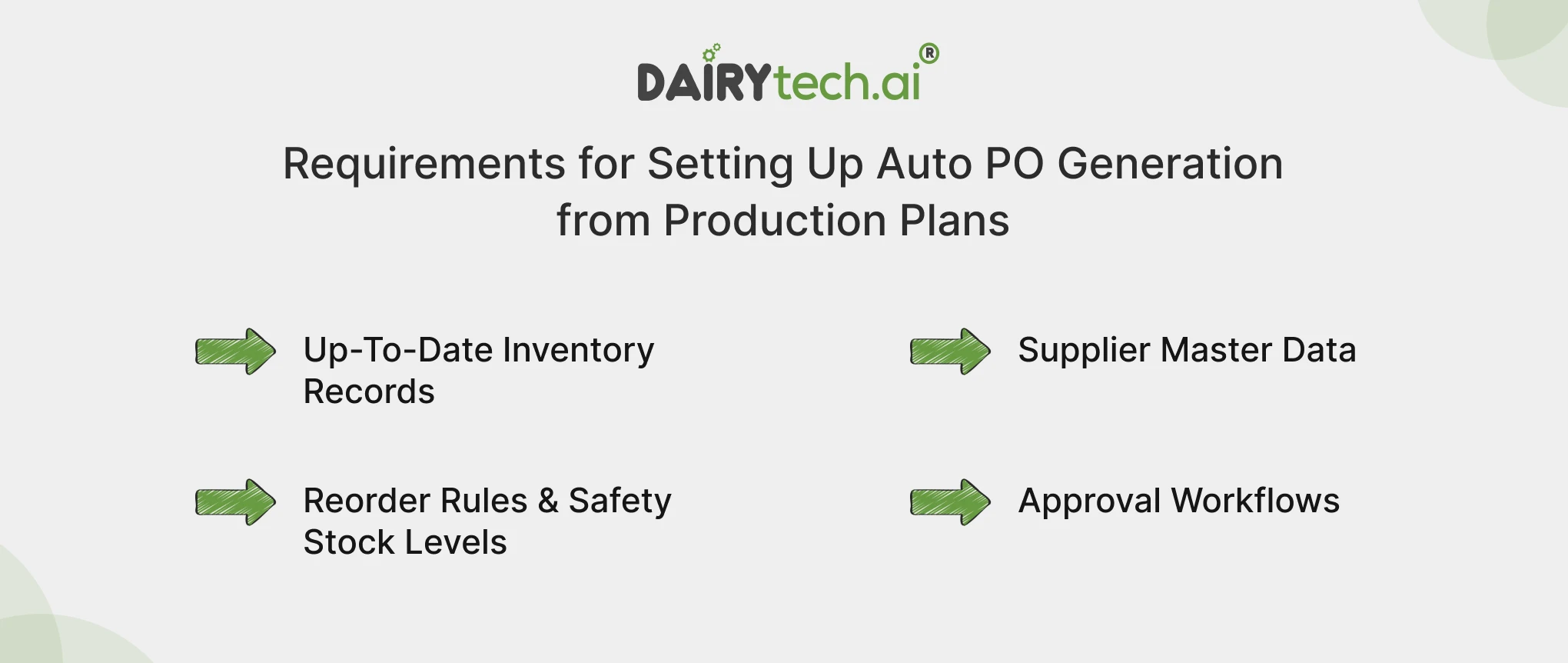
Accurate Bills of Materials
Every product needs a BoM that reflects current formulations, yields, and packaging specifications. Stale or incomplete BoMs produce inaccurate material requirements.
Up-to-date inventory records
If your stock counts are wrong, your net requirements will be wrong. Implement cycle counting or barcode scanning to keep inventory accurate.
Supplier master data
Each approved supplier needs lead times, minimum order quantities, pricing, and contact details in the system. Without this, the ERP can’t calculate order timing or generate correct POs.
Reorder rules and safety stock levels
Define the buffer stock you want to maintain for each material. The ERP uses safety stock as a floor; it won’t let inventory drop below it without raising a PO.
Approval workflows
Set value-based thresholds: POs under a certain amount auto-approve; larger orders route to a manager. This keeps the process moving without bypassing controls.
Learn more about what features every dairy ERP system needs to support end-to-end operations like this.
Real-Time Inventory Triggers and Dynamic Reordering
Beyond MRP-driven procurement, dairy ERP also supports event-driven PO triggers by raising orders when inventory falls below defined thresholds, regardless of the production schedule.
This is particularly useful for:
- Consumables and indirect materials, such as cleaning chemicals, lubricants, and safety equipment, that don’t appear on product BoMs but are consumed continuously.
- Fast-moving packaging, including milk pouches and cartons, is consumed. A real-time trigger ensures you never run short between production planning cycles.
- Cold chain inputs, materials stored under refrigeration, where over-ordering has a direct cost. Dynamic reordering based on real-time usage keeps cold storage optimized.
Our modern dairy ERP systems support both planned (MRP-driven) and unplanned (threshold-triggered) procurement in a single unified system.
Supplier Management and Vendor Integration
Procurement automation is only as good as the supplier network behind it. Dairy ERP supports structured vendor management that feeds directly into the PO process.
Approved Vendor Lists (AVL) define which suppliers are authorized for each material category, with preferred, backup, and emergency designations. When the system generates a PO, it selects the right supplier based on priority, availability, and lead time.
Vendor scorecards track on-time delivery, quality compliance, and price accuracy over time. This data informs future sourcing decisions and contract negotiations.
Price list management ensures that auto-generated POs always use the current contracted price, not last year’s rate or a manually entered estimate.
EDI and email integration allow POs to be transmitted directly to suppliers in their preferred format, eliminating the manual step of downloading and forwarding documents.
For dairy plants with a complex supplier base, multiple milk producers, packaging vendors, and ingredient suppliers, this structured approach to vendor management is essential for reliable automation.
Traceability, Compliance, and Audit Trails
For dairy manufacturers, procurement isn’t just a cost function; it’s a food safety function. The raw materials you buy, who you buy them from, and when they arrive are all part of your traceability chain.
Dairy ERP maintains a complete audit trail from purchase order to production batch. When a quality issue is identified, such as adulterated packaging material or out-of-spec coagulant, the system can immediately identify which batches used that material, which suppliers provided it, and which deliveries are in scope for recall.
This batch-level traceability, linked with the procurement record, is a requirement under FSMA 204, FSSAI, and most third-party food safety certifications.
Explore how dairy ERP improves operational visibility and control across your entire plant, including procurement.
Choosing the Right Dairy ERP for Purchase Order Automation
Not all ERP systems handle dairy procurement the same way. When evaluating platforms, look for:
- Native MRP/MPS (Master Production Schedule) with dairy-specific BoM handling
- Real-time inventory integration with procurement triggers
- Multi-site and multi-warehouse support if you operate across locations
- Supplier portal or EDI integration for streamlined PO transmission
- Configurable approval workflows with mobile access
- Full traceability linking POs to production batches and quality records
- Dairy-specific implementations on proven platforms (Odoo, Microsoft Dynamics 365 BC)
DairyTech.ai specializes in implementing and configuring ERP platforms specifically for dairy businesses, not generic manufacturing, but dairy-specific workflows from milk intake to dispatch.
Want a dairy ERP that automates your procurement from day one? Speak with a Dairytech specialist today.
Frequently Asked Questions (FAQs)
Can a dairy ERP automatically generate purchase orders without any human involvement?
Yes, for routine replenishment orders within pre-approved thresholds. Most dairy plants configure their ERP to automatically approve and send POs for standard consumables, while routing larger or non-standard orders through a human approval step. This balances efficiency with financial control.
What is the difference between MRP and MPS in dairy ERP?
MPS (Master Production Schedule) defines what finished products will be produced and when. MRP (Material Requirements Planning) takes the MPS and calculates the raw materials, packaging, and ingredients needed to be procured to execute production. In dairy ERP, both run together; MPS drives MRP, which drives purchase orders.
How accurate are auto-generated POs if production plans change?
Modern dairy ERP systems re-run MRP whenever the production plan changes. If a batch is added, moved, or cancelled, the system recalculates requirements and updates or cancels the associated POs accordingly. The accuracy depends on how quickly plan changes are entered into the system.
What data do I need to set up before enabling purchase order automation?
You need accurate Bills of Materials for all products, an up-to-date approved vendor list with lead times and pricing, correct opening inventory counts, and defined safety stock levels for each material. Without clean master data, automated POs will be inaccurate.
Can dairy ERP handle multiple suppliers for the same material?
Yes. You can define a primary supplier, a secondary supplier, and an emergency supplier for each material. The system will default to the primary supplier and automatically use the backup if the primary is unavailable or lead times are too long.
Does automating purchase orders help with food safety compliance?
Significantly. Automated POs are fully logged with timestamps, user IDs, quantities, suppliers, and document attachments. This creates the audit trail required by FSMA 204, FSSAI, and ISO 22000, linking each delivery to the purchase order and, downstream, to the production batch that used it.
How long does it take to implement purchase order automation in a dairy plant?
For plants already on an ERP, enabling MRP-driven PO automation typically takes 4-8 weeks of configuration, data cleanup, and testing. For new ERP implementations, Dairytech typically delivers a working system in 10-16 weeks, depending on plant complexity.
Is dairy ERP purchase order automation suitable for small dairy plants?
Yes. Even small plants with 5-10 SKUs benefit from eliminating manual procurement errors and stockouts. Cloud-based ERP solutions like Odoo make automation accessible without large upfront infrastructure investments.