For most dairy manufacturers, the last few days of the month feel like a fire drill. Finance teams are chasing down production variances, cross-checking farmer payment records, reconciling van sales cash, and manually pulling inventory counts, all while operations keep running. The result? A close cycle that stretches 10 to 15 days, full of errors and rework.
This is not a people problem. It is a systems problem.
In this guide, we break down every reconciliation area that dairy manufacturers must close each month, the most common failure points in manual processes, and how a purpose-built dairy ERP like DairyTech cuts close time from weeks to days automatically.
Why Month-End Close Is Uniquely Complex for Dairy Manufacturers
Unlike most manufacturing industries, dairy carries compounding complexities that make the month-end close harder:
Perishability and speed
Dairy products expire fast. Inventory that existed on Day 1 of the month may no longer exist on Day 30, yet it still needs to be accounted for, including spoilage, write-offs, and yield losses.
Multi-stage production
Raw milk is procured from dozens or hundreds of farmers; processed through multiple production lines; converted into various products (milk, butter, cheese, and whey); and distributed through vans, distributors, and retailers. Every stage generates data that must be reconciled at month-end.
Variable input quality
Fat (FAT) and solids-not-fat (SNF) content of raw milk vary by farmer, season, and herd. This directly affects product yields and costs, and those variances must be tracked and explained each month.
Cash-heavy van sales
Many dairy businesses run driver-led van sales with cash collection at the point of delivery. Reconciling driver cash against dispatched inventory against invoices is notoriously error-prone without digital tools.
Regulatory obligations
From FMMO (Federal Milk Marketing Order) pricing compliance in the US to food safety audit trails, dairy manufacturers face regulatory reporting deadlines that are often tied to the monthly close cycle.
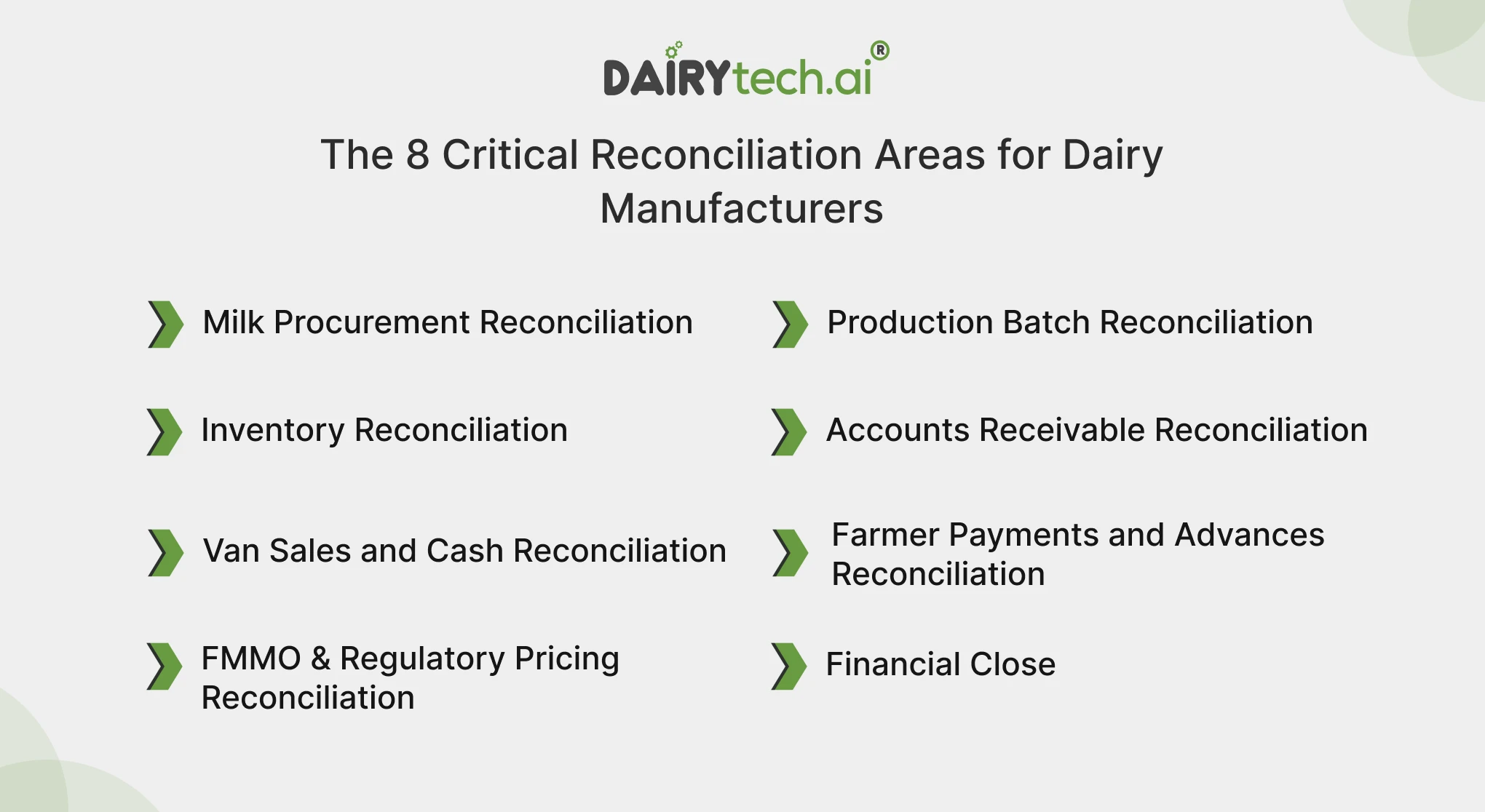
The 8 Critical Reconciliation Areas for Dairy Manufacturers
Milk Procurement Reconciliation
Every litre of raw milk received from farmers must be reconciled against:
- Farmer-wise collection records (weight or volume)
- FAT/SNF quality test results
- Agreed pricing per component
- Advance payments or deductions made during the month
- Farmer payout totals vs. ledger entries
In manual systems, this means cross-referencing paper collection slips with lab test logs and payment vouchers. Errors in FAT/SNF reading alone can create significant payout discrepancies and trigger farmer disputes.
How DairyTech automates it: DairyTech auto-captures milk inflow per farmer with IoT-integrated quality testing (FAT/SNF). Every collection is priced in real time against configured rate cards. Farmer ledgers update automatically, and month-end procurement reconciliation becomes a single report — not a five-day manual exercise.
Production Batch Reconciliation
Every batch processed during the month must be closed with:
- Raw material consumed (milk, additives, packaging) vs. Bill of Materials (BOM)
- Actual yield vs. standard yield
- Yield variance explanations (CIP losses, evaporation, changeover waste)
- Byproduct quantities (whey, cream) captured and valued
- Batch-level cost per unit calculated
This is where most dairy manufacturers lose money silently. A 1–2% yield loss per batch, undetected across 30 days, becomes significant by month-end.
How DairyTech automates it: DairyTech tracks every batch against the BOM in real time. Yield variances trigger alerts the moment they exceed configured thresholds, not at month-end. By close, every batch is already reconciled with actual vs. standard costs, byproduct weights, and variance notes.
Related reading: How DairyTech Helps Reduce Yield Losses in Dairy Production
Inventory Reconciliation
Physical inventory must match the system ledger at month-end across the following:
- Finished goods (by SKU, batch, and location)
- Raw material stock (milk in silos, packaging materials, additives)
- Work-in-progress (milk in processing)
- Expiry write-offs and near-expiry provisions
- Cold room and warehouse stock at each location
Manual inventory counts in dairy are especially painful because stock moves fast, shifts happen 24/7, and cold rooms are unpleasant places for clipboards.
How DairyTech automates it: DairyTech maintains a live inventory ledger that updates with every production batch, dispatch, and return. Expiry monitoring flags near-expired stock automatically. Month-end stock take becomes a verification exercise, not a discovery exercise, drastically reducing surprises.
Accounts Receivable Reconciliation
Every invoice raised during the month must be reconciled against:
- Payments received (bank, UPI, cash, cheque)
- Distributor and retailer outstanding balances
- Credit notes issued (returns, quality rejections)
- Aging buckets: current, 30-day, 60-day, 90-day+
- Credit limit breaches and collections escalations are needed
In dairy, distributors often receive product daily but pay weekly or monthly. Keeping accurate AR at month-end, especially with large distributor networks, is a significant challenge.
How DairyTech automates it: Automated invoicing on every dispatch. Payment matching via integrated payment gateways (Stripe, PayPal, Authorize.net). Real-time AR aging dashboards. Credit limit alerts sent before, not after, the breach. Month-end AR reconciliation is a sign-off, not a scramble.
Van Sales and Cash Reconciliation
Driver-led van sales create one of the messiest reconciliation challenges in dairy:
- Van loaded inventory vs. inventory returned (unsold stock)
- Invoices raised on route vs. deliveries made
- Cash collected by driver vs. cash deposited
- Short deliveries, substitutions, or damaged goods
- Driver-level P&L for the month
According to DairyTech’s own data, cash mismatches from van sales are responsible for revenue leakage and up to 60% higher audit costs when managed manually.
How DairyTech automates it: Each driver uses DairyTech’s mobile POS app. Every delivery generates a digital invoice. Cash collected is logged in-app and reconciled against deposits automatically. Van-level inventory is tracked from load to return. Month-end van reconciliation closes with a report, not a confrontation.
Farmer Payments and Advances Reconciliation
Beyond procurement volumes, dairy manufacturers must reconcile the following:
- Total milk value due to each farmer
- Advances paid during the month
- Deductions (feed, veterinary services, equipment loans)
- Net payment due vs. payment made
- Any disputed collections requiring resolution
Farmer payment disputes are one of the leading causes of supply disruption in dairy. Inaccurate or late reconciliation erodes trust.
How DairyTech automates it: DairyTech maintains a digital farmer ledger with every collection, test result, advance, and deduction recorded in real time. Month-end statements are generated automatically. Farmers receive transparent digital records, eliminating disputes before they start.
FMMO and Regulatory Pricing Reconciliation (US Markets)
For US dairy manufacturers operating under Federal Milk Marketing Orders:
- Class utilization (Class I, II, III, IV) must be calculated and reported
- Component-based settlement (butterfat, protein, other solids, nonfat solids) must reconcile
- Over-order premiums and deductions must be applied correctly
- Monthly producer statements must be generated within regulatory deadlines
Manual FMMO reconciliation is both tedious and high-stakes; errors result in regulatory penalties and producer underpayment or overpayment.
How DairyTech automates it: DairyTech’s FMMO pricing module automates class calculation, component-based settlement, and producer statement generation. Compliance reports are ready at close, not after a week of manual calculations.
Financial Close: P&L, Cost of Goods Sold, and Balance Sheet
The final layer ties it all together:
- Cost of goods manufactured (raw milk cost + processing + packaging + overhead)
- Cost of goods sold per product category
- Gross margin by SKU or product line
- Accruals for outstanding farmer payments and distributor credits
- Bank reconciliation against all cash movements
- Integration with accounting software (QuickBooks, Xero)
How DairyTech automates it: Because every upstream process — procurement, production, inventory, sales, van delivery — feeds into a single system, COGS calculates automatically. Integrated with QuickBooks and Xero, journal entries post without manual data entry. The finance team reviews and approves rather than builds from scratch.
External resource: AICPA: Month-End Close Best Practices for Manufacturing
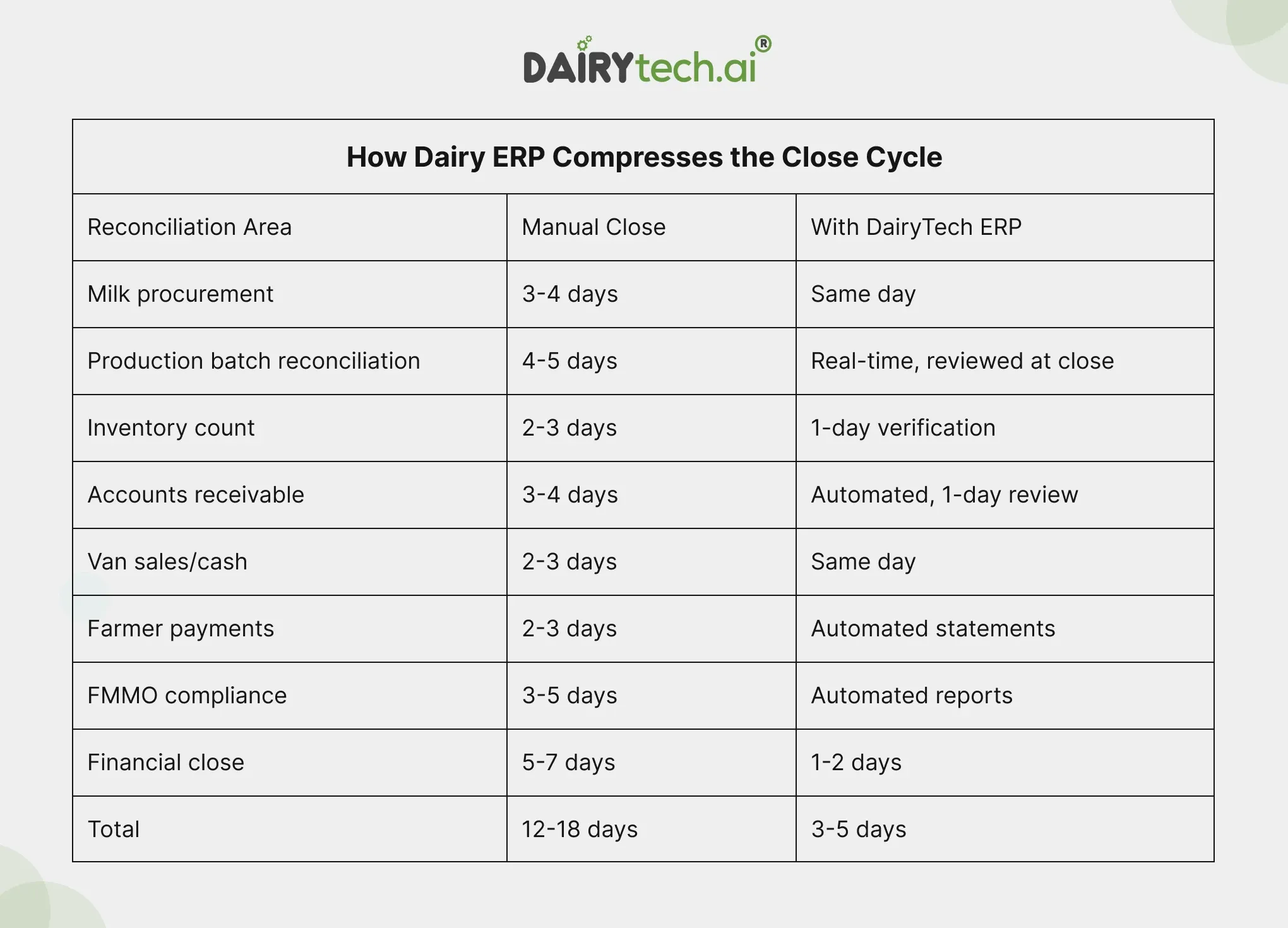
How Dairy ERP Compresses the Close Cycle
Here is a typical comparison between manual and ERP-driven close cycles for a mid-sized dairy manufacturer:
5 Signs Your Dairy Business Needs ERP-Driven Close Automation
- Your close takes more than 7 days, and the last few days are always the most chaotic.
- You discover errors after close; adjustments and restatements are common.
- Finance depends on operations for data, and ops doesn’t prioritize finance deadlines.
- Van sales cash never quite reconciles; small differences are written off rather than investigated.
- Farmer disputes spike at month-end because payment calculations can’t be easily verified.
If any of these resonate, the root cause is almost always disconnected systems and manual data entry, not your team’s capability.
What to Look for in a Dairy ERP for Month-End Close
Not all ERP systems handle dairy-specific reconciliation well. When evaluating a dairy ERP for close automation, look for the following:
- Dairy-native data model: The system should natively understand FAT/SNF-based pricing, batch yields, byproduct tracking, and van sales, not require custom configuration of a generic ERP.
- Real-time ledger updates: Every transaction, including collection, batch, dispatch, and payment, should post to the ledger immediately, not in batch uploads.
- Integrated accounting: Native integration with QuickBooks or Xero (not an Excel export) ensures the financial ledger stays in sync throughout the month.
- IoT connectivity: Integration with flow meters, quality analyzers, and weigh bridges removes manual data entry at the source.
- Audit-ready reports: Month-end reports should be structured for auditor consumption, not internal review only.
DairyTech is purpose-built for exactly this. Trusted by 100+ dairy brands, it connects every stage of your operation, from milk collection to financial close, in a single platform.
Ready to Cut Your Close Cycle in Half?
Stop chasing data at month-end. DairyTech gives your finance team real-time visibility into procurement, production, inventory, and sales, so close becomes a review, not a reconstruction.
Book a Discovery Call with DairyTech
Frequently Asked Questions (FAQs)
Q1. What is the month-end close in dairy manufacturing?
A1. Month-end close is the process of reconciling all financial and operational data from the prior month, including milk procurement, production batches, inventory, sales, and payments, to produce accurate financial statements. In dairy, this is more complex than most industries due to perishability, variable input quality, and cash-heavy distribution.
Q2. How long should the month-end close take for a dairy manufacturer?
A2. With manual processes, most mid-sized dairy businesses take 10–18 days to close. With an integrated dairy ERP, this can be compressed to 3–5 days because data is captured in real time throughout the month.
Q3. What is the biggest reconciliation challenge specific to dairy?
A3. Milk procurement reconciliation (FAT/SNF-based pricing across multiple farmers) and van sales cash reconciliation are consistently the most time-consuming and error-prone areas in the dairy month-end close.
Q4. Can dairy ERP replace QuickBooks or Xero?
A4. Not necessarily, and most dairy businesses don’t need it to. DairyTech integrates with QuickBooks and Xero, so your existing accounting software continues to be the financial record of truth while DairyTech handles all the dairy-specific operational data and feeds it in automatically.
Q5. What is FMMO reconciliation, and does dairy ERP handle it?
A5. FMMO (Federal Milk Marketing Order) reconciliation is required for US dairy manufacturers to calculate class utilization and component-based producer settlements per federal regulations. DairyTech’s FMMO pricing module automates this calculation and generates compliant producer statements at month-end.
Q6. How does dairy ERP handle yield variance reconciliation?
A6. DairyTech tracks actual yield per batch against the standard BOM in real time. Any variance beyond configured thresholds triggers an alert during the month, so by month-end, variances are already identified, explained, and documented, not discovered.
Q7. Is a dairy ERP suitable for small and mid-sized dairies or only large operations?
A7. DairyTech is designed for dairy businesses of all sizes. The platform is configurable to your scale, and most businesses go live within 6 weeks. Pricing is designed to be accessible without enterprise-level costs.
Q8. What data does finance need from operations to close the books?
A8. Finance needs: total milk procured per farmer, production batch records with actual yields and costs, finished goods inventory counts, all dispatch and delivery records, van sales cash collected, and outstanding customer balances. With DairyTech, all of this is available in real time — no data requests to operations needed at month-end.