Every dairy order is a race against the clock.
A retailer places a bulk yogurt order on Monday morning. By Tuesday afternoon, it needs to be picked, packed, invoiced, and loaded, because Wednesday is the last viable day before shelf-life restrictions kick in. Meanwhile, three more orders just came in from distributors, a van driver is reporting a partial return of near-expiry milk pouches, and your production team says the latest batch ran low on fat content.
This is the daily reality of running a perishable product business. Unlike general goods, perishable dairy orders cannot simply be queued, processed, and shipped at leisure. Every step, from order placement to proof of delivery, is time-sensitive, compliance-sensitive, and margin-sensitive.
This is where a purpose-built dairy ERP system changes the equation. Rather than juggling spreadsheets, WhatsApp messages, and disconnected tools, dairy businesses can manage every perishable order from a single, real-time platform, with full visibility, automated controls, and the speed that perishable logistics demands.
Why Perishable Order Management Is Different
Before understanding how a dairy ERP helps, it’s worth noting what makes perishable order management uniquely complex.
Generic order management systems are built for predictable products: an order comes in, inventory is checked, the item ships, and the cycle repeats. For perishable dairy products, that model breaks down immediately.
Pasteurized milk may have a 7–14 day shelf life. Fresh cream or paneer may have even less. Customers, whether retailers, distributors, or foodservice operators, expect products to arrive with enough remaining shelf life to be commercially viable, typically at least 50–70% of the total shelf life intact at the point of delivery. This means that from the moment an order is placed, the ERP must not just ask, “Do we have stock?” But “do we have stock that will still be fresh when it arrives?”
Add in cold chain requirements, demand volatility, multi-channel order flows (retail, wholesale, van sales, direct-to-consumer), and strict food safety regulations, and you have an order management challenge that no generic tool is designed to handle.
According to the FDA’s FSMA Rule 204 on Food Traceability, dairy manufacturers must maintain detailed lot-level traceability records for all perishable food items, making ERP-level traceability not just a convenience but a legal requirement.
Key Challenges in Perishable Dairy Order Management
Short Shelf Lives Leave No Room for Error
A delayed shipment, a mispicked batch, or an overlooked expiry date can render an entire order unsellable. Without real-time visibility into shelf life at the SKU and lot levels, businesses are forced to rely on manual checks, creating risk at every touchpoint.
Multi-Channel Order Complexity
Dairy businesses typically serve multiple customer types simultaneously: retail chains, wholesale distributors, HORECA (hotels, restaurants, and catering) clients, and van-sale routes. Each channel has different order frequencies, minimum quantities, delivery windows, and pricing structures. Without a unified system, orders fall through the cracks, are duplicated, or are processed out of priority.
Order Cutoff Times and Production Alignment
For same-day or next-day delivery of perishables, order cutoff times matter enormously. If a retail order arrives after the production run has already been allocated, the business either scrambles to fulfill it or disappoints the customer. Without ERP-level integration between order management and production scheduling, these misalignments are constant.
Demand Volatility and Over- or Under-Ordering
Perishable demand fluctuates sharply, driven by seasonality, promotions, weather, and consumer behavior. Overproduction leads to spoilage. Underproduction leads to stockouts and lost sales. Neither is acceptable in a margin-sensitive business.
Returns, Shorts, and Near-Expiry Claims
Perishable returns are common and complex. A retailer may return near-expiry goods, a driver may bring back unsold stock from a van route, or a customer may claim they received product close to expiry. Without proper tracking, these events create financial discrepancies, inventory inaccuracies, and disputes.
Ways Dairy ERP Helps Manage Perishable Order Management
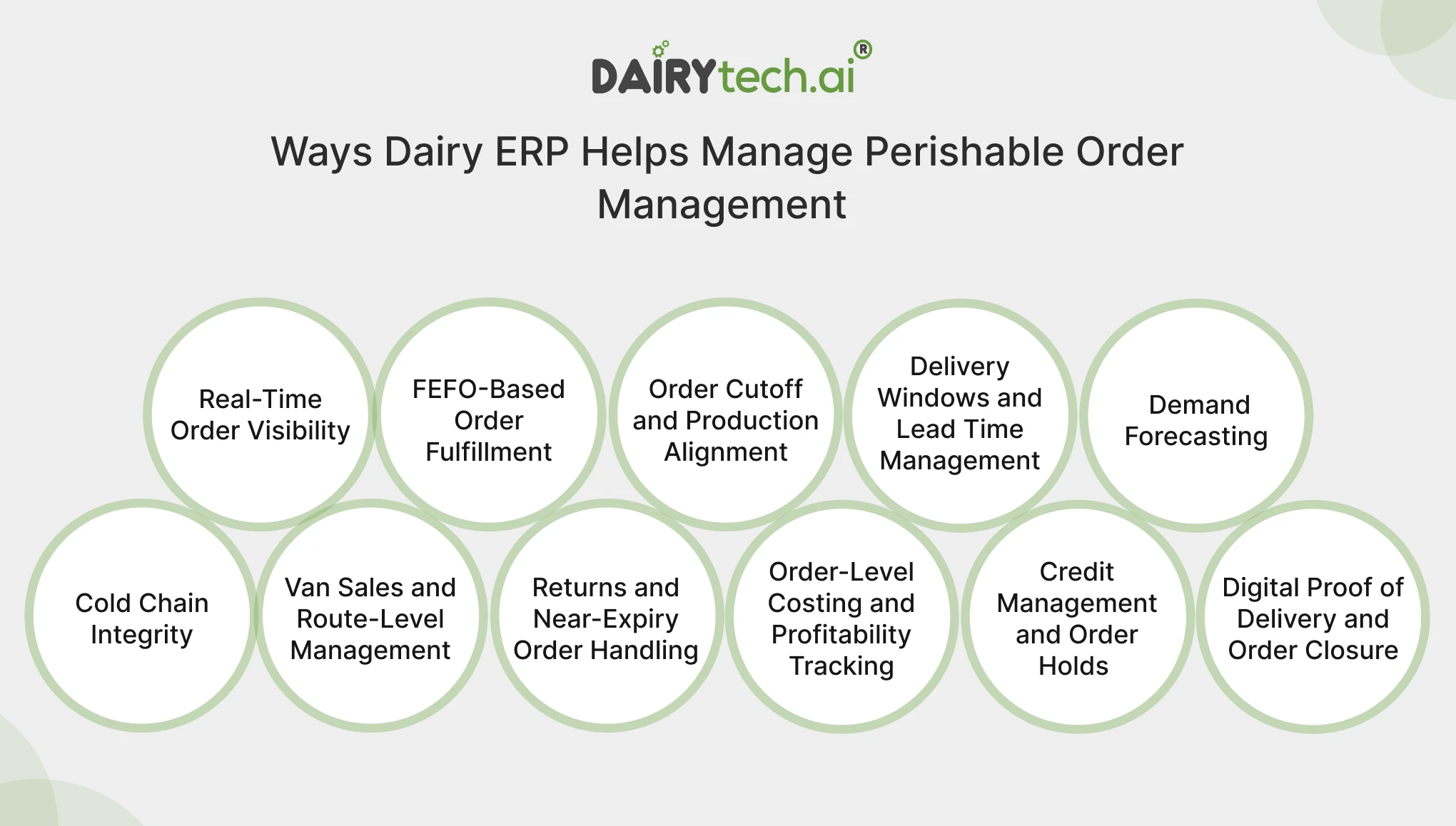
Real-Time Order Visibility Across All Channels
A dairy ERP consolidates orders from all channels, including retail, wholesale, distributor portals, and van sales, into a single dashboard. Sales teams, production planners, and logistics managers can all see the same live picture: which orders are pending, which are allocated, which are dispatched, and which are overdue.
This real-time visibility eliminates the “who confirmed what” chaos that plagues teams relying on email threads and phone calls. Every order has a timestamp, a status, and a clear owner.
Book a discovery call with DairyTech to see how real-time order management works in practice for your operation.
FEFO-Based Order Fulfillment
FEFO (First Expiry, First Out) is the fundamental rule of perishable order fulfillment, and a dairy ERP enforces it automatically.
When an order is placed, the system identifies the lot or batch with the earliest expiry date that still meets the customer’s minimum shelf-life requirement. It then allocates that stock to the order, ensuring nothing sits in the warehouse getting closer to expiry while newer stock gets shipped instead.
This is a step beyond FIFO (First In, First Out). FEFO accounts for batch-level variability because two batches manufactured on different days may have different expiry dates based on raw milk quality, processing conditions, or packaging. FEFO-based fulfillment systematically protects both product freshness and your margins. Learn how DairyTech manages this end-to-end in How Does Dairy ERP Manage Expiry Dates and Shelf Life?
Automated Order Cutoff and Production Alignment
One of the most underappreciated features of a dairy ERP is its ability to connect order cutoff times directly to production scheduling. When an order is placed, the system checks whether the requested quantity and delivery date can be fulfilled from existing stock. If not, it triggers a production flag so planners can act before the cutoff window closes.
This alignment eliminates last-minute scrambles. Production knows what needs to be made and by when. Logistics knows when the products will be ready for loading. And the customer gets a confirmed delivery window rather than a vague “we’ll try.”
Customer-Specific Delivery Windows and Lead Time Management
Different customers have different requirements. A supermarket chain may require deliveries between 4 AM and 8 AM, with a minimum of 10 days’ remaining shelf life. A restaurant client may accept a 5-day shelf life but needs next-day delivery. A wholesale distributor may order weekly with 48-hour lead times.
A dairy ERP stores these parameters at the customer level and applies them automatically at the order stage. This means the system won’t let an order be confirmed if the available stock can’t meet the customer’s shelf-life requirement or if the delivery window conflicts with the available route schedule.
This reduces customer complaints, return claims, and compliance risks without adding manual checking work.
Demand Forecasting to Drive Smarter Order Planning
Perishable order management begins before the order is placed. If production is misaligned with demand, either there’s nothing to ship, or there’s too much stock aging in the warehouse.
Dairy ERP systems use historical order data, seasonal trends, and promotional calendars to generate demand forecasts at the SKU level. These forecasts feed directly into production planning, so the right volumes are produced at the right time, reducing both stockouts and waste.
According to Shopify’s 2026 Guide on Perishable Inventory Management, businesses that implement demand forecasting for perishables reduce spoilage-related losses by up to 25%, while improving order fill rates significantly.
For more on how DairyTech manages logistics downstream from orders, see How Does Dairy ERP Simplify Logistics and Distribution Processes?
Cold Chain Integrity Linked to Order Status
What happens to an order if the refrigerated truck breaks down mid-route? Or if cold storage temperatures spiked overnight?
In a dairy ERP with IoT integration, cold chain events are directly linked to order and batch records. If a temperature deviation is detected in a storage unit, the system can flag all orders allocated from that unit, hold them for quality review, and notify the relevant team before the compromised product reaches the customer.
This proactive control is only possible because the ERP connects quality data, inventory data, and order data in a single system. Learn more about how this works in How Cold Chain Monitoring in Dairy ERP Prevents Spoilage & Reduces Waste.
Is your cold chain connected to your order management system? Talk to a DairyTech expert to find out what’s possible.
Van Sales and Route-Level Order Management
For dairy businesses operating van sales or route-based delivery, order management extends to the driver level. Drivers load stock in the morning, make deliveries on a fixed route, take cash or digital payments, handle unsold returns, and reconcile at the end of the day.
Without a connected system, this process is riddled with discrepancies: cash mismatches, unrecorded returns, inaccurate inventory counts, and delayed invoicing.
A dairy ERP gives drivers a mobile app that handles all of this in real time, recording deliveries, logging returns, capturing payments, and syncing with the central system automatically. The result is a fully closed order loop, from allocation to delivery confirmation to cash reconciliation. Read more about how this works in How Dairy ERP Helps Manage Van Sales.
Returns and Near-Expiry Order Handling
Returns are an unavoidable part of perishable order management. A retailer may return stock that didn’t sell before the use-by date. A customer may reject a delivery because the remaining shelf life is shorter than agreed.
A dairy ERP handles these events systematically. When a return is logged, the system captures the reason, the batch or lot number, the remaining shelf life, and the customer details. It then determines whether the returned stock can be redistributed, sold at a discount, used for secondary processing (e.g., butter or ghee), or written off.
This structured approach prevents phantom inventory, clears disputes faster, and gives management accurate data on return rates by product, customer, and route. See How Dairy ERP Helps Businesses Handle Returns and Damage Tracking for a deeper look.
Order-Level Costing and Profitability Tracking
Not all orders are equally profitable. A large wholesale order with negotiated pricing and tight margins may be less valuable than a smaller retail order at full price. Without order-level cost visibility, businesses often can’t tell which customers, routes, or SKUs are actually profitable.
A dairy ERP captures costs at the order level, including raw material costs, production costs, packaging, logistics, and returns. This enables management to see true order profitability and make smarter decisions about pricing, minimum order quantities, and customer prioritization.
Credit Management and Order Holds to Prevent Revenue Leakage
In the dairy industry, credit terms are common, especially with distributors and retailers. But when credit limits aren’t enforced at the order stage, businesses ship product and invoice customers who may already be overdue on previous payments.
A dairy ERP integrates credit limit management with order processing. When an order is placed by a customer who has exceeded their credit limit or has overdue invoices, the system can automatically flag or hold the order, preventing revenue leakage before it happens.
This is particularly important for perishable products, where the goods cannot be easily retrieved once shipped.
Digital Proof of Delivery and Order Closure
The order isn’t complete until the customer has confirmed receipt. In a perishable business, this matters because delivery disputes are common. Did the driver leave 50 cases or 48? Was the product delivered on time? Was the temperature correct?
A dairy ERP with a driver mobile app captures digital proof of delivery: GPS-stamped timestamps, e-signatures, photo documentation, and product condition notes. These records close the order loop and provide an audit trail that resolves disputes quickly and accurately.
The Business Impact: What Changes When You Get Order Management Right
When perishable order management is handled through a purpose-built dairy ERP, the operational improvements compound quickly:
- Fewer expired write-offs because FEFO fulfillment and expiry alerts prevent old stock from sitting unshipped
- Higher order fill rates because demand forecasting aligns production with actual customer demand
- Fewer customer complaints because shelf-life requirements are enforced at the order stage, not discovered at delivery
- Faster dispute resolution because every order, delivery, and return has a complete digital record
- Better margins because order-level costing reveals which customers and products are truly profitable
- Reduced revenue leakage because credit limits and payment terms are enforced automatically
Conclusion
Managing perishable dairy orders is one of the most operationally demanding challenges in the food industry. Every order involves a clock, and the consequences of getting it wrong are expensive: wasted product, unhappy customers, compliance failures, and eroded margins.
A purpose-built dairy ERP doesn’t eliminate complexity. It makes complexity manageable by connecting order management to production, inventory, cold chain, logistics, and finance in a single real-time system. The result is faster, more accurate order fulfillment, fewer spoilage incidents, and the kind of operational control that lets a dairy business grow confidently.
DairyTech is built specifically for this challenge. Trusted by 100+ dairy brands, our platform gives you real-time visibility and automated control across every stage of the order lifecycle, from the moment an order is placed to the moment the driver gets a signed delivery confirmation.
Ready to bring order to your perishable operations? Book a free discovery call with DairyTech and see how we can transform your order management.
Frequently Asked Questions (FAQs)
Q1. What is FEFO, and why does it matter for dairy order management?
A1. FEFO stands for First Expiry, First Out. It is a stock allocation method that prioritizes dispatching products with the earliest expiry date first. For dairy, this is more accurate than standard FIFO because two batches made on the same day may have different expiry dates depending on raw milk quality and processing. A dairy ERP enforces FEFO automatically at the order fulfillment stage, reducing spoilage and ensuring customers receive product with maximum remaining shelf life.
Q2. How does a dairy ERP handle customer-specific shelf-life requirements?
A2. The ERP stores minimum shelf-life parameters at the customer level; for example, “this retailer requires at least 10 days remaining at the point of delivery.” When an order is placed, the system checks available stock against this requirement and only allocates lots that meet the criteria. If no qualifying stock is available, the system flags the gap before the order is confirmed.
Q3. Can a dairy ERP manage orders from multiple channels, such as retail, wholesale, and van sales, in one system?
A3. Yes. A purpose-built dairy ERP consolidates orders from all channels into a single dashboard. Each channel can have its own pricing rules, delivery windows, credit terms, and fulfillment logic, but they all flow through one system, giving management full visibility and control.
Q4. How does dairy ERP prevent expired products from being shipped?
A4. The system monitors expiry dates in real time across all inventory locations. Before an order is fulfilled, the ERP confirms that allocated stock will not exceed expiry during the delivery window. Automated alerts notify teams when products are approaching expiry so they can be prioritized for dispatch, redirected to faster-moving channels, or flagged for write-off. Cold chain deviations can also trigger automatic order holds before the compromised product leaves the warehouse.
Q5. What happens to returned dairy orders in the ERP?
A5. Returns are logged against the original order with details including lot number, reason for return, remaining shelf life, and customer. The system then evaluates disposition options — redistribution, secondary use (e.g., processing into butter or ghee), discount sale, or write-off — and updates inventory and financial records accordingly. This prevents phantom inventory and ensures accurate margin reporting.
Q6. How long does it take to implement a dairy ERP?
A6. Most dairy businesses go live with DairyTech within 6 weeks, including setup, data migration, user training, and testing without disrupting ongoing operations. Custom configurations may take slightly longer.
Q7. Does dairy ERP integrate with existing accounting or logistics tools?
A7. Yes. DairyTech integrates with accounting platforms like QuickBooks and Xero; payment gateways including Stripe, PayPal, and Authorize.net, and IoT devices including GPS trackers, cold room sensors, and SCADA systems. This means you don’t need to abandon existing infrastructure; you connect it.
Q8. How is dairy ERP different from a generic ERP or order management system?
A8. Generic ERP and OMS tools are built for standard goods. They don’t natively understand shelf life, FEFO, cold chain compliance, FAT/SNF-based pricing, or batch traceability, all of which are fundamental to dairy operations. A dairy-specific ERP like DairyTech is built with these requirements at its core, which means fewer workarounds, faster implementation, and more reliable outcomes.