Every carton of milk on a retailer’s shelf has a story. It began at a farm, moved through a collection point, was processed and pasteurized, packaged, stored in a cold room, loaded onto a delivery van, and eventually placed in a refrigerator case. At any point in that journey, something can go wrong, such as a temperature breach, a contamination event, a mislabeled batch, or a late payment to a farmer.
The question isn’t whether things go wrong. They do. The question is, how quickly can you find the problem, trace it back to its origin, and fix it before it harms customers or your brand?
That’s what full supply chain traceability is about. And in 2026, it’s no longer optional.
With increasing regulatory pressure from FSMA 204, rising consumer expectations around food transparency, and tighter margins across the dairy industry, dairy businesses need a single system that tracks every drop of milk from the farmer’s bulk tank to the retailer’s shelf. That system is a purpose-built Dairy ERP.
What Is Full Traceability in Dairy: And Why Does It Matter?
Traceability in the dairy supply chain means the ability to track a product, or any of its raw material components, both forward (where it went) and backward (where it came from) at every stage of its journey, from procurement through processing, packaging, distribution, and retail.
Full traceability answers critical operational questions like the following:
- Which farms supplied the milk in a particular Batch?
- Which retailers received products from that batch?
- Was there a cold chain deviation during transit on Route 7 last Tuesday?
- Which production line processed the recalled lot, and what else ran on that line that day?
Without a connected dairy ERP, answering these questions means combing through spreadsheets, paper logs, driver notes, and phone calls, a process that takes days. With one, it takes minutes.
The stakes are real. According to McKinsey, 73% of global consumers are now willing to pay more for traceable dairy products. Meanwhile, a single contamination recall can cost a dairy business millions in product destruction, logistics, and brand damage, most of which can be avoided with faster detection and response.
Stage 1: Farmer & Milk Procurement Traceability
Traceability doesn’t start at your plant gate. It starts at the farm.
Farmer-Level Data Capture
Every collection event should generate a traceable record. DairyTech’s dairy ERP captures farmer-wise milk intake data at the point of collection, including:
- Farmer ID and farm location
- Collection date, time, and route
- Quantity collected (in liters or kilograms)
- Fat % and SNF % readings
- Temperature at pickup
- Adulteration test results
- Transporter and vehicle details
This data is tied to a digital farmer passbook, a running ledger of every collection, quality reading, and payment for each supplier. When a quality issue surfaces downstream, you can immediately pull the source farm’s records and determine whether the problem originated at procurement.
Automated Quality Testing with IoT Integration
DairyTech integrates with milk analyzers, IoT sensors, and auto-testing equipment at collection points. Test results flow directly into the ERP without manual entry and transcription errors. Fat/SNF-based pricing is calculated and applied automatically, removing payment disputes between farmers and plant managers.
Want to see how DairyTech gives you full visibility from your farmers to your plant? Book a Free Consultation with our Dairy ERP Team
Stage 2: Production & Batch Traceability
Once raw milk enters your plant, the traceability chain must continue, including batch by batch and process by process.
Batch-Level Tracking Across Every Production Step
A dairy ERP assigns a unique batch ID to every production run. That batch record links:
- The raw milk lots that fed into it (with farmer-level sourcing data)
- The Bill of Materials (BOM) used, including additives, cultures, and packaging materials
- The processing equipment and production line
- Start and end times for each production step
- Quality checkpoints: pasteurization temperature and duration, pH, moisture, microbial test results
- Yield data and variance from expected yield
- Any byproducts created (e.g., whey from cheese production)
This means that if a quality anomaly is detected in finished goods, you can trace it back not just to the batch but also to the specific raw material lot, the processing shift, and even the equipment that handled it.
Yield Monitoring and Variance Alerts
Hidden yield losses are one of the most common and underreported inefficiencies in dairy manufacturing. A modern dairy ERP like DairyTech tracks actual yield vs. expected yield per batch and sends automated alerts when variances exceed defined thresholds. Catching an 8% yield loss early can recover hundreds of thousands of dollars annually.
Stage 3: Quality Control and Compliance Documentation
Traceability and quality control are inseparable. Knowing where a product came from only matters if you also know whether it met standards at every checkpoint.
QC Checkpoints Across the Entire Process
DairyTech embeds quality checkpoints at every critical stage, including raw milk intake, pasteurization, processing, filling, packaging, and pre-dispatch. Lab test results are captured directly into the ERP, whether entered manually by QC staff or imported automatically from connected lab instruments.
Audit-Ready Compliance Reports
Dairy businesses face compliance requirements from regulators, including the FDA (FSMA 204), FSSAI, and various country-specific food safety authorities. DairyTech generates audit-ready reports at the click of a button, including batch traceability logs, temperature records, supplier documentation, and quality test histories.
FSMA 204 and Forward/Backward Traceability
FSMA Rule 204, the FDA’s Food Traceability Rule, mandates that food businesses maintain records of Critical Tracking Events (CTEs) and Key Data Elements (KDEs) throughout the supply chain. While the enforcement date has been extended to July 2028, businesses that implement compliant traceability systems now will be better positioned competitively and operationally.
DairyTech’s bidirectional batch traceability, both forward trace (where did this batch go?) and backward trace (what went into this batch?), is directly aligned with FSMA 204’s requirements for dairy products, including soft and semi-soft cheeses.
Preparing for FSMA 204 compliance? Talk to a DairyTech expert about audit-ready traceability.
Stage 4: Inventory Management and Cold Chain Traceability
Perishable dairy products live and die by temperature. A batch that’s perfectly manufactured can still become a liability if the cold chain is broken during storage or transit.
Real-Time Cold Chain Monitoring
DairyTech integrates with cold room sensors, GPS temperature trackers, and IoT monitoring devices to give you live visibility into storage conditions across your warehouse, cold rooms, and refrigerated vehicles. When a temperature deviation occurs, the system triggers an automated alert, so your team can act before the product is compromised, not after.
Expiry and Shelf-Life Tracking
Every SKU in DairyTech’s inventory module carries a manufacturing date, batch number, and expiry date. The system automatically flags stock approaching expiry, applies FEFO (First Expired, First Out) logic to picking and dispatch, and generates spoilage risk alerts before losses occur.
Lot-Level Inventory Visibility
Beyond knowing how much stock you have, DairyTech tells you which lots are in which locations — down to the cold room bay or pallet position. This granularity is what makes rapid recalls possible. Instead of withdrawing an entire product category, you can isolate and pull only the affected lots.
Stage 5: Recall Management and Crisis Response
No dairy business wants to issue a recall. But when it happens, the speed of your response is the difference between a manageable event and a brand-damaging crisis.
Trace-Forward Recall Execution
With DairyTech’s traceability data, your team can identify every retailer, distributor, and delivery route that received products from an affected batch within minutes, not days. You get a complete downstream map: which customers received the product, in what quantities, and when.
Trace-Back Root Cause Investigation
Simultaneously, the system lets you trace backward: which farms contributed milk to the affected batch, which production line and shift processed it, and whether the same raw materials appeared in other batches. This accelerates root cause identification and prevents the same issue from recurring.
AI-Driven Anomaly Detection
DairyTech’s AI layer monitors production and quality data in real time, flagging statistical anomalies before they escalate into safety events. This predictive capability is the difference between catching a contamination risk in-plant vs. discovering it post-distribution.
Stage 6: Distribution, Van Sales, and Last-Mile Traceability
Traceability doesn’t end when the product leaves your warehouse. The last mile, delivery to distributors, retailers, and direct customers, is where many dairy businesses lose visibility entirely.
Route-Level and Van-Level Inventory Tracking
DairyTech’s van sales module tracks inventory at the individual vehicle level. Each van is loaded with a specific set of batch-traced products, and every sale, return, or unsold item is logged against the van’s route and the driver’s POS app. This creates an unbroken chain of custody from plant to point of delivery.
E-Proof of Delivery (ePOD)
Every delivery is confirmed with a digital proof of delivery that is timestamped, geo-tagged, and linked to the batch records of the products delivered. If a retailer later reports a quality issue with a specific product, you can immediately trace it to the van, route, batch, and farm of origin.
Retailer and Distributor Account Management
DairyTech’s CRM and finance modules maintain complete delivery and payment histories for every retailer and distributor account. Combined with batch traceability data, this creates a full audit trail that covers every commercial and product movement across your distribution network.
See DairyTech’s end-to-end traceability in action. Schedule a Live Demo of the Platform
Stage 7: Consumer Transparency and Digital Labeling
Modern consumers want to know where their food comes from. This isn’t just a marketing opportunity; it’s increasingly a competitive differentiator and regulatory expectation.
QR Code and Batch Code Traceability for Consumers
Dairy businesses using DairyTech can generate batch-level QR codes for product packaging that allow consumers to verify the origin of their product, which farm the milk came from, when it was processed, and what quality checks it passed. This kind of consumer-facing transparency builds brand trust and commands premium pricing.
Supporting Export and International Market Compliance
If you export dairy products, traceability documentation is a non-negotiable requirement in most international markets, from EU food safety standards to Gulf Cooperation Council (GCC) import regulations. DairyTech’s audit-ready reports and batch documentation meet the requirements of most major export markets, reducing the administrative burden of cross-border trade.
Stage 8: Sustainability, ESG Reporting, and Responsible Sourcing
Sustainability is no longer a differentiator — it’s a baseline expectation from retailers, institutional buyers, and investors. And sustainability starts with traceability.
Carbon Footprint Tracking Across the Supply Chain
When you have granular data on every stage of production, from farm feed inputs to delivery route miles, you can calculate and report on the carbon footprint of your dairy products. DairyTech’s data infrastructure provides the foundation for emissions reporting aligned with emerging ESG standards in the food industry.
Responsible Farmer Sourcing Documentation
Many retailers and large food service customers now require their dairy suppliers to demonstrate responsible sourcing practices, such as fair payments, quality standards, and consistent engagement with a verified supplier network. DairyTech’s farmer management module maintains a documented record of every farmer relationship, payment, and quality event, providing the evidence trail your procurement customers require.
How DairyTech Delivers End-to-End Traceability on One Platform
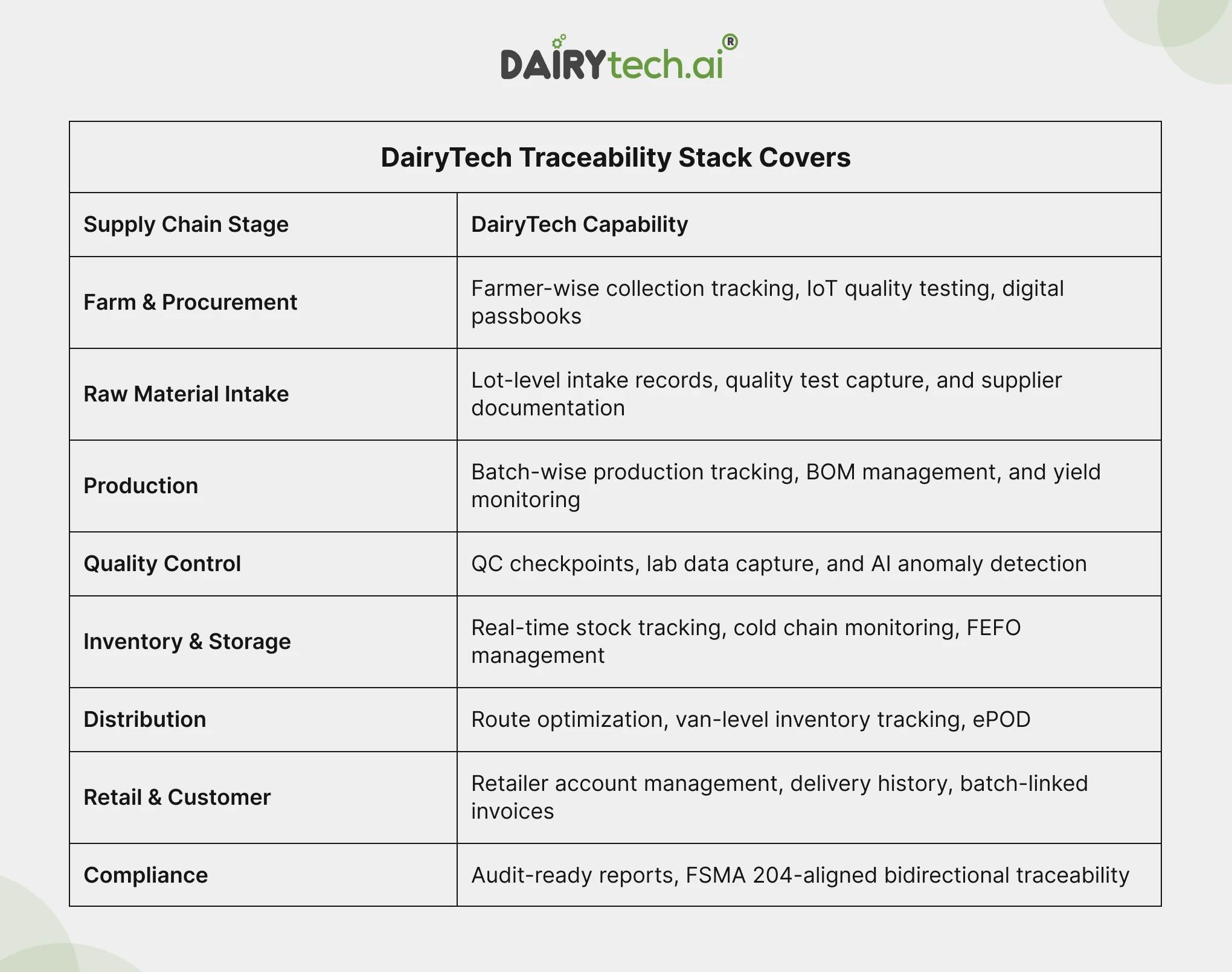
Unlike generic ERP systems bolted together with third-party integrations, DairyTech is built from the ground up for dairy operations. Every module, from farmer payment to retailer delivery, is natively connected. The traceability data flows automatically across all the stages without manual data transfers or reconciliation.
Here’s what the DairyTech traceability stack covers end-to-end:
Real Results: How Haribol Transformed Operations with DairyTech
Haribol, a fast-growing dairy brand, was running operations across disconnected systems — spreadsheets, legacy software, and paper logs. Production visibility was limited, farmer disputes were frequent, and traceability was reactive rather than proactive.
After implementing DairyTech:
- 2x improvement in operational efficiency
- 8% reduction in yield losses — directly improving margins
- 95% reduction in farmer payment disputes — thanks to automated, transparent payment calculations
These numbers reflect what happens when traceability is built into operations, not bolted on as an afterthought.
Want results like Haribol? Read the Full Case Study
The Bottom Line: Traceability Is a Business Asset, Not a Compliance Checkbox
Dairy businesses that treat traceability as a regulatory burden will always be behind. Those who treat it as an operational asset, a source of real-time intelligence that reduces waste, protects margins, enables faster recalls, and builds customer trust, will lead their market.
DairyTech is the only dairy-specific ERP platform designed to connect every stage of your supply chain, from the farmer’s collection point to the retailer’s shelf, on a single, unified system. Trusted by 100+ dairy brands, it delivers the real-time visibility and control that modern dairy operations demand.
Ready to build a fully traceable dairy supply chain? Consult with the DairyTech Team Today
Frequently Asked Questions
Q1. What is traceability in the dairy supply chain?
A1. Traceability in dairy means the ability to track a product and all the raw materials that went into it both forward and backward across every stage of the supply chain. Full traceability connects farmer milk collection, processing, batching, quality control, storage, and delivery into a single, linked chain of data. A dairy ERP automates the processes and makes the business audit-ready.
Q2. Why is traceability important for dairy businesses?
A2. Traceability protects your business in multiple ways: it enables fast, targeted recalls that minimize costs and public health risk; it supports regulatory compliance (including FSMA 204 and international food safety standards); it reduces spoilage and waste through better cold chain monitoring; and it builds consumer and retailer trust in an era where food provenance is increasingly important.
Q3. What is FSMA 204, and how does it affect dairy businesses?
A3. FSMA Rule 204 is the FDA’s Food Traceability Rule, which requires food businesses to track Critical Tracking Events (CTEs) and Key Data Elements (KDEs) at each stage of their supply chain. Several dairy products, including soft and semi-soft cheeses, are listed under FSMA 204. The enforcement deadline has been extended to July 2028, giving dairy businesses time to implement compliant systems. DairyTech’s bidirectional traceability is designed to meet these requirements.
Q4. How does a dairy ERP enable recall management?
A4. With batch-level traceability, a dairy ERP can identify within minutes exactly which products and lots are affected by a recall, where they were distributed, and which customers received them, enabling targeted product withdrawal. Simultaneously, backward traceability identifies the root cause at the source, whether at the farm level, in production, or in the cold chain. Without a dairy ERP, this process can take days and usually results in much broader, more costly expenditures.
Q5. Can DairyTech trace products all the way back to individual farmers?
A5. Yes. DairyTech captures farmer-wise milk collection data at the point of procurement, including quality parameters, quantity, and collection time. This data is linked to production batches so that any downstream quality issue can be traced directly back to the farm of origin. Farmers also benefit from digital passbooks and transparent payment records tied to the same data.
Q6. How long does it take to implement DairyTech’s dairy ERP?
A6. Most dairy businesses go live with DairyTech within 6 weeks, covering system setup, data migration, training, and pilot testing. The implementation process is structured in six stages: Discovery & Process Mapping, System Setup & Configuration, Data Migration & Integration, Training & User Onboarding, Testing & Pilot Run, and Go-Live & Support.
Q7. Does DairyTech support cold chain traceability for perishable products?
A7. Yes. DairyTech integrates with cold room sensors, GPS temperature trackers, RFID smart shelves, and IoT monitoring devices. The system provides real-time temperature alerts, logs temperature data against specific lots and routes, and uses AI-driven spoilage prediction to flag risks before they result in product loss.