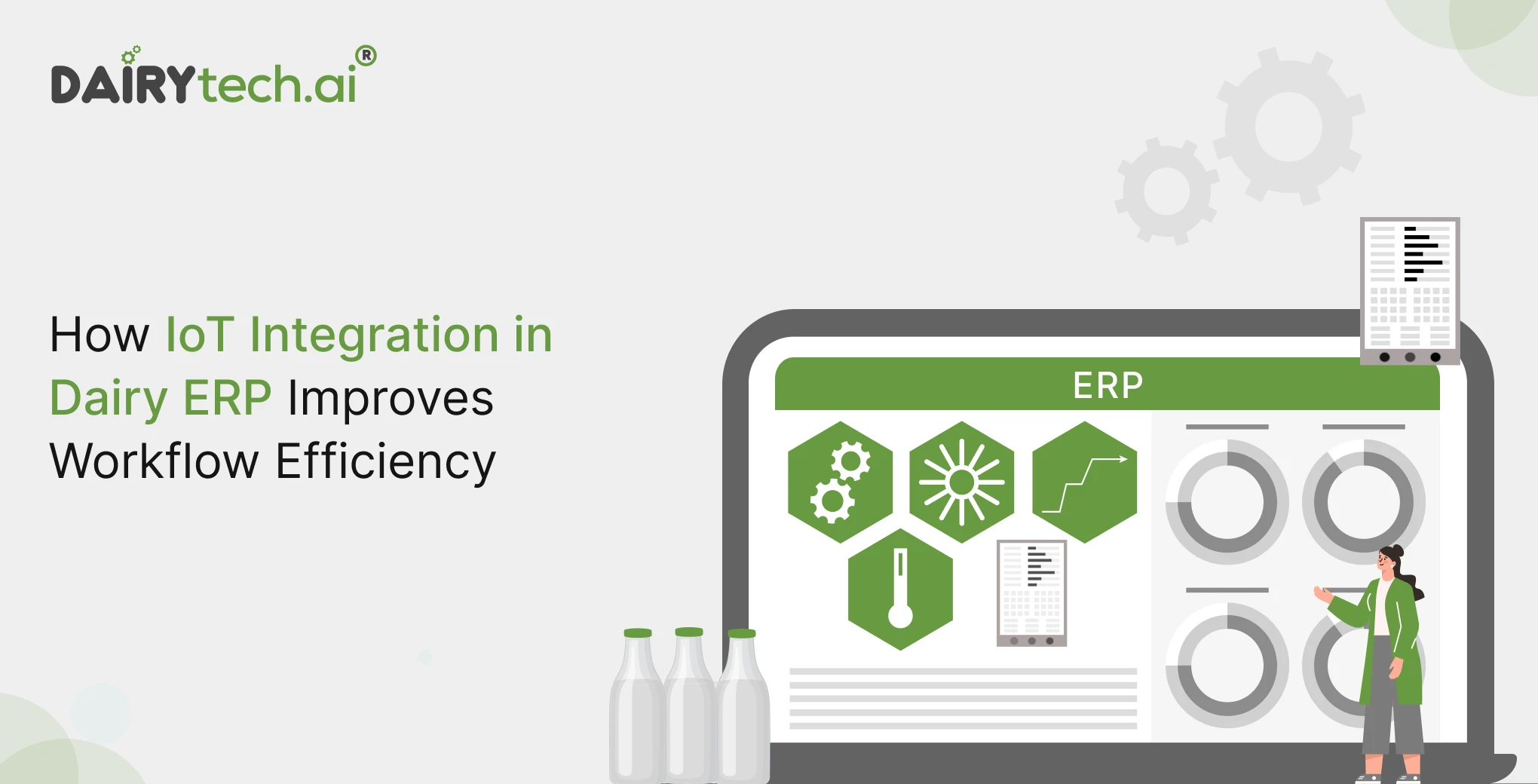
The dairy industry has heard the promise of IoT for years. Smart sensors. Connected devices. Real-time dashboards. But for operations running tight margins, whether a mid-size milk processing plant or a large cooperative, the real question isn’t can you integrate IoT with your Dairy ERP?”
It’s where it actually pays off?
This guide cuts through the noise. We walk you through the specific integration points between IoT devices and Dairy ERP systems that generate genuine operational value, flag where the ROI case is weak, and show you what to prioritize if you’re just getting started.
What Is IoT-ERP Integration in Dairy Operations?
IoT-ERP integration in dairy means connecting physical sensors, devices, and monitoring equipment across the processing plant, cold chain, and distribution network directly to your Enterprise Resource Planning (ERP) system. Instead of staff manually logging temperature readings, milk fat content, or tank levels, the sensor does it automatically and in real time, and the ERP acts accordingly: triggering alerts, updating records, generating compliance reports, or adjusting procurement schedules.
The hardware side includes temperature loggers, flow meters, RFID tags, GPS trackers, weighing scales, automated milk analyzers, and energy monitors. The ERP side includes modules for procurement, quality management, production planning, inventory, distribution, and finance.
Where the two meet, that’s where the magic (and the value) happens.
Cold Chain Monitoring: The Highest-ROI Integration Point
Cold chain failure is one of the costliest problems in the dairy industry. A single temperature excursion between intake and the plant, within cold storage, or during distribution can spoil an entire batch, trigger a recall, or result in regulatory non-compliance.
Where IoT makes sense here:
- Milk intake and receiving docks: Automated temperature checks at the point of intake, synced with ERP procurement records, eliminate manual-entry errors and create an auditable chain of custody before milk enters the plant.
- Cold stores and silos: Continuous wireless temperature sensors across storage tanks and cold rooms log readings at configured intervals. If temperatures drift outside acceptable ranges, the ERP flags the affected stock, prevents it from being allocated to premium product lines, and alerts the quality manager instantly.
- Refrigerated transport vehicles: GPS-enabled temperature data loggers transmit real-time readings to the ERP during transit. Deviations trigger instant alerts to fleet managers and are logged against each consignment for traceability.
- Finished goods cold storage: Temperature monitoring tied to the ERP’s inventory module creates a complete cold chain record from production to dispatch — essential for large retail and institutional customers requiring proof of temperature control.
The result? Fewer rejected batches, faster incident response, and cold chain data that’s ready for FSSAI, FDA, or EU compliance audits at the click of a button, not a week of manual record-pulling.
Ready to tighten your cold chain traceability? Talk to a Dairytech ERP Specialist
Milk Quality Sensors and Automated Lab Integration
Manual milk testing is slow, prone to transcription errors, and creates bottlenecks at intake. IoT-connected inline milk analyzers to measure fat, SNF (solids-not-fat), protein, lactose, and adulterants change this equation entirely.
Where IoT makes sense here:
- Collection center and plant intake: Inline analyzers at intake points automatically send quality readings to the ERP. The system calculates payment rates based on fat and SNF content, updates the supplier ledger, and generates payment advice, all without human intervention.
- In-process quality checkpoints: Quality readings from inline sensors at key production stages (post-pasteurization, post-standardization) flow directly into ERP quality management modules. Out-of-spec product is quarantined digitally before it progresses further in the production stream.
- Batch traceability: Quality readings are linked to specific batch IDs, lot numbers, and supplier codes, enabling end-to-end traceability from intake to finished product.
What you avoid: Manual errors, disputes over payment calculations, and compliance with paper-based quality records.
Where it’s weak: Smaller operations processing fewer than 5,000 liters per day may not see sufficient ROI to justify the cost of inline analyzers. Portable handheld testers synced via Bluetooth to the ERP can be a more cost-effective middle ground.
Production Line Automation and Real-Time OEE Tracking
On the processing plant floor, IoT sensors attached to pasteurizers, homogenizers, separators, and filling lines feed real-time operational data into the ERP’s production management module.
Where IoT makes sense here:
- OEE (Overall Equipment Effectiveness) tracking: Sensors measure machine uptime, speed, and quality output in real time. ERP calculates OEE automatically and flags underperforming lines before the shift ends, not after the weekly review meeting.
- Automated batch recording: Flow meters and weight sensors auto-populate batch production records in the ERP, reducing manual data entry and ensuring accurate yield calculations.
- CIP (Clean-In-Place) monitoring: Sensors verify that cleaning cycles reach the correct temperature and chemical concentration, and the ERP logs compliance data for food safety audits automatically.
- Energy metering per production run: Attaching energy meters to individual production lines and syncing data to the ERP’s cost accounting module reveals exactly how much power each product SKU consumes, enabling more accurate product costing.
Where it’s weak: If your ERP’s production module isn’t already set up with proper BOM (Bill of Materials) structures and routing, adding IoT data on top will create confusion rather than clarity.
Milk Procurement Automation at Collection Centers
For dairy cooperatives and large processors sourcing from multiple suppliers and collection points, procurement is operationally complex. IoT integration at the collection center level simplifies it dramatically.
Where IoT makes sense here:
- RFID-tagged milk cans: RFID readers at collection centers automatically identify incoming consignments, match them to pre-registered supplier profiles in the ERP, and trigger the intake process; no manual can-number logging is required.
- Automated weighing and recording: IoT-connected weighing scales sync weight data directly to ERP procurement records, eliminating disputes and reducing processing time at collection centers.
- Inline quality-linked payment calculation: Quality analyzer data from collection centers feeds directly into the ERP’s procurement module, enabling automated fat- & SNF-based payment calculations, deduction management (loans, input supply), and bank transfer file generation, all triggered by sensor data and not spreadsheets.
The downstream payoff is fully automated supplier payment processing: accurate, transparent, and auditable without the overhead of manual data reconciliation.
Processing milk from multiple suppliers and collection points? See How Dairytech Automates Your Procurement-to-Payment Cycle
Predictive Maintenance for Dairy Equipment
Unplanned equipment downtime in dairies can be expensive, especially for time-sensitive processes, such as pasteurization and packaging. Predictive maintenance IoT changes the equation from reactive to proactive.
Where IoT makes sense here:
- Vibration and temperature sensors on compressors and motors: Anomalies in vibration frequency or operating temperature predict bearing failures and motor degradation weeks before breakdown. The ERP automatically generates a maintenance work order and schedules it during planned downtime.
- Filling machine performance monitoring: Sensors on filling lines detect micro-deviations in fill weights or sealing performance that precede more significant failures. Early alerts prevent both equipment damage and quality defects.
- Refrigeration system monitoring: For cold stores and blast freezers, sensors flag gradual degradation in refrigeration performance, allowing preventive action before product loss occurs.
- Pasteurizer and heat exchanger monitoring: Flow and temperature sensors detect fouling and efficiency drops in heat exchangers before they breach food safety thresholds, enabling planned maintenance without emergency stoppages.
The ERP link is critical here: without connecting sensor alerts to a maintenance management module, you systematically generate alerts that no one acts on. IoT without ERP integration in maintenance is just a very expensive alarm system.
Inventory Management and Raw Material Tracking
Dairy inventory is uniquely challenging. These challenges, including short shelf lives, temperature-sensitive materials, and complex multi-SKU production, mean that real-time inventory visibility is not a luxury.

Where IoT makes sense here:
- Tank level monitoring: Ultrasonic or pressure sensors on raw milk silos, ingredient tanks (cream, sugar, flavors), and packaging material stores sync live inventory levels to the ERP, enabling automated procurement triggers and preventing production stoppages due to stockouts.
- Weight-based inventory tracking: Load cells on bulk ingredient storage provide continuous inventory weight data to the ERP, replacing manual stock counts with real-time visibility.
- RFID in the finished goods warehouse: RFID tags on pallets and cases feed movement data, including putaway, picking, and dispatch, into the ERP inventory module automatically, reducing mispicks and improving FEFO (First Expired, First Out) compliance for perishable dairy SKUs.
- Packaging material consumption tracking: Sensors on filling and packaging lines track material consumption in real time, providing the ERP’s materials management module with accurate usage data and reducing packaging waste.
Want to eliminate inventory blind spots in your dairy plant? Explore Dairytech’s Real-Time Inventory Management Module
Fleet, Distribution, and Delivery IoT Integration
For dairies managing their own distribution fleet, delivering to retailers, institutions, or doorstep customers, GPS telematics and IoT integration with the ERP’s distribution module deliver measurable savings.
Where IoT makes sense here:
- Real-time delivery tracking: GPS data synced to the ERP allows customer service teams and operations managers to track deliveries in real time, reducing “where’s my order” calls and enabling proactive exception management.
- Proof-of-delivery automation: Handheld devices or in-cab tablets with RFID or barcode scanning confirm delivery and sync to the ERP instantly, triggering invoicing without manual intervention.
- Cold chain compliance during delivery: Temperature loggers in delivery vehicles provide a continuous, ERP-linked temperature record for each delivery, essential for premium and institutional customers requiring cold chain certification.
- Driver behavior and fuel efficiency: Telematics data (idling, harsh braking, and speeding) synced to ERP fleet cost modules enable fuel tracking and driver performance management.
Energy Management and Sustainability Reporting
Energy is typically one of the most costly aspects for dairy processors. IoT energy meters on key equipment, such as chillers, boilers, compressors, pasteurizers, and filling lines, provide granular, real-time visibility that aggregate utility bills simply can’t match.
Where IoT makes sense here:
- Per-product energy costing: When energy consumption is metered at the equipment level and linked to production runs in the ERP, you can calculate energy cost per liter of milk, per kilogram of butter, or per unit of cheese, enabling accurate product-level profitability analysis.
- Peak demand management: Real-time energy data helps operations teams avoid demand peaks that incur penalty charges.
- Water and steam consumption monitoring: Flow meters on water and steam lines provide the ERP’s cost module visibility into utilities consumption by production area or product line, which is critical for reducing waste and improving plant efficiency.
- ESG and sustainability reporting: For dairies working with large retail chains or export markets that require sustainability metrics, ERP-linked energy and water IoT data enable automated report generation, a massive time saver compared to manual data compilation.
Food Safety, Compliance, and Traceability
This is the area where IoT-ERP integration delivers the risk-reduction value, and its absence creates the most regulatory exposure.
Where IoT makes sense here:
- Automated HACCP record keeping: Critical control point monitoring (temperatures, pH, chlorine levels, holding times) captured by sensors and stored in the ERP creates tamper-proof, audit-ready HACCP records with zero manual effort.
- Batch traceability: Linking sensor data (quality at intake, processing parameters, packaging machine ID, cold store temperature) to batch and lot numbers in the ERP means that in the event of a product recall, you can identify affected batches in minutes, not hours.
- Certificate of Analysis automation: Quality data from inline analyzers populate CoA documents automatically in the ERP, reducing the turnaround time from batch completion to customer dispatch.
- Regulatory reporting: For FSSAI, FDA, or export-market compliance, ERP-linked IoT data provides the audit trail that regulators increasingly expect with no scrambling to reconstruct records before an inspection.
Where IoT Integration Doesn’t Make Sense (Yet)
Honesty matters here. Not every dairy operation is ready for, or will benefit from, full IoT-ERP integration.
Skip IoT integration for now if:
- Your ERP data quality is poor. If your master data (supplier records, product codes, routing) is messy, sensor data will make it worse, not better.
- You don’t have the technical capacity to maintain sensors. IoT devices need calibration, connectivity management, and maintenance. Without a capable team or vendor, you’ll end up with ghost data.
- Your volumes are too low. A dairy processing plant with under 10,000 liters per day has limited cases of automation. ROI clears the implementation cost hurdle.
- You’re still managing procurement on spreadsheets. Fix the ERP foundation first. IoT amplifies what’s already working; it doesn’t fix what isn’t
Getting Started: A Practical Prioritization Framework
If you’re planning your IoT-ERP integration roadmap, here’s a simple prioritization lens:
- Start with the cold chain and quality. It is the highest regulatory risk and most immediate ROI.
- Add procurement automation next, especially if you source from multiple collection centers. Automation here scales your operation without adding headcount.
- Then production monitoring with OEE and batch recording improvements pays off once you have procurement and quality under control.
- Layer in predictive maintenance, inventory, and energy; these require a more mature data infrastructure but deliver significant long-term savings.
- Fleet and distribution IoT last, unless distribution is a major pain point or differentiator for your business.
Not sure where to start your IoT-ERP integration? Book a Free Dairytech Integration Assessment
Conclusion
IoT integration with Dairy ERP isn’t a binary choice between “do everything” and “do nothing.” The dairies that get the most value approach it strategically, starting with the areas of highest regulatory risk and operational cost, building solid data foundations, and expanding integration as confidence and ROI grow.
Cold chain monitoring, quality automation, and procurement tracking are almost always worth doing. Predictive maintenance and energy management are highly valuable for larger processors. And inventory IoT pays off best for multi-SKU operations with complex warehouse and cold storage needs.
If you’re mapping your integration roadmap, the question isn’t whether IoT and ERP should talk to each other. It’s about which conversations to start first.Ready to build your dairy plant’s IoT-ERP integration roadmap? Dairytech’s specialists work with dairy processors and cooperatives across procurement, production, and distribution to design practical, high-ROI integration strategies. Schedule Your Free Consultation with Dairytech Today
Frequently Asked Questions (FAQs)
Q1. What is IoT integration with Dairy ERP?
A1. IoT-ERP integration in dairy connects physical sensors and devices, such as temperature loggers, milk analyzers, RFID readers, GPS trackers, and production line monitors, to your Dairy ERP system. Data from these devices flows automatically into ERP modules for quality management, procurement, production, maintenance, and distribution, eliminating manual data entry and enabling real-time decision-making.
Q2. Which dairy operations benefit most from IoT-ERP integration?
A2. The highest-value use cases are cold chain monitoring, automated milk quality testing at collection points and intake, supplier payment automation via RFID and weighing integration, and production line OEE tracking. Operations with complex procurement networks and those with stringent regulatory compliance requirements see the strongest ROI.
Q3. How does IoT improve milk quality management in a dairy ERP?
A3. Inline milk analyzers measure fat, SNF, protein, and adulterants and send results directly to the ERP. The system automatically calculates payment rates, flags out-of-spec milk, quarantines affected batches, and generates compliance records, all without manual testing data entry. This reduces disputes, speeds up intake, and creates a complete, auditable quality trail.
Q4. Is IoT-ERP integration expensive for small- or mid-size dairies?
A4. The cost varies significantly depending on the scope. Cold chain temperature monitoring can be implemented affordably even for smaller operations. Full production-line IoT is more capital-intensive. The key is phased implementation: start with the highest-ROI touchpoints (cold chain and quality) and expand as the system pays for itself. Cloud-based Dairy ERP platforms have also significantly reduced integration costs over the past few years.
Q5. How does IoT help with dairy supply chain traceability?
A5. IoT devices track and record milk at every stage, from the collection center through plant processing and packaging to cold storage and distribution. All data flows into the ERP and is linked to batch and lot records. In the event of a quality incident or recall, your team can identify exactly which batches are affected and where they are in the supply chain within minutes.
Q6. What connectivity infrastructure does IoT-ERP integration require in a dairy plant?
A6. Most plant-based IoT deployments use a combination of Wi-Fi, cellular (4G/5G or NB-IoT for remote collection points), and Bluetooth Low Energy (BLE) for short-range sensor communication. Cloud-based ERP platforms with API-based IoT integrations handle the data ingestion layer. In areas with poor connectivity, edge computing devices can buffer data locally and sync to the ERP when connectivity is available.
Q7. How long does it take to implement IoT-ERP integration in a dairy plant?
A7. A focused cold chain and quality monitoring integration can go live in 6–12 weeks for a well-organized operation with a modern ERP. Full plant-wide IoT integration covering production, maintenance, energy, and fleet typically takes 6–18 months, depending on the scope and the readiness of your existing ERP setup. Starting with one module and expanding is the most reliable approach.
Q8. What are the compliance benefits of IoT integration with Dairy ERP?
A8. IoT-ERP integration creates automated, tamper-proof records for HACCP critical control points, cold chain temperature logs, batch traceability, and quality certificates. This dramatically reduces the time and effort required for regulatory audits (FSSAI, FDA, BIS, export market certifications) and significantly reduces the risk of non-compliance fines or product recalls.