Dairy plants operate on some of the tightest margins in food manufacturing. When a batch of pasteurized milk has a shelf life of 7-14 days, it leads to a spoiled product, wasted energy, and lost revenue if the cold storage is not managed efficiently.
Industry estimates suggest that dairy operations can lose 30–35% of production value to spoilage, overstocking, and inefficient cold chain handling. These are the losses that go unnoticed and are silently eroding margins every week.
The DairyTech Inventory Module, when configured for food and beverage operations, addresses many of these root causes through systematic stock control, automated expiry tracking, and real-time visibility. This guide breaks down exactly how each feature maps to cold storage waste and where a dairy-specific ERP like DairyTech takes those capabilities further.
Why Cold Storage Waste Is a Structural Problem for Dairy Plants
Cold storage waste in dairy rarely comes from a single failure. It’s the product of several compounding issues:
- Overstocking due to inaccurate demand forecasting leads to piling up unused inventory, which pushes products past their expiry window before dispatch.
- FIFO/FEFO violations happen when staff pick newer stock before older stock, leaving short-shelf-life SKUs to age in the cold room.
Temperature excursions slip by unnoticed until they have already compromised product quality. - Manual stock records create discrepancies between what’s on paper and what’s actually in the cold room, resulting in phantom stock and surprise write-offs.
- No lot-level traceability means a single quality issue forces broad recalls instead of targeted ones, multiplying product loss.
Eliminating cold storage waste means solving all of these simultaneously, which is why a piecemeal approach (a spreadsheet here, a temperature logger there) rarely works at scale.
What Is the DairyTech Inventory Module, and Why Does It Matter for Dairy?
DairyTech’s Inventory Module is the stock management backbone of our ERP suite. It handles product movements across locations, tracks lots and serial numbers, enforces picking strategies, manages reorder rules, and integrates with procurement, production, and sales modules.
For dairy plants, the most relevant capabilities are the following:
- Lot and batch tracking with full traceability
- Configurable removal strategies (FEFO, FIFO, LIFO)
- Expiry date enforcement on all stock moves
- Multi-location and multi-warehouse management
- Automated reorder points and min/max rules
- Putaway rules for cold room organization
- Integration with Manufacturing for batch-level production tracking
- Barcode scanning for real-time stock confirmations
None of these features is dairy-exclusive out of the box, but configured correctly or extended with a dairy ERP layer, they become powerful tools against cold storage waste.
Want to see how a dairy-specific ERP handles this end-to-end? Book a Discovery Call with DairyTech
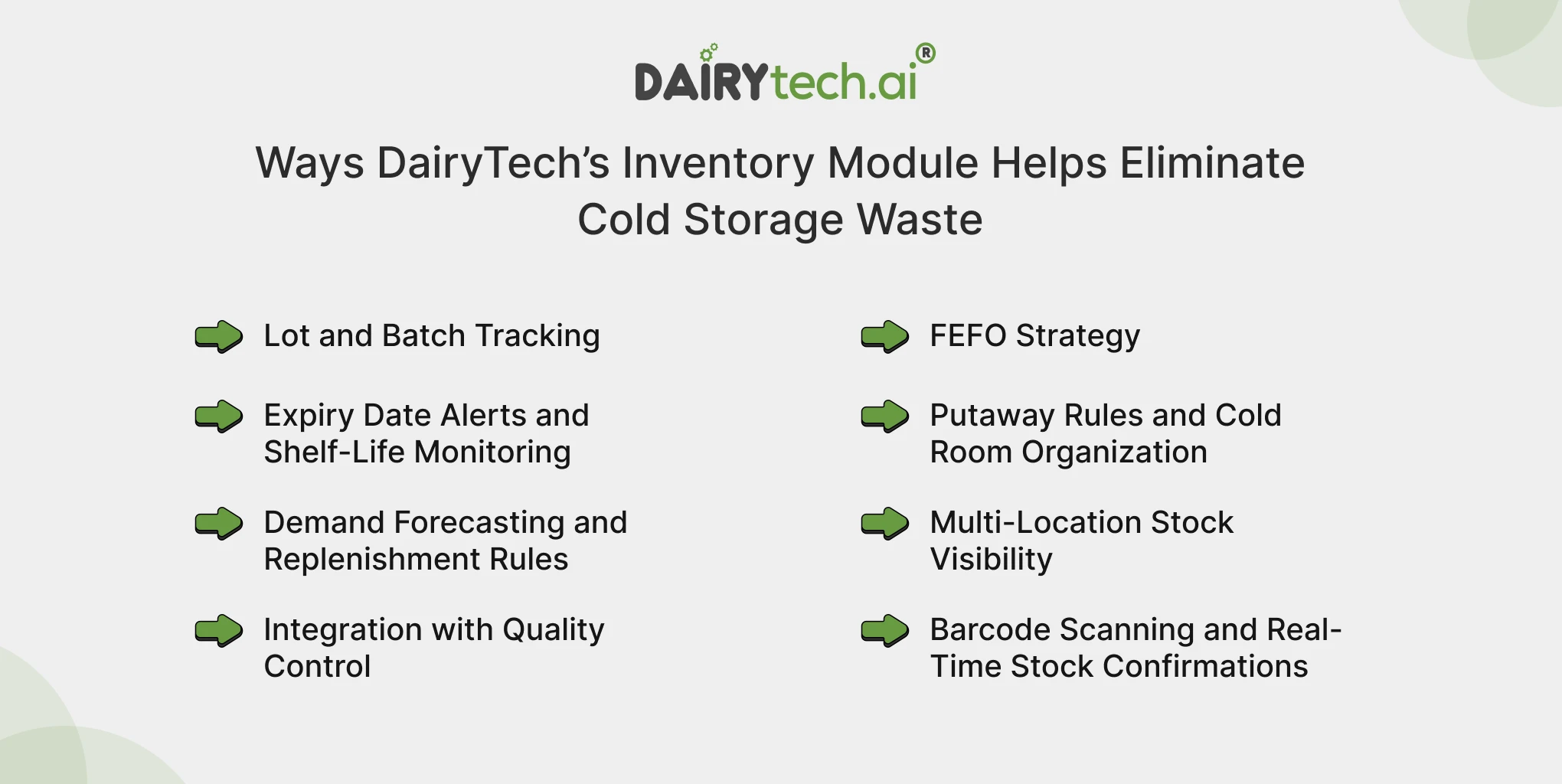
Ways DairyTech’s Inventory Module Helps Eliminate Cold Storage Waste
Lot and Batch Tracking
The foundation of cold storage waste reduction is knowing what you have, where it is, and when it expires, at the batch level, not just the product level.
Our inventory module supports full lot and serial number tracking across all product movements: goods receipts, internal transfers, production outputs, and customer dispatches. Every lot carries its own expiry date, creation date, and movement history.
For a dairy plant, this means the following:
- Each batch of pasteurized milk, yogurt, or cheese is tracked as a distinct lot with its own production timestamp and best-before date.
- When stock is moved from the cold room to the dispatch area, the system records the specific lot picked for a full forward and backward traceability chain.
- If a quality issue surfaces, a contamination alert, an abnormal pH reading, or a supplier claim, the plant can isolate the affected lot instantly without touching the rest of the inventory.
The waste reduction impact: Batch traceability prevents broad recalls. Instead of writing off an entire product line, plants can isolate and remove only the affected lot, protecting the rest of the stock.
FEFO Strategy
FEFO (First Expiry First Out) is the most effective picking strategy for perishable inventory. It guarantees that the batch with the nearest expiry date is always picked first, and stock with a shorter shelf life does not get trapped in inventory while newer stock is shipped out.
The Inventory Module supports FEFO natively as a removal strategy. When configured on a product category or a specific storage location, every picking operation automatically selects the lot with the earliest expiry date, regardless of which shelf it’s on or the order in which stock was received.
This is a critical departure from manual cold room management, where staff often pick from the nearest pallet, frequently the most recently delivered stock, leaving older batches to expire unnoticed at the back.
The waste reduction impact: FEFO enforcement alone can eliminate the majority of expiry-related write-offs. Dairy plants that switch from ad-hoc picking to automated FEFO typically see a significant reduction in expired stock within the first few months.
Is your cold room running FEFO or just hoping staff remembers to? See how DairyTech enforces FEFO at the batch level.
Expiry Date Alerts and Shelf-Life Monitoring
FEFO handles the picking side. But what about stock that’s approaching expiry and hasn’t been dispatched yet, or stock that’s at risk of exceeding its shelf life due to a demand shortfall?
The Inventory Module allows you to set expiry date warnings for lots. When a lot reaches a configurable threshold before its best-before date, the system flags it for review. When combined with scheduled activities and a notification system, operations teams are automatically notified to take action, such as dispatching discounts, repurposing into a longer-shelf-life product, or initiating an early write-off before the product becomes a total loss.
For dairy plants managing multiple SKUs across fluid milk, cream, yogurt, cheese, and butter, each with different shelf lives, this creates a tiered early-warning system:
- Fluid milk (7–14 days): Alerts at 3 days before expiry
- Yogurt (21–30 days): Alerts at 5 days before expiry
- Hard cheese (60–90 days): Alerts at 14 days before expiry
The waste reduction impact: Early alerts convert imminent write-offs into recoverable situations, whether through price promotions, route prioritization, or production repurposing. The cost of acting early is almost always lower than the cost of disposal.
For a deeper look at how a dairy ERP manages shelf life across every product category, read: How Does Dairy ERP Manage Expiry Dates and Shelf Life?
Putaway Rules and Cold Room Organization
Unstructured cold rooms create waste in two ways: stock gets lost or forgotten in poorly organized locations, and temperature-sensitive products end up in zones with the wrong thermal profile (e.g., ice cream stored near a door that experiences temperature swings).
The putaway rules automate the storage location for incoming stock based on product category, lot attributes, or custom conditions. This is what it means for a dairy plant:
- Fluid milk always goes to Zone A (coldest, closest to dispatch)
- Aged cheeses go to Zone C (controlled humidity, lower temperature)
- Products near expiry are flagged for a priority zone that triggers faster dispatch.
This removes the human call on where to put a pallet and reduces the risk of mislocation and temperature exposure.
Impact on waste reduction: Well-organized cold rooms directly reduce temperature excursion events and position short-shelf-life products in locations that enable FEFO compliance.
Demand Forecasting and Replenishment Rules to Prevent Overstocking
The most elegant form of cold storage waste is overstocking: ordering or producing more than demand can absorb within the product’s shelf life. It looks like operational diligence on procurement day is a write-off at month’s end.
The Inventory Module integrates with the replenishment engine, allowing dairy plants to set the following:
- Minimum and maximum stock rules per product per location
- Order points that trigger procurement or production orders automatically when stock drops below a threshold
- Lead time buffers that account for procurement and production cycles
When connected to the sales module, actual customer orders and historical consumption patterns feed into demand signals, enabling more accurate reorder quantities that match what the plant can actually dispatch within the product’s shelf life.
The waste reduction impact: Demand-matched replenishment stops the cycle of overproduction followed by forced write-offs. For high-velocity SKUs like fluid milk, even a 10% reduction in overstock directly translates to less daily waste.
Ready to stop overproducing for the cold room? Talk to a DairyTech specialist about demand forecasting for dairy.
Multi-Location Stock Visibility
Larger dairy operations manage multiple cold rooms, storage zones, or even off-site distribution warehouses. Without a unified view, each location becomes a silo, and inter-location transfers happen based on guesswork rather than real stock positions.
Our dairy ERP’s multi-location inventory structure gives plant managers a single real-time view of stock across all locations: which lots are in which cold room, what’s in transit, and what’s allocated to pending orders. Managers can initiate inter-location transfers, track movement in real time, and see consolidated expiry risk across the entire operation.
With a blast freezer, a main cold room, and a dispatch staging area, this provides a solution for dairy plants with a production facility, avoiding stock sitting past its window in one location when another location is short of stock.
The waste reduction impact: Unified stock visibility eliminates inter-location blind spots, enabling proactive rebalancing before expiry windows close.
Integration with Quality Control
In dairy manufacturing, not all stock that enters the cold room should be dispatched. Batches awaiting QC results, a fat/SNF test, a microbial count, and a pH check must be quarantined until cleared to avoid accidental dispatch.
Our Inventory Module supports quality control locations and lot-level quarantine. Stock in quarantine doesn’t appear as available inventory and can’t be picked. When QC clears the lot, it’s automatically released to available stock. If QC rejects it, the lot is blocked and put separately.
Under FDA FSMA 204 traceability requirements, dairy processors need to maintain lot-level records that support rapid, precise recalls, making QC-linked inventory quarantine not just operationally smart but a compliance baseline.
For dairy plants, this integration prevents two types of waste:
- Dispatching non-compliant product (which leads to costly recalls and customer claims)
- Over-blocking compliant stock (where delays in manual QC clearance push product close to its expiry before it can be dispatched)
The impact: Tight QC-inventory integration reduces both the risk of non-conforming product reaching customers and the operational delays that eat into shelf life.
Barcode Scanning and Real-Time Stock Confirmations
Manual stock records, including clipboards, whiteboards, and end-of-day spreadsheets, are the enemy of cold storage accuracy. By the time a discrepancy is discovered, the stock in question may already be at risk.
Dairy ERP mobile barcode scanning enables warehouse staff to confirm stock movements in real time, directly from the cold room floor. Every receipt, transfer, and dispatch is recorded at the moment it happens, keeping system records synchronized with physical reality.
For dairy cold rooms, this means the following:
- Receiving teams scan incoming milk or cream deliveries and assign lot numbers immediately
- Picking teams scan barcodes during dispatch, triggering FEFO-compliant lot selection automatically
- Physical inventory counts are conducted on a rolling basis without halting operations
The waste reduction impact: Real-time accuracy eliminates the phantom stock problem, stock that appears on the system but is already expired, mislaid, or physically absent. Accurate records mean accurate decisions.
How DairyTech Extends Inventory Capabilities for Dairy Plants
The Inventory Module is a powerful general-purpose tool of our dairy ERP. But dairy operations have needs that go beyond what a generic configuration addresses:
- Fat/SNF-based lot attributes that tie procurement quality data to inventory lots
- IoT integration with cold room sensors for automated temperature monitoring, deviation alerts, and not just manual data entry
- AI-driven spoilage prediction that flags at-risk lots based on temperature history, not just calendar expiry dates
- Batch-level byproduct tracking where a single milk intake lot generates multiple product batches (e.g., cream, skim milk, butter) that all need separate expiry tracking
- Van sales inventory integration, tracking cold chain continuity from the cold room to the delivery vehicle to the customer
- FMMO compliance automated class calculations that tie inventory movements to regulatory reporting
DairyTech is built with dairy-specific capabilities, giving plants the full power of a proven ERP backbone with the operational depth that dairy manufacturing actually requires.
To understand how cold chain monitoring works within a dairy ERP end-to-end, see “How Cold Chain Monitoring in Dairy ERP Prevents Spoilage & Reduces Waste.”
Real-World Impact: What the Numbers Look Like
When dairy plants move from manual cold room management to a properly configured ERP inventory system, the measurable outcomes typically include the following:
- 30–35% reduction in spoilage through FEFO enforcement and expiry alerting
- Significant reduction in emergency write-offs through early-warning systems
- Improved lot recall precision, isolating a single batch versus writing off a full product line
- Reduction in cold room labor hours spent on manual counts and discrepancy investigation
- Improved shelf-life compliance with retailers who penalize short-dated deliveries
These aren’t theoretical benefits. DairyTech’s implementation with Haribol, a dairy business that went from operational bottlenecks to global expansion, delivered a 2x operational efficiency and an 8% higher return on investment, with a 95% reduction in farmer payment disputes as a downstream effect of better data integrity across the operation.
What would eliminating cold storage waste mean for your margins? Let’s calculate it together. Book a call with DairyTech.
Conclusion: Cold Storage Waste Is a Solvable Problem
Cold storage waste in dairy isn’t inevitable. It’s the result of systems that never fit the pace and complexity of dairy operations. Manual records lag behind reality. Picking processes ignore expiry logic. And no one has full visibility into stock positions.
The Inventory Module tackles each of these failure modes. It delivers lot tracking, FEFO enforcement, expiry alerting, putaway rules, and real-time stock accuracy. Add dairy-specific capabilities and it goes further still. Think IoT cold chain monitoring, AI spoilage prediction, batch byproduct tracking, and van sales integration. Together, they make it a complete cold storage waste elimination platform.
Maybe your dairy plant still manages cold room inventory on spreadsheets, clipboards, or disconnected point solutions. If so, the gap between where you are and where you could be is real. You can measure it in spoilage percentages and write-off line items.
DairyTech helps dairy plants go from operational blind spots to real-time visibility, without enterprise complexity or pricing. Book your Discovery Call today.
Frequently Asked Questions
Does your dairy ERP Inventory Module support FEFO out of the box for dairy products?
Yes. FEFO (First Expiry, First Out) is a native removal strategy in the inventory module. It can be configured per product category or per storage location, and it automatically selects the lot with the earliest expiry date during picking operations. For dairy products, the shelf life varies significantly across SKUs; FEFO can be used for perishable categories, while other products use FIFO or LIFO.
How does dairy ERP handle temperature-related spoilage? Can it integrate with cold room sensors?
Standard ERP does not include native IoT cold room monitoring. Open architecture enables integration with temperature sensor systems and IoT platforms. DairyTech extends dairy ERP with IoT integrations, including cold room sensors, GPS temperature trackers, and SCADA connections, that automatically log temperature data against inventory lots and trigger alerts when deviations occur. This moves cold chain monitoring from reactive (discovering spoilage after it happens) to predictive (acting before product quality is compromised).
Can Dairy ERP track the same milk intake batch across multiple finished products?
Standard ERP lot tracking handles one-to-one and one-to-many lot relationships in manufacturing. For dairy plants where a single milk collection lot produces cream, skim milk, butter, and cheese, all with different expiry dates, DairyTech’s batch management layer provides explicit byproduct tracking per batch, maintaining the full traceability chain from raw milk to each finished SKU.
How long does it take to implement Dairy ERP-based inventory management in a dairy plant?
Implementation timelines vary based on the complexity of the operation, the number of storage locations, and the level of customization required. DairyTech’s structured onboarding process, covering discovery, system setup, data migration, training, and testing, typically gets dairy businesses live within 6 weeks. Operations with advanced customization needs may require additional time.
What’s the difference between using a generic ERP and a dairy-specific ERP like DairyTech?
Generic ERP provides powerful inventory management tools that work well across industries. A dairy-specific ERP layer like DairyTech adds functionality that’s not practical to configure from scratch: fat/SNF-based lot attributes, FMMO compliance, van sales tracking, AI-driven spoilage prediction, and IoT integrations with dairy-specific equipment. For dairy plants with simple operations, a well-configured ERP instance may be sufficient. For plants managing procurement, production, cold storage, and distribution simultaneously, a purpose-built dairy ERP typically delivers faster value with less custom development.
Can a dairy ERP inventory module reduce the cost of dairy product recalls?
Yes, significantly. Full lot traceability in dairy ERP gives the plant instant answers the moment it identifies a quality issue. It can pinpoint exactly which lot the issue affects, where it dispatched that lot, and which customers received it. This precision-recall capability replaces broad product-line recalls with surgical, lot-level ones. Broad recalls destroy far more inventory and customer trust than necessary. And the cost gap is real. For mid-size dairy operations, a full recall can cost tens of thousands of dollars more than a targeted lot recall.