Every milk delivery business runs on routes. Whether you’re supplying 50 households or 5,000 retail outlets, the route is the backbone of your sales operation. But managing routes manually, through WhatsApp messages, printed lists, or driver memory, creates invisible losses that quietly drain your margins.
Dairy businesses face challenges like missed deliveries, overloaded vans on one route and half-empty on another, cash that doesn’t reconcile at the end of the day, customers who ordered extra but got shorted, or drivers who spend 20 minutes figuring out the sequence each morning.
The problem isn’t the route itself. It’s the lack of a system built to manage it.
This is where dairy ERP, configured for dairy operations, changes everything. In this guide, we break down what route-wise sales planning means for a milk delivery business, what goes wrong without it, and how dairy ERP makes the entire operation manageable, from order intake to cash collection.
What Is Route-Wise Sales Planning in Milk Delivery?
Route-wise sales planning is the practice of organizing your customer orders, deliveries, driver assignments, and van inventory around defined geographic or operational routes, rather than treating each delivery as an isolated transaction.
In practical terms, it means:
- Every customer is assigned to a specific route (e.g., Route A: Industrial Zone, Route B: Residential North)
- Orders are batched and dispatched by route, not individually
- Each driver loads exactly what their route requires without any guesswork
- Sales targets, pricing, and promotions can be set at the route level
- End-of-day reconciliation maps back to a route, making cash and returns auditable
For dairy businesses, route-wise planning is especially critical because milk is perishable. An undelivered crate doesn’t wait; it expires. Inefficient routes don’t just cost fuel; they cost product.
Why Manual Route Management Fails Dairy Businesses
Before discussing dairy ERP’s solution, it’s worth understanding why spreadsheets and manual coordination consistently fail at scale.
Variable daily orders with no system to aggregate them
Dairy customers, especially households, frequently change their orders. One customer wants an extra liter tomorrow, and another is on holiday for a week. Without a central system capturing these changes by route, drivers work off yesterday’s list.
No visibility into van load vs. actual orders
Dispatchers guess how much product to load per van. As a result, stockouts occur mid-route, leaving customers unsatisfied, or excess stock is returned, posing high product spoilage and reconciliation issues.
Cash leakage at the driver level
When drivers collect cash manually without route-linked POS, discrepancies are common; the driver handles 40 stops, collects varying amounts, and reconciles at the end of the day from memory. The margin for error and for abuse is significant.
No route-level performance data
Identify your most profitable route, track overdue customer payments, and uncover underperforming SKUs across territories.
Without route-level visibility, critical business decisions become guesswork, putting revenue and profitability at risk.
Scaling breaks the system
Manual route management works (barely) at 10 routes. At 30, it becomes chaos. Every new route added to a spreadsheet system multiplies the coordination problem.
Related reading: How Dairy ERP Helps Manage Van Sales. It is a deep dive into mobile sales operations and why dairy businesses are moving away from manual van management.
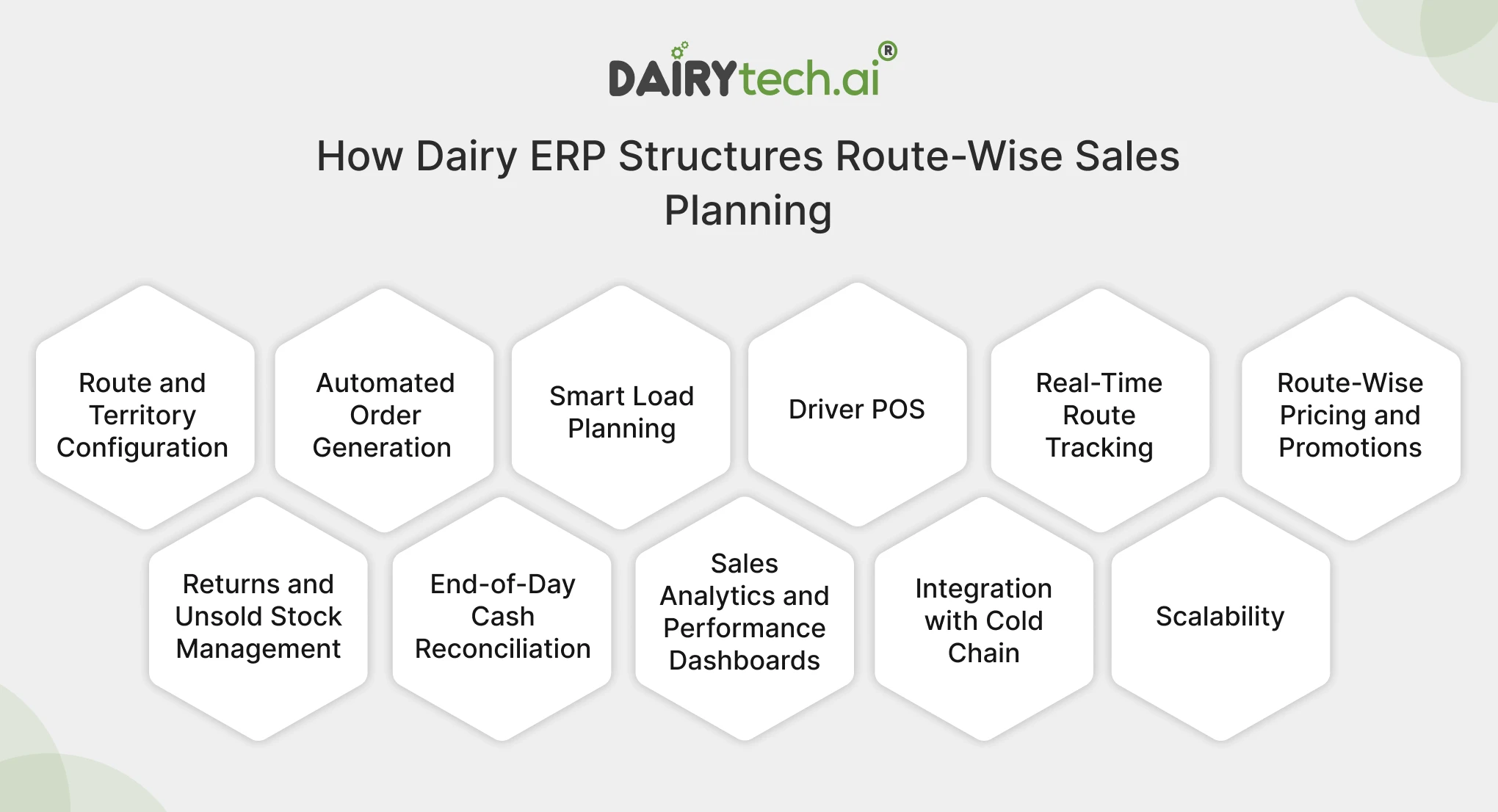
How dairy ERP Structures Route-Wise Sales Planning
Dairy ERP is a modular ERP platform with strong capabilities in sales, inventory, and logistics. When configured for dairy operations, as DairyTech does, it becomes a purpose-fit tool for route-based sales management. Here’s how each layer works.
Route and Territory Configuration
Dairy ERP’s route-wise planning is based on the ability to define and configure routes as operational entities rather than labels.
In a dairy ERP’s Sales and Inventory modules, routes can be set up as named territories with associated customers, delivery addresses, and assigned drivers. Each route gets its own:
- Customer list with delivery frequency (daily, alternate days, weekly)
- Preferred delivery window (e.g., 5–8 AM)
- Product catalogue with route-specific pricing if applicable
- Assigned vehicle and driver
This configuration means that when orders are generated, whether manually by a sales team or automatically via standing orders, they are immediately associated with the correct route. Dispatchers don’t need to sort and assign; the system does it.
Automated Order Generation for Standing Customers
The majority of milk delivery customers are on recurring orders. A household wants 2 liters of full-fat milk every morning. A café wants 10 liters of semi-skimmed milk Monday through Saturday.
Dairy ERP’s subscription and recurring sales order functionality allows dairy businesses to set up these standing orders once and auto-generate them on the correct schedule. Any customer-initiated modifications (via a customer app or portal) are automatically captured and reflected in the next day’s route sheet.
This eliminates the daily order updates across WhatsApp, phone calls, and physical notes. It ensures drivers receive an accurate route sheet before they leave the depot.
Smart Load Planning: Van Inventory Pre-Loading
One of the most common operational failures in dairy delivery is the mismatch between what’s loaded onto a van and what’s actually needed on the route.
Dairy ERP links confirmed route orders directly to warehouse pick lists. Before a driver departs:
- The system generates a pick list per van based on confirmed orders for that route
- It accounts for product variants (e.g., 500 ml vs. L, full-fat vs. skimmed)
- It flags any items that are low in stock before dispatch
- The driver’s van inventory is logged in the system, so every item is accounted for from depot departure to route completion.
This pre-loading accuracy directly reduces two problems: mid-route stockouts that lead to missed customers and excess returns that sit in the van and risk spoilage.
Driver POS: Capturing Sales and Cash on the Road
For milk delivery businesses that operate on a van sales model, where the driver sells at the point of delivery and collects cash, dairy ERP’s Point of Sale (POS) module, accessed via smartphones, becomes the central tool for transaction management.
With the driver POS configured for dairy routes:
- Each stop is pre-populated with the customer’s standing order
- The driver can modify the quantity at the door (customer wants an extra liter or one less)
- Payment is recorded as cash, UPI, card, or on account
- The system updates the van inventory in real time with each delivery
- Returns and unsold stock are logged per stop, not estimated at day’s end
This mobile POS capability means the driver is not the last link in a chain of manual records. Every transaction flows directly into the ERP, making end-of-day reconciliation a 5-minute task rather than a 2-hour discrepancy-hunting exercise.
Ready to see how this works in practice? Book a discovery call with DairyTech, and we’ll walk you through a live demo of route-wise operations in dairy ERP.
Real-Time Route Tracking and Delivery Confirmation
Dairy ERP integrates with GPS and fleet tracking tools to give dispatchers live visibility into where each driver is, which stops have been completed, and whether deliveries are running behind schedule.
For dairy operations, this matters beyond logistics. If a driver is significantly delayed, cold-chain integrity may be at risk. A dispatcher who can see that Route B is 90 minutes behind schedule can proactively alert customers, arrange a backup delivery, or flag the situation before spoilage becomes a write-off.
Each delivery can be confirmed with a digital proof of delivery, a customer signature, or a photo captured on the driver’s mobile device. This creates a clean and quick audit trail that resolves customer disputes (e.g., “I never received that order”).
The dairy ERP Inventory and Delivery documentation provides a detailed overview of how route operations, pick lists, and multi-step delivery flows work within the platform.
Route-Wise Pricing and Promotions
Not all routes are equal. A commercial route serving hotels and restaurants may operate on contract pricing, invoice terms (net 30), and bulk SKUs. A residential route may use daily retail pricing with immediate cash or UPI collection.
Dairy ERP’s sales pricelist functionality supports route-level pricing rules. This means:
- Commercial customers on Route C are automatically invoiced at their contract rate
- Promotional pricing (e.g., 10% off for the first month on a new residential route) is applied automatically based on configured rules
- Drivers don’t make pricing decisions at the door; the system enforces the right price for the right customer
This prevents both under-charging (revenue loss) and over-charging (customer disputes and churn), two common problems when pricing is just in a driver’s head or a manually maintained spreadsheet.
Returns and Unsold Stock Management by Route
In dairy delivery, returns are not an edge case; they’re part of every route, every day. Near-expiry stock comes back from retailers. A customer wasn’t home. A product was refused due to packaging damage.
Dairy ERP’s return management configuration at the route level enables drivers to log returns at the point of collection while specifying reason codes. This data feeds directly into:
- Inventory adjustment: returned stock is either restocked (if within quality standards) or flagged for write-off
- Route performance analysis: if Route D consistently returns 15% of delivered stock, that’s a signal about either product quality, demand forecasting accuracy, or customer service issues
- Supplier and production feedback: return patterns at the SKU level can inform production quantities for the following day
Related reading: How Dairy ERP Helps Businesses Handle Returns and Damage Tracking
End-of-Day Cash Reconciliation Per Route
Cash reconciliation is where manual systems collapse most visibly. A driver returns with cash, a bunch of receipts, and some unsold product. Matching that to 40 delivery records from memory is error-prone by design.
At the end of the day, dairy ERP compares what it believes should be in the vehicle (total value of confirmed deliveries minus returns) with what the driver delivers.
Route-wise reconciliation reports are generated automatically, showing:
- Total cash collected vs. expected
- Outstanding balances (customers who were invoiced but paid on credit)
- Discrepancies by stop, flagged for review
- Unsold stock returned to the warehouse, matched against the van load
This level of financial accountability per route doesn’t just reduce leakage; it creates a culture of operational integrity. Drivers know every transaction is tracked. Managers can resolve disputes with data rather than guesswork.
Route-Level Sales Analytics and Performance Dashboards
One of the most underused capabilities in route-wise ERP management is the analytical layer. Once route data flows cleanly into the dairy ERP, the reporting possibilities are significant.
Dairy managers can track:
- Revenue per route per day/week/month is your highest-value operational route.
- Order fulfillment rate by route is the percentage of orders on each route that are being completed successfully.
- The return rate by route and SKU represents the percentage of returns concentrated by route.
- Customer churn by route is the percentage of customers who have reduced or stopped orders.
- Driver performance includes delivery speed, collection accuracy, and customer feedback.
- Route profitability is the highest margin a route achieves after accounting for fuel, driver time, vehicle wear, and product losses.
These insights allow dairy operations managers to make evidence-based decisions: consolidate underperforming routes, reassign high-value customers to more reliable drivers, discontinue SKUs with high return rates in specific territories, and forecast production with greater accuracy.
See how DairyTech’s analytics layer is built for dairy-specific operations: Explore DairyTech’s Services.
Integration with Cold Chain and Inventory Management
Route-wise sales planning doesn’t operate in isolation. In a well-configured dairy ERP setup, it connects directly to cold chain and inventory management, two areas where unplanned breakdowns cause disproportionate losses.
Van loading triggers a cold chain check: products leaving the warehouse at incorrect temperatures are flagged before dispatch. GPS-linked temperature sensors (integrated via IoT) can alert the dispatcher if a van’s refrigeration unit underperforms during a route.
Inventory management ensures that route-level demand forecasting feeds back into procurement and production planning. If Route A is consistently consuming 500 more liters per week than initially planned, the ERP adjusts the raw milk procurement forecast accordingly, reducing both shortfalls and overproduction.
Related reading: How Cold Chain Monitoring in Dairy ERP Prevents Spoilage & Reduces Waste
Scalability: Adding New Routes Without Operational Chaos
The practical benefit of using dairy ERP to manage routes is that creating a new route is a configuration task.
When a dairy business decides to expand into a new territory, the process in the dairy ERP is:
- Create the new route with its territory boundaries and delivery windows
- Assign customers (new or transferred from existing routes)
- Configure pricing rules for the territory
- Assign a driver and vehicle
- Begin generating orders on the next cycle
Keep your existing spreadsheets intact. Prevent cross-contamination between route records and maintain cash collection workflows without manual reconfiguration. The new route inherits all the operational logic already configured in the system.
This scalability is what separates ERP-based route management from manual coordination; the system scales without increasing administrative overhead.
Implementing Route-Wise Sales Planning with DairyTech
DairyTech created an enterprise resource planning system specifically for dairy businesses, so route-based sales planning is pre-built with dairy-relevant logic rather than requiring extensive customization from a generic starting point.
The typical implementation path for route management includes:
Week 1-2: Discovery and route mapping
DairyTech’s implementation team maps your existing routes, customer lists, pricing rules, and driver assignments into a structured data model.
Week 3-4: System configuration
We configure the system with your routes, customer profiles, product catalog, pricing lists, and driver POS setup.
Week 5: Pilot run
One or two routes go live in parallel with your existing process, allowing your team to validate accuracy and driver usability.
Week 6: Full go-live
All routes transition to the dairy ERP system with live support from DairyTech during the first weeks of operation.
Ready to get started? Consult with DairyTech’s team to discuss your current route structure and what a transition to management would look like for your business.
What Dairy Businesses Gain: Real-World Impact
Dairy businesses that implement route-wise sales planning in dairy ERP consistently report improvements across four areas:
Reduced fuel and delivery costs
Optimized route sequencing and accurate load planning reduce unnecessary mileage and eliminate double-runs caused by missed deliveries.
Lower product losses
Accurate load planning means less unsold stock sitting in vans beyond its temperature window. Route-linked cold chain monitoring catches equipment failures before they become write-offs.
Better cash flow
Real-time cash collection via driver POS, combined with automated invoicing for credit customers, closes the gap between delivery and payment. Outstanding debt by route becomes visible and actionable.
Higher customer retention
Customers who receive accurate, on-time deliveries with digital confirmation and easy issue resolution don’t switch suppliers. Route-wise operations reduce the friction that drives churn.
According to research published by McKinsey & Company on supply chain digitization, companies that digitize their last-mile delivery and route operations see a 15–20% reduction in logistics costs and improvement in on-time delivery rates.
Frequently Asked Questions
Q1. What is route-wise sales planning in milk delivery?
A1. Route-wise sales planning is the practice of organizing all customer orders, driver assignments, van loading, and cash collection around defined delivery routes. Instead of managing each delivery individually, everything is batched, tracked, and analyzed at the route level, giving dairy businesses visibility and control over their entire delivery operation.
Q2. How does dairy ERP help with milk delivery route management?
A2. Dairy ERP provides tools for route configuration, automated order generation, van load planning, mobile driver POS, real-time delivery tracking, and end-of-day reconciliation, all connected in a single system. When configured by DairyTech for dairy-specific operations, these capabilities are aligned with the unique needs of milk delivery businesses, including perishable product management, FAT/SNF-based pricing, and cold chain compliance.
Q3. Can dairy ERP handle both van sales and pre-order delivery models?
A3. Yes, dairy ERP supports both models simultaneously. Pre-order customers are managed through standing orders that auto-generate daily route sheets. The driver uses the mobile POS system to take and confirm orders for van sales customers at the delivery location. Both transaction types reconcile within the same route-level reporting framework.
Q4. How does dairy ERP prevent cash leakage in dairy route operations?
A4. By requiring drivers to log each transaction in real time through a mobile POS, the dairy ERP creates an immutable record of every delivery, payment, and return on the route. End-of-day reconciliation compares the system’s expected cash collection against what the driver hands in, flagging discrepancies by stop. This transparency significantly reduces the opportunity for cash mismanagement.
Q5. What happens to unsold or returned stock in a dairy ERP setup?
A5. Unsold stock is logged at the point of return via the driver’s POS, with a reason code. The system automatically adjusts van inventory and warehouse records and flags the returned stock for quality assessment. Near-expiry returns and damaged products initiate a separate workflow for write-off or redistribution, which is tracked within the dairy ERP.
Q6. How long does it take to set up route-wise planning in dairy ERP for a dairy business?
A6. With DairyTech’s implementation methodology, most dairy businesses go live with route-wise management within 6 weeks. This includes route mapping, system configuration, data migration, driver training, and a pilot run before full go-live.
Q7. Is dairy ERP suitable for small dairy businesses with only a few routes?
A7. Yes. Dairy ERP’s modular structure means a small dairy business can start with the core route management capabilities and expand to more advanced features (analytics, IoT integration, multi-depot management) as the operation grows. Even at 3-5 routes, the cost-benefit analysis is compelling, particularly in terms of cash reconciliation accuracy and decreased product loss.
Q8. Can I integrate my existing accounting software with dairy ERP for dairy route management?
A8. DairyTech supports integration with accounting platforms, including QuickBooks and Xero, for dairy businesses that want to retain their current financial software. Route-level sales data, invoicing, and cash collection records sync into your accounting platform without requiring a full migration.