Every dairy business deals with returns. But very few dairy businesses deal with them well.
A pallet of milk pouches comes back damaged from a depot. A retailer returns near-expiry stock. A batch of packaging material arrives from the supplier with defective seals. In each case, someone logs a note, someone else raises a credit, and a third person updates the stock, manually, days later, often with incomplete information. By the time the numbers reconcile, some of the losses have already become permanent.
This is not a process problem. It is a systems problem. And Dairy ERP solves it, not by adding complexity, but by replacing scattered, manual handoffs with a single, automated, end-to-end workflow that turns every return event into a recoverable, traceable, data-generating transaction.
This guide explains exactly how and why dairy businesses that get this right are building a measurable margin advantage over those that don’t.
The Cost of Unmanaged Returns in Dairy
Ask most dairy operations managers what their return losses cost them annually, and they will give you a number that is almost certainly too low. Manual returns tracking captures only the obvious costs, the credit notes raised, and the stock written off. It misses the compounding losses that no spreadsheet is designed to find.
Some important dairy statistics:
- 6–12% of dairy products returned due to damage, quality failure, or expiry in distribution
- 40% of returned goods go uninspected before being restocked in manually managed operations
- $10k–$14k average annual write-off from unrecovered damage claims in mid-sized dairy businesses
- 3× faster return resolution time reported by dairies using ERP-driven return workflows
The hidden costs compound the headline numbers. Damaged stock that bypasses inspection and gets restocked generates downstream customer complaints and further returns. Supplier claims that go unraised become permanent write-offs. Credit notes raised a week after the event, without documentation, become disputed, and disputes cost management time that never appears in the loss column but always appears in the P&L.
The businesses that close this gap are the ones running returns through a system and not a notebook.
What is Return and Damage Management Actually Involved in
Before evaluating what a system should do, it helps to be precise about what returns management in dairy actually encompasses. It is wider than most operations teams realize, and that’s part of why manual approaches fail.
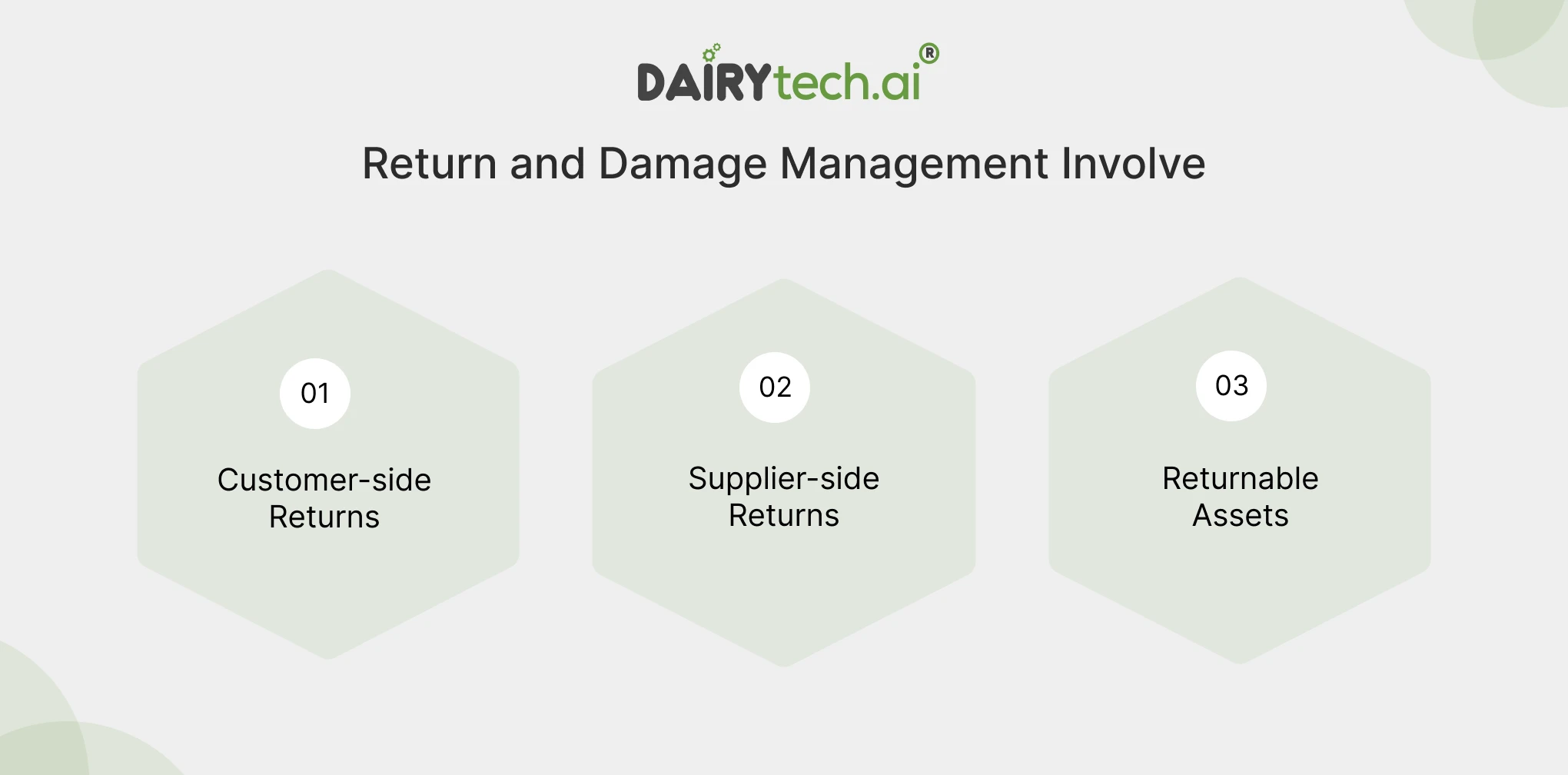
Customer-side Returns
These are returns from retailers, distributors, and institutional buyers. They include damaged goods (transit or handling damage), near-expiry or expired stock, overstocked returns, wrong product delivered, and cold chain failures. Each type requires a different resolution, such as credit note, replacement, write-off, or rework, and each resolution has stock, financial, and supplier implications.
Supplier-side Returns
These flow in the opposite direction, from the dairy back to its suppliers of packaging materials, raw ingredients, or production inputs. A batch of defective pouches or an off-specification delivery of packaging film needs to be returned, documented, and claimed. These are typically the highest-value returns and the most poorly managed in manual operations.
Returnable Assets
Crates, pallets, glass bottles, and other returnable packaging create a third return stream that requires its own reconciliation logic, including tracking what was sent, what came back, and what credit or replacement is owed. In high-volume dairy distribution, unreconciled returnables become a high ongoing cost.
The businesses that consistently close the returns gap are the ones running every return customer, supplier, and asset through a single system with automatic inventory, financial, and quality triggers.
How Dairy Handles Returns End-to-End
A purpose-configured Dairy ERP replaces the chain of disconnected manual steps with a single, integrated workflow. Here is what that looks like in practice — from the moment a return is initiated to the moment it is financially closed.
Return Authorization (RMA / RGA)
Every return begins with a formal digital authorization. An RMA for customer returns or an RGA for supplier returns. This records product, quantity, reason, and expected resolution before anything moves physically. Informal, untracked returns become structurally impossible.
Automated Receipt Generation
The ERP auto-generates a return receipt directly linked to the original sales or purchase order. Product details, quantities, and party information are pre-filled. No re-entry of data. No risk of the return being booked against the wrong transaction.
Quality Inspection Trigger
On receipt, the ERP automatically creates and assigns a quality inspection task with a configurable checklist, such as packaging integrity, temperature compliance, and batch and expiry verification, recording the outcome with photos and notes directly in the system.
Smart Stock Routing
Based on the inspection outcome, the ERP routes returned goods automatically: back to usable inventory if passed, to quarantine if potentially reworkable, or to scrap if condemned. No manual rerouting. No risk of failed goods re-entering the supply chain uninspected.
Automated Financial Settlement
A credit note (customer returns) or vendor debit note (supplier returns) is generated automatically on inspection completion, linked to the originating invoice or purchase order. Financial settlement happens in hours, not days.
Customer Portal Visibility
Retailers and distributors track return status, view credit notes, and download statements through a self-service portal without calling your team. This reduces inbound queries and builds the operational transparency that strengthens trading relationships.
Want to See This Workflow in a Live Dairy ERP? We will walk you through the full return lifecycle, from RMA creation to credit note generation, in a configured Dairy ERP environment built for dairy operations specifically. Book a Free Live Demo
Tracking Damaged Products with Dairy ERP
Most dairy businesses treat damage tracking as a documentation task — something to record so that a credit note can be raised. Dairy ERP treats it as a data-generation task — something that, over time, tells you exactly where your losses are coming from and how to stop them.
Reason Codes: Turning Returns into Data
Every return in a Dairy ERP is tagged at entry with a configurable reason code. Common codes include packaging damage, near-expiry return, cold chain breach, overstocking, wrong product delivered, and quality complaint. After three to six months, a dairy business running structured reason-code tracking can answer questions it previously could not. Which supplier’s packaging generates the most damage claims? Which delivery route produces the highest return rate? Which product SKU has an unusually short shelf life in the field?
Inspection Documentation
Every damage inspection generates a timestamped record: who inspected, when, what the outcome was, and what photos or notes were attached. This documentation resolves customer disputes without prolonged back-and-forth, supports insurance claims, defends against supplier liability disputes, and demonstrates compliance during food safety audits.
Quarantine and Disposition Management
Returned goods that fail inspection go to a quarantine stock location physically and digitally separate from usable inventory, where disposition decisions are made deliberately: rework, resell at reduced value, or scrap. Only explicitly condemned items are removed from inventory valuation. This prevents two costly mistakes: accidentally scrapping goods that could be recovered and accidentally restocking goods that should be scrapped.
Managing Supplier Returns With Dairy ERP
In most dairy businesses, supplier returns are the least systematically managed part of the returns process. They involve the highest individual values, require the most documentation to enforce, and are most likely to be absorbed as a loss when the process is manual.
The Problem With Manual Supplier Claims
When a batch of packaging material arrives defective, the typical manual response is a phone call, a note in a register, and maybe an email. The supplier requests more documentation. By the time the dairy has gathered the paperwork, weeks have passed, the supplier disputes the claim, and the dairy’s team has moved on to more pressing issues. The cost gets absorbed repeatedly, invisibly, and at a significant scale.
How Dairy ERP closes the Loop
Supplier returns are initiated directly from the original purchase order. The system generates a purchase return pre-populated with the correct vendor, product, quantities, and prices. On validation, it automatically creates a vendor debit note — a formal, enforceable credit claim — linked to the originating purchase, the return receipt, and any attached inspection documentation. Outstanding claims are tracked in an aging report so procurement teams always know what is owed, for how long, and from whom.
How Much Are Unrecovered Supplier Claims Costing Your Business?
Most dairy businesses do not know the true scale of their supplier return losses until they start tracking them systematically. Our free return management review maps your current process and identifies your highest-cost gaps at no charge. Get Your Free Return Review
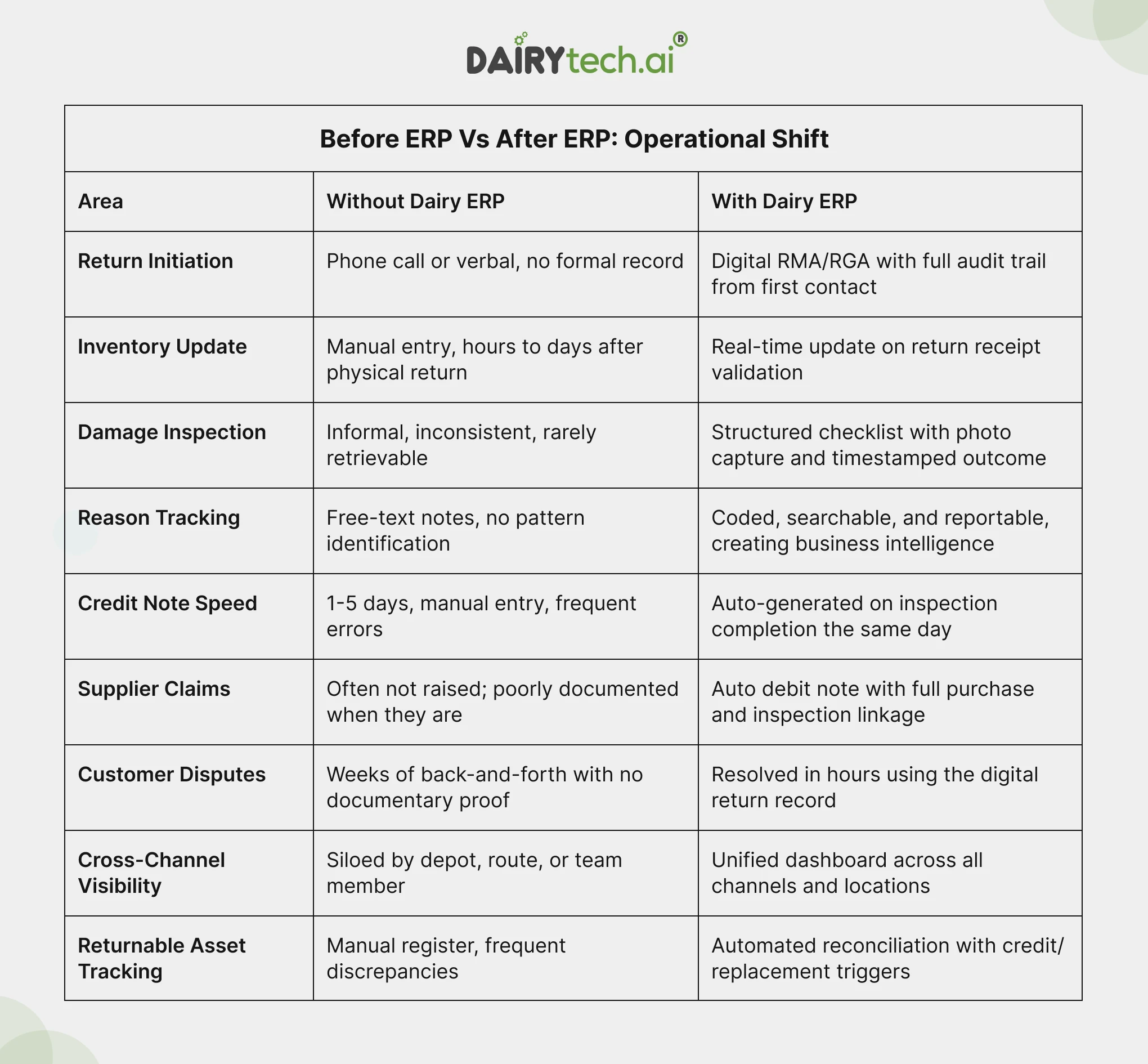
Before ERP vs After ERP: Operational Shift
The difference between manual returns handling and ERP-driven returns management plays out in every dimension of the operation. Here is the direct comparison across the areas that matter most:
Key Features to Look For in a Dairy ERP Return Module
Not all ERP systems handle dairy returns well. Many generic platforms lack the dairy-specific logic, including short shelf lives, cold chain compliance, and returnable asset reconciliation, which makes returns management genuinely useful in a dairy context. Here is what to evaluate:
RMA/RGA Authorization Workflows
Formal digital authorization before any physical return is accepted, with reason, product, and resolution type recorded upfront.
Sales-Order-Linkage Return Receipt
Auto-generated return documents that pre-populate from the original order, with full audit linkage throughout.
Configurable Inspection Checklists
Per-product-category inspection tasks with photo capture, temperature compliance fields, and batch/expiry verification.
Reason Code Framework
Configurable, searchable reason codes that accumulate into a trend dataset across routes, customers, suppliers, and SKUs.
Quarantine Stock Locations
Dedicated inventory zones for returned goods pending inspection, with smart routing to usable, rework, or scrap.
Automated Credit and Debit Notes
Auto-generation of customer credit notes and supplier debit notes on inspection completion.
Supplier Claim Aging Reports
Real-time visibility of outstanding supplier claims by vendor, amount, and days open.
Customer Self-Service Portal
Retailer and distributor access to return status, credit notes, and account statements without calls to your team.
Multi-Depot Support
Returns received at any branch flow into the same central dashboard with consolidated financial and stock visibility.
Returnable Asset Reconciliation
Crate, pallet, and bottle tracking per customer with automated reconciliation and deposit or replacement credit triggers.
Why Returns Management Is a Competitive Advantage
Returns management might seem like a back-office efficiency concern. In dairy distribution, that framing misses the competitive dimension entirely.
Faster Resolution Builds Retailer Trust
A retailer that receives a credit note the same day they return damaged stock trusts you differently than one who spends a week chasing a resolution. In high-frequency delivery relationships, trust is a commercial asset. ERP-driven resolution speed is not just an operational improvement; it is a retention mechanism.
Data-led Wastage Reduction Protects Margins
Dairy margins are thin and under constant pressure. Businesses that use return reason-code data to identify and eliminate the root causes of their highest-frequency returns systematically reduce waste in a way that compounds over time. This is a margin improvement that competitors operating on manual registers cannot match.
Documented Claims Make Suppliers Accountable
A supplier that knows your dairy consistently raises documented, timestamped, photo-supported debit notes for every substandard delivery will change their behaviour. This leverage is only available to businesses with systematic documentation.
Audit Readiness reduces Regulatory Risk
Food safety audits, insurance claims, and customer liability disputes all depend on records that prove what happened, when, and how it was handled. ERP-driven returns carry this documentation as a byproduct of normal operations, not a reconstruction effort after the fact.
Ready to Turn Your Returns Process Into a Competitive Advantage?
DairyTech.ai works with dairy businesses to implement and configure ERP return management workflows that fit your operation, including your product mix, your distribution model, and your team’s way of working. Start with a Free Consultation
Conclusion
Returns and damage management sit at the intersection of operations, finance, quality, and customer relationships. In dairy, specifically with its short shelf lives, temperature-sensitive products, and high return volumes, the cost of getting this wrong compounds quickly and quietly.
Dairy ERP does not just make returns faster to process. It makes them visible, recoverable, and intelligent. Every return becomes a data point. Every damage event becomes a documented claim. Every supplier failure becomes an enforceable debit note rather than an absorbed write-off. And every retailer gets the resolution speed and transparency that turns a transaction into a relationship.
The businesses winning on dairy margins are not finding ways to avoid returns; they are finding ways to handle them better than their competitors. That starts with the right system.
Frequently Asked Questions
Q1. What is the difference between an RMA and an RGA in a Dairy ERP?
A1. An RMA (Return Material Authorization) is issued for customer-side returns when a retailer or distributor is returning goods to the dairy. An RGA (Return Goods Authorization) is the supplier-side equivalent, authorizing the company to return defective materials back to a vendor. Both create a formal, traceable digital record before any physical movement occurs so that inventory, financial, and quality systems are updated accurately from the start.
Q2. Can Dairy ERP handle returns from multiple channels in one place?
A2. Yes. A properly configured Dairy ERP consolidates returns from all channels, including a field driver’s mobile app, a distributor portal, an internal warehouse desk, or a direct retail return, into a single workflow with the same authorization, inspection, and financial settlement process. This eliminates the siloed tracking that leaves some channels under-monitored.
Q3. What happens to returned dairy products that fail quality inspection?
A3. Failed items are automatically routed to a quarantine stock location physically and digitally separated from usable inventory, pending a disposition decision. The quality team assigns each item to one of three outcomes: return to usable stock, send to rework, or condemn to scrap. Only explicitly condemned items are written off. This prevents both prematurely scrapping recoverable goods and allowing failed goods to slip back into the supply chain.
Q4. How does Dairy ERP help recover money from suppliers for defective packaging or ingredients?
A4. When defective materials are received, the ERP initiates a purchase return directly from the original purchase order. On validation, a vendor debit note is automatically generated, such as a formal credit claim with the originating purchase, return receipt, and inspection documentation all attached. Outstanding claims are tracked in an aging report so procurement teams can follow up systematically. This structured approach makes supplier claims significantly harder to dispute and far more likely to be honored.
Q5. Will Dairy ERP work for businesses operating across multiple depots or regions?
A5. Yes. Multi-depot and multi-warehouse configurations are standard in a properly implemented Dairy ERP. Returns received at any branch or depot are processed locally but visible centrally — in the same returns dashboard, with the same inspection, routing, and financial workflows. Finance, operations, and quality teams get a company-wide view regardless of which location handled the return.
Q6. How does reason-code tracking help reduce future returns?
A6. Every return is tagged at entry with a configurable reason code. Over time, these codes accumulate into a dataset that reveals patterns invisible to manual systems: a specific supplier generating a disproportionate share of packaging claims, a particular route with unusually high damage rates, or a product SKU with consistently short field life. These insights allow operations managers to address root causes rather than just process symptoms, and that is where the real margin recovery happens.
Q7. Can retailers and distributors track their return status without contacting our team?
A7. Yes. Dairy ERP includes a customer-facing self-service portal where retailers and distributors can log in to view the live status of their pending returns, see and download credit notes, and access account statements without requiring access to the internal ERP system and without calling your team. This reduces inbound return queries significantly and builds the operational transparency that high-frequency delivery customers particularly value.
Q8. How long does it take to set up return management in a Dairy ERP?
A8. For a dairy implementing Dairy ERP from scratch, the returns management module typically takes one to two weeks to configure as part of the broader implementation, covering reason code setup, inspection checklists, stock routing rules, credit and debit note templates, and portal access. For a dairy that already has the ERP running for inventory and sales, adding or enhancing the returns module is usually a shorter configuration exercise, not a new implementation project.
Take the First Step Towards Profitable Returns Management
DairyTech.ai specializes in Dairy ERP implementation for dairy businesses of all sizes. Whether you are evaluating a first ERP or upgrading an existing system, we will map your current return process, identify your highest-cost gaps, and show you exactly how a configured Dairy ERP closes them in a free, no-commitment consultation. Book Your Free Consultation.