The dairy industry operates under pressures that few other sectors face at the same intensity. Perishable raw materials, strict food safety regulations, daily quality variability, complex supplier networks, and razor-thin margins all of these demand a level of operational precision that legacy systems simply cannot sustain.
The data support this shift. A 2023 report found that 66% of organizations that implemented ERP systems reported measurable improvements in operational efficiency. In dairy, where every hour of delay, every batch of waste, and every compliance gap carries real financial consequences, that improvement isn’t just desirable; it’s necessary.
This blog explores how dairy ERP implementation enhances efficiency across the dairy value chain and why an increasing number of dairy businesses are investing in purpose-built ERP platforms like those offered by DairyTech.
What ERP Actually Means for a Dairy Business
A dairy Enterprise Resource Planning (ERP) system is an integrated software platform that connects & unifies all core business processes within a single system. In dairy, where operations span from before sunrise at the collection centre to late-night financial reconciliation, this integration isn’t a convenience; it’s the foundation of efficient operations.
A dairy-focused ERP is tailored to manage end-to-end operations: from milk procurement at collection centers through processing, packaging, distribution, and financial reporting. Unlike generic ERP platforms that require heavy customisation to handle dairy-specific workflows, purpose-built dairy ERP systems arrive with the industry’s complexity already accounted for.
What a dairy ERP system delivers
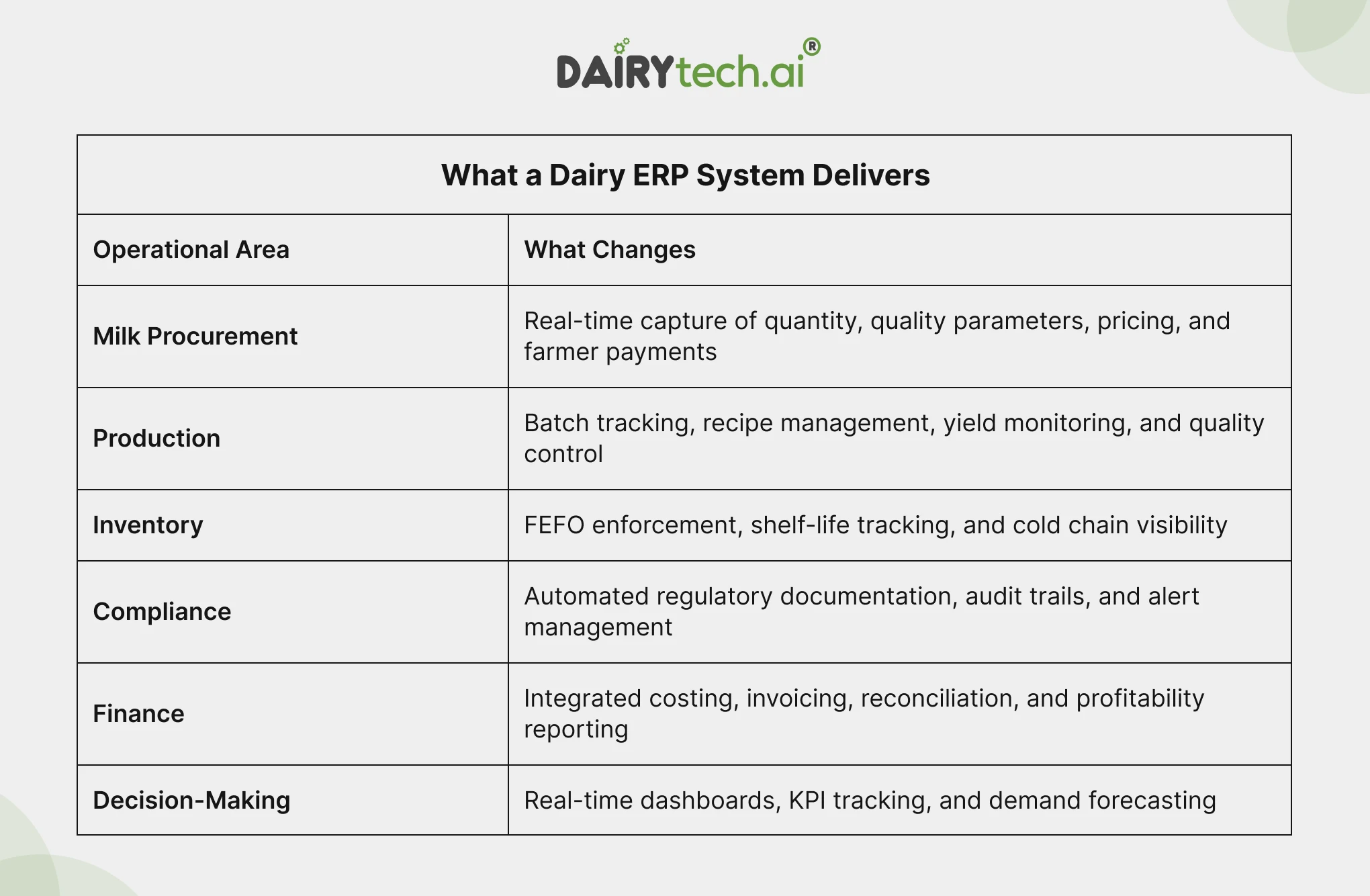
The result: elimination of data silos, reduction of manual intervention, and the ability to respond quickly to demand fluctuations, quality deviations, and supply disruptions before they become costly problems.
Ready to see what ERP implementation looks like for your dairy business? DairyTech’s consultants start with your workflows, not a generic sales presentation. Book a Free Consultation at dairytech.ai
How ERP Enhances Efficiency Across Key Dairy Functions
ERP software for the dairy industry integrates procurement, production, inventory, logistics, and finance into a unified digital platform. Here is how that integration translates into measurable efficiency gains across every major functional area.
Milk Procurement and Collection
Milk procurement is the foundation of dairy operations and one of the most operationally complex, due to daily quality variability, volume fluctuations, and the intricacy of farmer payment structures.
An ERP system digitizes and standardizes the entire milk collection process. At each collection centre, it captures real-time data, including quantity, fat and SNF content, and quality test results. This data feeds directly into automated payment calculations, applying quality-linked pricing, incentives, and deductions without manual intervention.
Efficiency gains in procurement:
- Eliminates manual data entry at collection centres, reducing errors and delays
- Automates farmer payment settlements with full auditability
- Provides real-time visibility into procurement volumes and quality trends
- Enables better production planning based on actual milk availability
- Strengthens farmer relationships through transparent, timely payments
The outcome is a more reliable, accurate, and efficient procurement process, from the collection centre to the plant gate.
Production and Processing
In dairy processing, efficiency depends on precise planning, yield optimization, and minimal losses at every stage. ERP systems support batch-wise production management, recipe and formulation control, and real-time monitoring of processing activities.
By tracking input-to-output ratios at each production stage, the system enables dairy manufacturers to identify where losses occur, take corrective action, and continuously improve yield performance.
Efficiency gains in production:
- Aligns milk availability with demand forecasts for optimal capacity utilisation
- Reduces downtime through proactive production scheduling
- Tracks processing losses at each stage to support yield improvement
- Enforces quality checks at every production step, minimising rework and waste
- Supports consistent product quality across batches, shifts, and sites
Inventory and Cold Chain Management
Managing perishable dairy inventory is one of the industry’s most persistent operational challenges. Without real-time visibility, overstocking and stock-outs become expensive, recurring problems, and spoilage erodes tight margins.
ERP systems provide real-time inventory visibility across raw materials, work-in-progress material, and finished goods. They track batch numbers, expiry dates, and shelf life, enforcing First-Expiry-First-Out (FEFO) inventory management to reduce spoilage and wastage.
Efficiency gains in inventory and cold chain:
- Real-time stock visibility across all warehouses and distribution points
- FEFO enforcement prevents short-shelf-life products from reaching customers
- Automated replenishment planning reduces both stock-outs and overstocking
- Cold chain monitoring tracks storage conditions and flags temperature deviations
- Expiry alerts enable proactive stock rotation before products become unsaleable
Supply Chain and Distribution
The dairy supply chain ERP systems enhance supply chain efficiency by integrating demand forecasting, order management, logistics coordination, and distributor operations into a single platform. The result is a more responsive, visible supply chain that can adapt to changes in demand without the typical lag.
Efficiency gains in supply chain and distribution:
- Demand-aligned distribution planning reduces over-delivery and returns
- Integrated order management improves on-time delivery performance
- Distributor and retailer portals provide visibility into orders, returns, and receivables
- Route optimisation reduces logistics costs and improves delivery reliability
- Stronger channel relationships through accurate, timely order fulfilment
Financial Control and Profitability
ERP brings financial discipline and real-time transparency to dairy operations by integrating accounting, costing, and financial reporting directly with operational data. Management gains a clear, accurate view of profitability at the product, plant, and channel level, not just at month-end.
Efficiency gains in finance:
- Real-time tracking of procurement costs, production expenses, and logistics overheads
- Automated invoicing, payments, and reconciliations reduce manual effort and errors
- Accurate cost-per-unit analysis supports better pricing and margin management
- Statutory reporting automation reduces compliance overhead
- Identifies cost leakages before they compound into significant margin erosion
“Integrating financial data with operational performance gives dairy management something they rarely had before: the ability to see exactly where money is being made or lost in real time.”
Want to see how DairyTech’s ERP handles these functions for businesses like yours? Request a Workflow Demo at dairytech.ai
Compliance, Quality, and Traceability
Compliance, quality assurance, and traceability are non-negotiable in dairy. Strict food safety regulations, high consumer sensitivity to product quality, and the perishable nature of dairy products mean that failures in any of these areas carry immediate consequences, including financial, reputational, and regulatory consequences.
A dairy ERP system addresses all three as integrated functions and not separate systems.
Regulatory Compliance Management
Dairy businesses must comply with multiple local and international regulations covering food safety, hygiene, labeling, and environmental standards. ERP systems embed regulatory requirements directly into operational workflows, removing the need for separate compliance tracking.
Mandatory records for milk procurement, processing, storage, and distribution are maintained automatically.
Audit-ready reports for regulatory authorities are generated on demand, not manually assembled before an inspection.
Compliance with FSSAI, ISO, HACCP, and other food safety frameworks is built into core process control.
Automated alerts flag potential compliance breaches before they become violations.
Quality Control and Assurance
Consistent product quality is the foundation of brand reputation and consumer trust in dairy. ERP systems enable quality management at every stage, from raw milk collection through to finished goods dispatch.
Quality parameters, including fat content, SNF levels, microbial counts, and temperature readings, are recorded, monitored, and analyzed in real time. Batch-wise quality testing, deviation tracking, and nonconformance management are built into procurement and production workflows, so quality data is never siloed from the operations it governs.
When a quality deviation occurs, the system flags it immediately. Only compliant products move forward through the supply chain.
End-to-End Lot and Batch Traceability
Traceability is the backbone of recall readiness and regulatory confidence. A dairy ERP links raw milk sources, processing batches, storage locations, and distribution channels, providing complete end-to-end traceability within a single platform.
In the event of a quality issue or product recall, the system identifies affected batches and their distribution points in seconds, not hours. This speed reduces financial exposure, limits the scope of a recall, and demonstrates to regulators and buyers that your quality management systems are robust.
Risk Mitigation and Recall Readiness
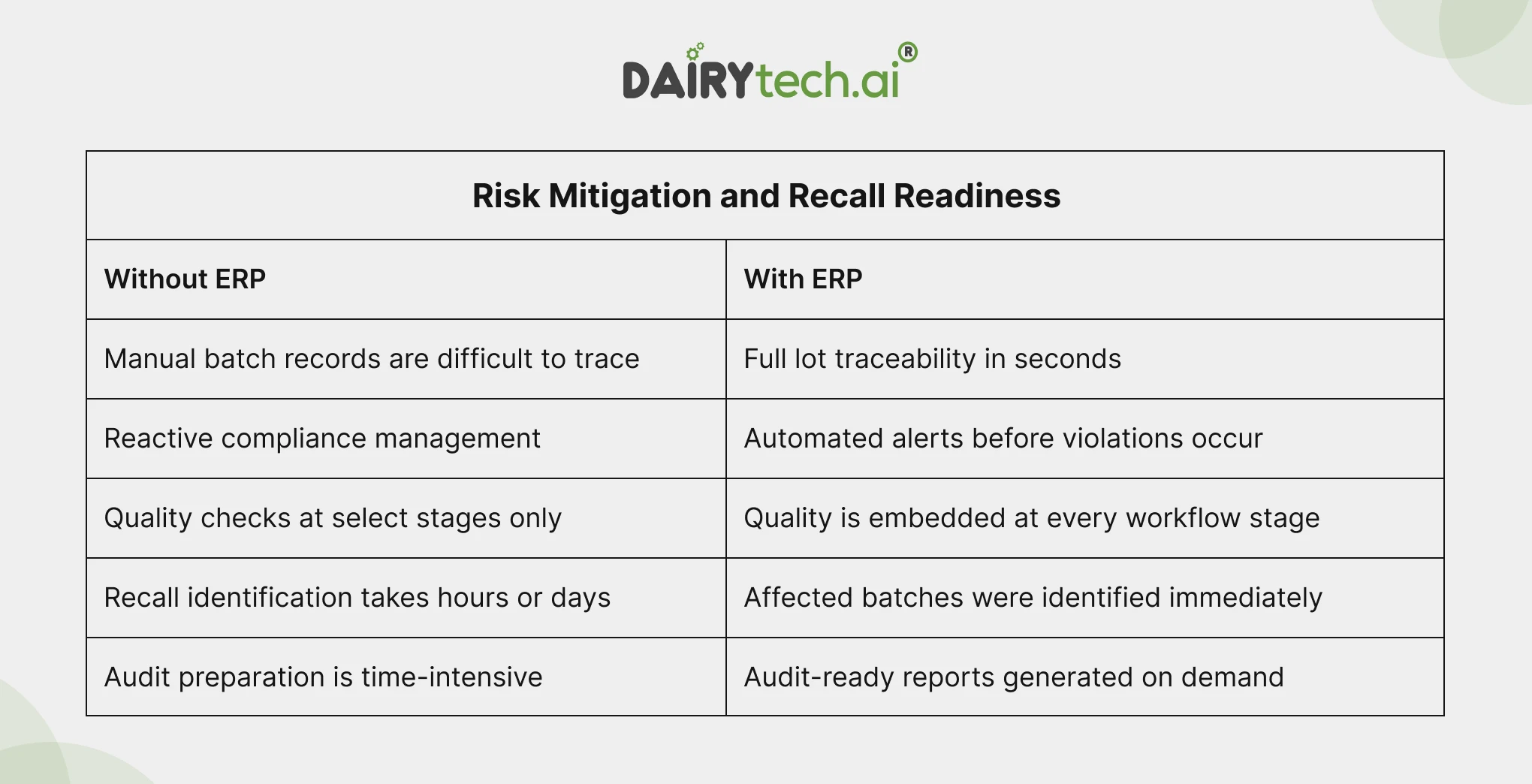
When compliance, quality, and traceability operate as an integrated system, dairy businesses shift from reactive problem-solving to proactive risk management.
Data-Driven Decision-Making With ERP
In the dairy industry, margins are tight and operational variables change daily. Timely, accurate decision-making is not a management aspiration; it is a competitive requirement. ERP systems consolidate data from every function into a single platform, enabling decision-makers to move from instinct-based management to evidence-based strategy.
Real-Time Operational Visibility
ERP software provides real-time dashboards covering milk procurement volumes, quality parameters, production yields, inventory levels, sales performance, and financial status. Decision-makers can see what is happening in real-time, not in yesterday’s spreadsheet report.
This real-time visibility is especially valuable in dairy, where perishable inventory, fluctuating milk supply, and daily demand changes require fast, informed responses.
KPI Monitoring and Performance Benchmarking
Dairy ERP enables the definition and tracking of KPIs specific to dairy operations:
- Milk yield variance by collection centre and supplier
- Processing losses by batch and production line
- Spoilage rates by product category and storage location
- On-time delivery performance by route and distributor
- Product-wise and channel-wise profitability margins
Continuous monitoring of these KPIs supports benchmarking across plants and collection centers and drives structured continuous improvement.
Demand Forecasting and Production Planning
ERP uses historical data and trend analysis to forecast demand and align production schedules accordingly. The result: procurement, processing, and distribution plans that reflect actual market demand rather than best guesses.
Better forecasting reduces overproduction, minimizes cold storage waste, and ensures processing capacity is used efficiently and is not left idle or overwhelmed.
Cost Analysis and Profitability Insights
By integrating operational data with financial reporting, ERP enables profitability analysis at the product, customer, region, and channel levels. Management can identify which products, routes, or distribution channels are genuinely profitable and which are quietly eroding margins.
These insights support better pricing decisions, smarter cost optimization, and more confident investment planning.
DairyTech’s dairy ERP is built to make real-time operational visibility the default, not a reporting project. See the DairyTech Platform at dairytech.ai
The Bottom Line
In an industry where operational efficiency, product quality, and regulatory compliance directly impact profitability, ERP implementation has moved from a technology upgrade to a strategic business decision.
By integrating milk procurement, production, inventory, cold chain, supply chain, finance, and quality control into a unified system, a dairy ERP delivers complete visibility and tighter control across the entire dairy value chain. The outcome is less waste, productivity, stronger compliance, faster decision-making, and a business that can scale without scaling.
DairyTech offers customized ERP solutions for the dairy industry, complete with domain expertise, implementation methodology, and a long-term support model to ensure successful transformation.
If you are ready to improve efficiency, strengthen traceability, and gain better control of your dairy operations, the next step is a conversation. Contact DairyTech to Discuss Your Dairy Business
Frequently Asked Questions
Q1. What is ERP implementation in the context of the dairy industry?
A1. ERP implementation in dairy refers to deploying and configuring an Enterprise Resource Planning system to manage and connect all core dairy business functions, including milk procurement, quality testing, production, cold chain inventory, distribution, compliance, and financial reporting, within a single integrated platform. A successful ERP implementation replaces disconnected tools and manual processes with centralized, real-time data and automated workflows across the entire operation.
Q2. How does ERP improve operational efficiency in dairy businesses?
A2. ERP improves efficiency by eliminating data silos, automating manual processes, and providing real-time visibility across procurement, production, inventory, logistics, and finance. Specifically in dairy, this means automated farmer payment calculations; real-time quality monitoring; FEFO inventory enforcement to reduce spoilage; demand-aligned production planning; and integrated financial reporting, all of which reduce errors, cut waste, and accelerate decision-making.
Q3. How long does an ERP implementation typically take for a dairy business?
A3. The timeline depends on the size and complexity of the operation, the number of integrations required, and the implementation methodology used. For small to mid-sized dairy businesses, a structured, phased implementation typically takes three to six months from project kick-off to go-live. Larger operations with multiple sites, complex integrations, or enterprise-level platforms can take six to twelve months or more. A phased approach, starting with core workflows and adding modules over time, helps manage risk and reduce initial go-live timelines.
Q4. What are the biggest challenges in dairy ERP implementation? And how are they managed?
A4. The most common challenges include data migration from legacy systems (often messy or incomplete), change management for staff who are accustomed to manual processes, integration with existing equipment (analyzers, weighbridges, and IoT sensors), and ensuring the system is configured for dairy-specific workflows rather than adapted from a generic template. These challenges are best managed by choosing an implementation partner with genuine dairy domain expertise, following a structured phased project plan, and investing in thorough role-based training before go-live.
Q5. Is ERP implementation suitable for small dairy businesses or only large ones?
A5. ERP is beneficial to dairy businesses of all sizes; however, the right system and implementation scope should be comparable in size and operational complexity. Small and growing dairy businesses benefit from the discipline and visibility that ERP provides, even on a small scale, and implementing early allows the business to grow into a structured system rather than attempting to retrofit one during a period of rapid expansion. Modular ERP platforms allow smaller dairies to start with the functions they need most and expand with the business growth.
Q6. How does dairy ERP support food safety compliance and traceability?
A6. A dairy ERP embeds regulatory requirements directly into operational workflows, so compliance isn’t a separate process; it’s built into how the system works. Quality parameters are recorded at every production stage, regulatory documentation is generated automatically, and audit-ready reports can be produced on demand. End-to-end lot and batch traceability links every raw milk source to every finished goods delivery, enabling rapid recall identification and minimizing the scope and cost of any quality incident.
Q7. What is the ROI of ERP implementation for dairy businesses?
A7. ROI varies by operation, but dairy businesses typically realise value across multiple dimensions: reduced spoilage and wastage through better inventory and shelf-life management, lower labour costs from automation of manual processes (procurement data entry, payment calculations, financial reconciliation), improved yield from better production monitoring, reduced compliance costs from automated regulatory documentation, and stronger profitability visibility enabling better pricing and cost decisions. A 2023 study found that 66% of organizations reported improved operational efficiency following ERP implementation. In dairy, where margins are tight and processes are complex, that improvement translates directly into bottom-line impact.
Q8. Why should dairy businesses choose DairyTech for ERP implementation?
A8. DairyTech specializes exclusively in ERP implementation for the dairy industry. Unlike generalist ERP partners who adapt generic systems to dairy workflows, DairyTech provides purpose-built solutions and consultants with hands-on dairy domain experience. This means faster implementation, fewer surprises, and a system that reflects the way dairy operations actually run, from milk procurement and fat/SNF-based pricing to cold chain compliance and lot traceability. DairyTech also provides a structured post-go-live support model with documented SLAs and ongoing partnership, not just a one-time deployment.
DairyTech delivers purpose-built ERP solutions for the dairy industry, including processors, cooperatives, distributors, and delivery businesses. Speak with a dairy ERP specialist.