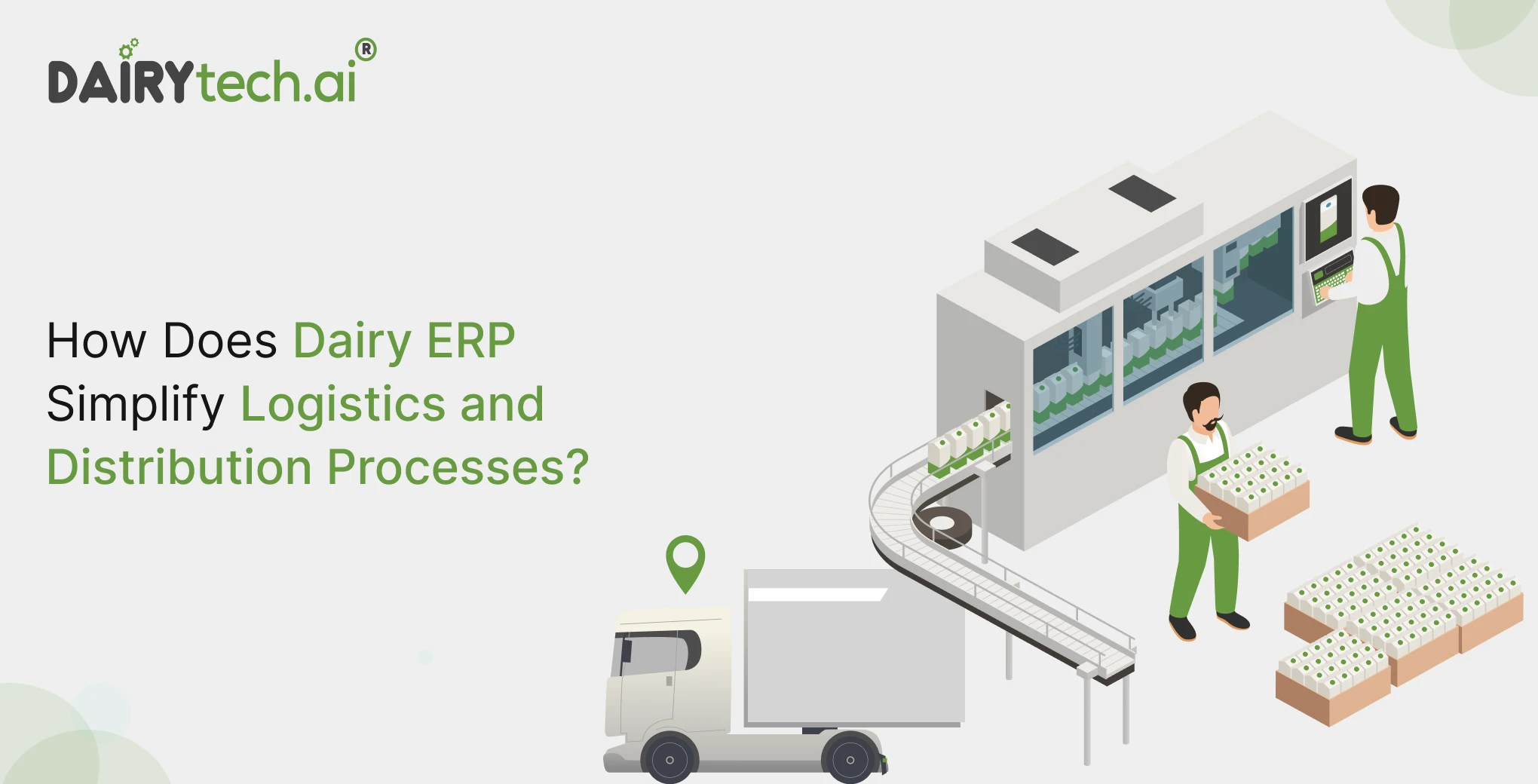
Dairy logistics is one of the most challenging operations in the dairy supply chain. You’re moving perishable products under tight temperature windows across multiple delivery points, with drivers managing cash, stock, and customer relationships simultaneously, often before sunrise.
When that complexity is managed through spreadsheets, paper routes, and phone calls, things break down. Deliveries get delayed. Products spoil. Routes run inefficiently. Customers churn. And by the time you see the problem, it has already cost you.
A dairy ERP, purpose-built for dairy operations, brings every part of your logistics and distribution process into a single, connected system. From order placement to proof of delivery, here is exactly how it works.
What Makes Dairy Logistics So Complex?
Before diving into solutions, it’s worth understanding why dairy logistics is uniquely difficult compared to other food distribution operations.
Dairy products are perishable and time-sensitive. Every hour in an uncontrolled environment shortens shelf life. At the same time, dairy businesses typically serve a wide mix of customers, including retail stores, hotels, institutions, and households, each with different order frequencies, pack sizes, and delivery windows.
Layer on top of that: van-based sales where drivers carry and sell stock directly, manual cash collection and reconciliation at the end of every run, and the constant risk of spoilage if a cold chain gap goes undetected.
Research consistently shows that inefficient delivery routes alone increase fuel and operational costs by up to 30%. Add poor inventory tracking and cold chain gaps, and total operational losses can climb significantly higher.
Key Logistics and Distribution Challenges in Dairy Operations
Dairy businesses running on disconnected systems typically experience the same cluster of problems:
- Unoptimized delivery routes that result in longer turnarounds, higher fuel consumption, and late deliveries
- No real-time container or vehicle tracking, leaving operations teams blind during active runs
- Van-level inventory mismatches between what drivers carry and what gets sold or returned
- Manual cash reconciliation at end of day, creating discrepancies and accountability gaps
- Cold chain blind spots with no automated alerts when temperature thresholds are breached
- Reactive customer communication: customers call in to find out where their delivery is
- No centralized order management, with orders coming in via phone, WhatsApp, and email with no single view
These are not minor inconveniences. They compound into real financial loss: spoilage, lost sales, increased bad debt, and reduced customer trust.
How Dairy ERP Simplifies Logistics and Distribution
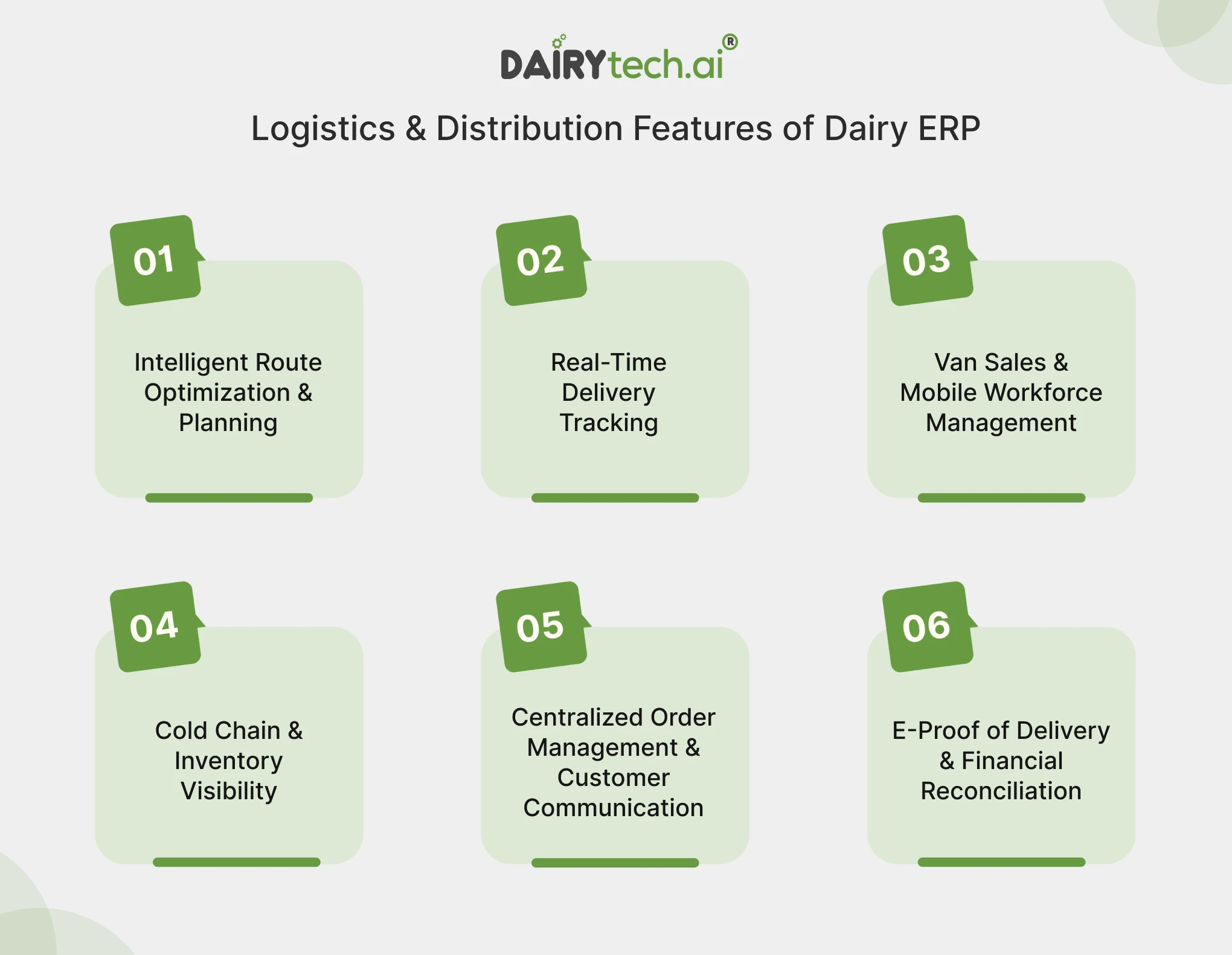
Generally, enterprise resource planning systems do not offer logistics and distribution features; however, our custom-made dairy ERP fills this gap, making it an end-to-end dairy management system. The logistics and distribution features of dairy ERP are the following:
Intelligent Route Optimization and Planning
A dairy ERP replaces manual route planning with automated, data-driven route optimization. The system accounts for delivery volumes, customer locations, vehicle capacity, and time windows to build the most efficient sequence for every run.
Multi-stop route planning ensures drivers cover more ground in less time with lower fuel consumption. For dairy businesses running multiple vehicles or covering large geographies, this capability alone generates measurable savings in fuel, driver hours, and fleet wear.
Real-Time Delivery Tracking
With dairy ERP, operations managers and customers no longer have to guess where a delivery is. Real-time tracking gives the back office live visibility into every vehicle in the fleet, its current location, stops completed, and estimated time of arrival at the next point.
This visibility enables faster intervention when something goes wrong. If a driver is running behind schedule, dispatch can reroute or reassign. If a vehicle hasn’t moved when it should have, it’s immediately visible.
For customers, real-time order tracking through a customer ordering app changes the entire service experience. Instead of calling in, they receive live updates. That shift alone reduces inbound support calls and improves retention.
Van Sales and Mobile Workforce Management
Van sales, where drivers carry stock, sell directly to customers, and collect payment on route, are a staple of dairy distribution. They are also one of the hardest things to manage without the right tools.
A dairy ERP provides drivers with a dedicated mobile POS application that manages the following:
- Van-level inventory at load-out and throughout the route
- Point-of-sale transactions, including multiple payment methods
- Return and unsold stock tracking, so end-of-day reconciliation is automatic
- Cash collection records that sync directly to the central system
When drivers close out their run, the ERP already knows what was sold, what was returned, and how much cash was collected. Manual tallies and end-of-day discrepancies disappear.
Cold Chain and Inventory Visibility
Dairy products are only valuable if they arrive in condition. A dairy ERP with IoT integration continuously monitors temperature across vehicles and storage points, triggering automated alerts when deviations occur before the product is compromised.
Beyond temperature, the inventory module tracks:
- Real-time stock levels across all warehouse and vehicle locations
- Expiry and shelf-life monitoring to prioritize dispatch of older stock
- AI-driven spoilage prediction that flags at-risk inventory before losses occur
- Predictive demand forecasting so production and dispatch are matched to actual expected demand, not estimates
These capabilities directly address one of the most painful cost drivers in dairy distribution: spoilage and shrinkage from poor cold chain management. Businesses running without real-time cold chain visibility routinely see 30–35% wastage. With ERP-driven monitoring, that number drops sharply.
Centralized Order Management and Customer Communication
A dairy ERP brings all orders, such as subscription, one-time, bulk, and institutional, into a single order management interface. Whether an order comes through the customer app, a sales rep, or a distributor portal, it is captured, confirmed, and queued for dispatch in one place.
Customers gain access to a self-service ordering app where they can place orders, modify subscriptions, track deliveries in real time, and access invoices. This reduces the administrative burden on your team and gives customers the transparency they expect.
For recurring dairy customers in particular, households and cafes on daily delivery schedules, subscription management within the ERP ensures no orders are missed and adjustments are processed instantly.
E-Proof of Delivery and Financial Reconciliation
Every delivery generates a record. With a dairy ERP, drivers capture electronic proof of delivery (e-POD) at each stop, a digital confirmation that the right product was delivered to the right place at the right time.
This has significant downstream benefits:
- Dispute resolution becomes fast and factual; the record is there
- Invoice generation is triggered automatically on confirmed delivery
- Accounts receivable is updated in real time, eliminating the lag between delivery and billing
- Cash reconciliation happens automatically, flagging discrepancies before they become write-offs
For dairy businesses where manual van sales and cash collection have historically created a 60% overhead on audit costs, this automation is transformative.
The Real-World Impact: What Changes After Implementation
Dairy businesses that implement a purpose-built ERP typically see changes across several dimensions within the first few months:
- Delivery routes run faster with less fuel, as optimized planning removes redundant stops and backtracking
- Driver accountability improves when every transaction is recorded digitally and synced automatically
- Customer satisfaction rises when orders arrive on time and customers can track deliveries themselves
- Spoilage decreases as cold chain monitoring surfaces problems before they cause product loss
- Financial visibility improves as invoicing, reconciliation, and accounts receivable are automated
DairyTech client Haribol, for example, moved from operational bottlenecks and limited visibility to streamlined operations and global expansion, achieving a 2x improvement in operational efficiency after implementation.
Why DairyTech ERP Is Built Specifically for Dairy Logistics
Generic ERP platforms were designed for manufacturing or retail, not for the specific demands of dairy distribution. When dairy businesses try to adapt those platforms, they end up with workarounds, custom integrations, and modules that don’t quite fit.
DairyTech.ai is built from the ground up for dairy operations. The logistics and distribution modules reflect real-world dairy workflows: morning van load-outs, multi-stop milk routes, FAT/SNF-based procurement pricing, cold chain management, and same-day reconciliation.
The result is a system that works the way your operation works, not one you have to rebuild your processes around.
The Bottom Line
Dairy logistics and distribution will always be demanding. But the complexity that comes from disconnected systems, manual processes, and zero real-time visibility is not inherent to the industry; it’s a choice. A dairy ERP removes that complexity and gives your operation the structure, visibility, and automation it needs to run consistently and profitably.
If your delivery routes are running long, your drivers are reconciling cash manually, or you have no clear view of what’s happening in your cold chain right now, it’s worth looking at what a purpose-built dairy ERP can do for your operation.
Consult with DairyTech today and see how logistics and distribution can work when everything is connected.
Frequently Asked Questions
What logistics features does a dairy ERP include?
A dairy ERP typically includes route optimization, real-time delivery tracking, van sales management with mobile POS, cold chain monitoring, e-proof of delivery, centralized order management, and automated invoicing and reconciliation, all in one connected system.
How does dairy ERP reduce delivery costs?
By optimizing multi-stop routes, eliminating redundant trips, reducing manual errors in cash and stock management, and providing real-time visibility that enables faster intervention, a dairy ERP reduces fuel costs, driver hours, and operational waste. Unoptimized routes can increase costs by up to 30%; ERP-driven planning directly addresses this.
Can dairy ERP handle van sales and mobile drivers?
Yes. A dairy ERP includes a dedicated driver POS application that manages van-level inventory, point-of-sale transactions, multiple payment methods, return stock tracking, and cash collection, all syncing automatically to the central system.
How does dairy ERP improve cold chain management?
Through IoT sensor integration, a dairy ERP continuously monitors temperature across vehicles and storage, sends automated alerts on deviations, tracks expiry dates in real time, and uses AI-driven prediction to identify spoilage risk before losses occur.
How long does it take to implement a dairy ERP for logistics?
Most dairy businesses go live within 6 weeks, including setup, data migration, training, and a pilot run. DairyTech’s structured implementation process ensures minimal disruption to ongoing operations during the transition.