Every liter of milk that leaves your plant carries your brand’s reputation. Behind that quality promise is a chain of lab tests, including fat content, SNF (Solids-Not-Fat), bacteria counts, adulteration checks, and more, conducted dozens or hundreds of times a day.
Yet in most dairy operations, the results of those critical tests live in a spreadsheet, a notebook, or a standalone lab software system that never talks to the rest of the business. Procurement teams make decisions without real-time quality data. Payments to farmers get delayed. Rejected batches slip through.
The solution is lab testing integration in dairy ERP, connecting your lab analyzers directly to your enterprise software so that quality data flows automatically into procurement, production, finance, and compliance workflows.
This guide explains why it matters, what problems it solves, what features to look for, and how DairyTech delivers an end-to-end solution built specifically for dairy businesses.
Ready to see it in action? Book a Free DairyTech Demo. Watch live lab data flow from analyzer to payment in minutes.
What Is Lab Testing Integration in Dairy ERP?
Lab testing integration refers to the direct, automated connection between physical lab analyzers (such as Milko-Scan, Ekomilk, Lactoscan, or Foss instruments) and your dairy ERP software. Instead of a lab technician manually typing test results into a separate system, or worse, a paper register, the analyzer pushes data directly into the ERP the moment a test is complete.
This integration creates a single source of truth for milk quality data across your entire operation:
- Milk reception points and collection centers get real-time accept/reject decisions
- Procurement and finance teams use quality data to calculate accurate farmer payments
- Production planning adjusts based on actual incoming fat and SNF levels
- Quality managers and compliance officers access a complete, tamper-proof audit trail
In short, lab integration turns quality control from a siloed back-office function into a live operational intelligence layer for your dairy business.
Why Lab Testing Integration in Dairy ERP Matters
Lab testing is at the core of dairy quality, compliance, and profitability. Integrating lab testing directly into your dairy ERP eliminates manual errors, speeds up decision-making, improves traceability, and helps dairy businesses maintain consistent product quality while meeting regulatory standards.
Quality Is the Foundation of Dairy Profitability
In dairy, quality is not just a compliance checkbox; it directly determines revenue. Prices based on milk fat and SNF content mean that every inaccurate or delayed reading is a potential financial error, either overpaying farmers for substandard milk or underpaying them for premium quality. Both outcomes hurt the business.
The Scale of the Problem Is Enormous
A mid-sized dairy processing 50,000 liters per day across 10 collection routes may conduct 200–500 individual quality tests daily. At that volume, manual data entry is not just inefficient; it is operationally unsustainable. Errors compound. Decisions lag behind reality.
Regulators Are Raising the Bar
Food safety regulators worldwide, such as FSSAI in India, FDA in the US, and EFSA in Europe, increasingly require end-to-end traceability and documented quality records. Disconnected lab systems make compliance audits slow, costly, and risky. Integrated lab data means you are audit-ready every day, not just when an inspector arrives.
AI and Automation Are Reshaping the Industry
Modern dairy businesses that compete on efficiency and scale are investing in digital integration at every layer. Lab analyzer integration is a foundational step in building a data-driven dairy operation capable of predictive quality control, automated compliance reporting, and intelligent procurement decisions.
Types of Lab Tests That Can Be Integrated
Understanding which tests are typically run in dairy operations helps illustrate the scope of what integration covers:
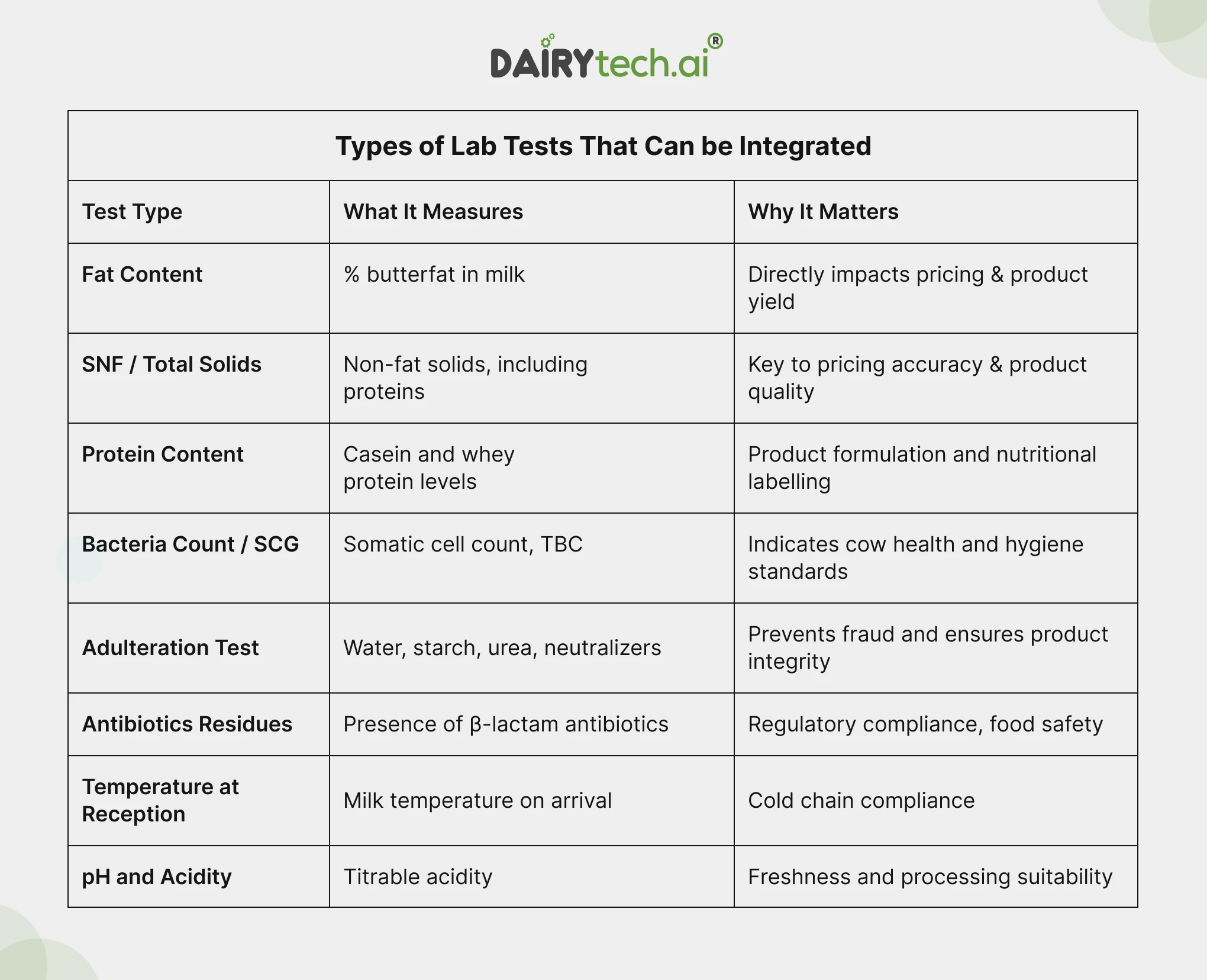
Each of these test results, historically entered by hand, can be captured and automatically pushed into the ERP through lab integration.
The Real Problems with Manual Data Entry in Dairy Labs
Manual data entry is a minor inconvenience until you look at its downstream effects across the dairy operation.
Transcription Errors That Cost Real Money
A farmer’s payment changes when the fat percentage is entered as 3.8% rather than 3.08%. An incorrectly recorded bacteria count is acceptable if it exceeds the threshold that allows the production of contaminated milk. These are not hypothetical scenarios; they are daily risks in operations running hundreds of manual entries per shift.
Lag Time Between Testing and Decision-Making
When a lab technician tests milk at a collection center and manually records results, those results may take minutes to hours to reach procurement or plant managers. In that window, contaminated or substandard milk may already have entered the production line.
Data Silos That Fragment Business Decisions
Lab data in one system, procurement data in another, and accounting in a third mean that connecting quality to payment requires manual reconciliation, a process that is slow, error-prone, and unscalable. There is no single view of “what quality milk did we receive today and what did we pay for it?”
No Real-Time Quality Visibility
Without integrated systems, quality trends, a gradual rise in bacteria counts from a particular route, and seasonal fat percentage drops go unnoticed until they become serious problems. Real-time integration enables early detection and proactive action.
Compliance Gaps and Audit Nightmares
Regulatory audits require complete, traceable records linking every product batch back to its incoming milk quality data. Manual systems make this reconstruction slow and unreliable. Missing or inconsistent records can result in fines, recalls, and reputational damage.
Farmer and Supplier Disputes
When farmers receive payments calculated from data they cannot verify because it lives in a spreadsheet they cannot access, disputes arise. Lack of transparency erodes trust between dairies and their supplier network.
Inability to Scale Operations
As a dairy operation adds collection routes, shifts, or processing lines, manual data entry scales linearly with headcount. The cost and error rate grow in proportion to volume. Integration, by contrast, scales at near-zero marginal cost.
Are manual errors draining your dairy’s profitability? See How DairyTech Eliminates Manual Data Entry. Book a Free Demo
How Integrating Lab Analyzers Solves These Problems
Direct integration between lab analyzers and your dairy ERP addresses each of the problems above at its root:
Automatic Data Capture: Zero Human Transcription
The moment an analyzer completes a test, results are transmitted via API, serial port, or network connection directly into the ERP. No human enters a number. No transcription error is possible. The data in the system is exactly what the analyzer measured.
Real-Time Quality Gates at Collection Points
Integrated systems can enforce automatic accept/reject logic: if the bacteria count exceeds a defined threshold, the system flags the batch, alerts the operator, and prevents it from being logged as accepted, all before a drop enters the tank. This is quality control operating at machine speed.
Automated, Quality-Linked Farmer Payments
With fat, SNF, and quality scores flowing directly into the ERP, farmer payment calculations happen automatically. Dairy management can configure payment formulas (e.g., price per liter × fat % × SNF % with quality bonuses or penalties), and the system calculates payouts accurately every time.
Cross-Functional Data Visibility in One Dashboard
When lab data lives in the same system as procurement, production, and finance, every stakeholder sees the same real-time picture. The plant manager knows the incoming quality before the milk arrives. The finance team can reconcile quality-based payments instantly. The quality manager tracks trends across all routes and shifts.
Regulatory Compliance Built Into Operations
Every test result is timestamped, linked to a batch or farmer ID, and stored with a complete audit trail. Compliance reports that once took days to compile can be generated in minutes. The system is always audit-ready.
Farmer Self-Service Transparency
With integrated systems, quality data can be surfaced through farmer portals or mobile apps, giving suppliers visibility into their own test results and the calculations behind their payments, reducing disputes and building long-term trust.
Regulatory Compliance and Food Safety Standards: Why Integration Is No Longer Optional
Global and regional food safety frameworks increasingly require documented, traceable quality data at every stage of the dairy supply chain:
FDA 21 CFR Part 11 (US)
Electronic records and electronic signatures must be tamper-proof and auditable, a standard that manual spreadsheets cannot reliably meet.
ISO 22000 / FSSC 22000
Food safety management systems require documented monitoring of critical control points (CCPs), including incoming quality of raw milk.
FSSAI (India)
Schedule IV compliance, hygiene standards, and traceability requirements demand documented quality records from reception through processing.
EU Regulation 853/2004
Demands that raw milk have documented records and meet certain somatic cell and total bacteria count.
Lab testing integration ensures your quality records are automatically generated, consistently formatted, and instantly retrievable, transforming compliance from a reactive exercise into a built-in operational capability.
Key Features to Look for in a Dairy Lab Integration Solution
Not all ERP lab integration solutions are equal. When evaluating options, look for these essential capabilities:
Multi-Analyzer Compatibility
The solution should support integration with major analyzer brands, such as Foss, MilkoScan, Ekomilk, Lactoscan, BeneSystems, and others, via standard communication protocols (RS-232, TCP/IP, USB, and LIMS APIs).
Real-Time Data Sync
Test results should flow into the ERP within seconds of completion, not in batches at the end of the shift.
Configurable Quality Parameters and Thresholds
Dairy businesses vary in what they test and the standards they enforce. The system should allow you to configure test types, acceptable ranges, and automatic escalation rules without custom development.
Automated Quality-Based Pricing
The integration should directly feed into procurement pricing workflows, automatically applying fat / SNF-based price formulas and quality adjustment factors.
Farmer/Supplier Linkage
Each test result should be traceable to a specific farmer, collection route, and shift, enabling both accurate payment and complete batch traceability downstream.
Compliance-Ready Audit Trails
Every record should be timestamped, user-stamped, and immutable once recorded, with full export capabilities for regulatory reporting.
Quality Trend Analytics and Dashboards
Dashboards that surface quality trends by route, farmer, season, and product type turn lab data into strategic business intelligence.
Mobile and Field Accessibility
Collection center supervisors should be able to view and act on lab results from mobile devices in the field, not just from a desktop at headquarters.
Integration with Production Planning
Quality data should feed into production scheduling so that available fat and SNF levels inform what products to manufacture each day.
Seamless ERP Integration (Not a Bolt-On)
Avoid solutions where the lab module is a separate application that syncs periodically. Look for native integration within the ERP so that quality data is a first-class citizen in every workflow.
Want to see all these features in one platform? Get a Live Feature Walkthrough of DairyTech
The ROI of Lab Testing Integration: What Dairy Businesses Actually Gain
For decision-makers evaluating investment in lab integration, the business case is tangible:
Payment accuracy
Eliminating manual entry errors in fat/SNF calculations directly reduces overpayments. Even a 0.1% error rate adds up, across thousands of daily transactions, to significant financial leakage over a year.
Labor savings
Reducing manual data entry at collection centers and the lab frees staff for higher-value work. Businesses typically eliminate 2–4 hours of daily reconciliation work per location.
Rejection rate reduction
Real-time quality gates prevent substandard milk from entering production, reducing the cost of rework, batch failures, and product recalls.
Audit readiness
Compliance audits that previously required days of record retrieval and compilation can be completed in hours, significantly reducing the cost and risk of regulatory scrutiny.
Farmer retention
Transparent, accurate, automated payments strengthen farmer relationships and reduce supplier churn, a critical competitive advantage in competitive milk procurement markets.
The Solution: DairyTech, Lab Analyzer Integration
DairyTech is a purpose-built dairy ERP platform designed to address the specific operational complexity of dairy businesses, from farm-to-plant procurement to quality control, production, distribution, and financial management.
Why DairyTech for Lab Integration?
Unlike generic ERP systems that treat lab data as an afterthought, DairyTech is built from the ground up with dairy quality workflows at its core. Lab analyzer integration is not a module you bolt on; it is a native capability woven into every operational process.
How DairyTech’s Lab Integration Works
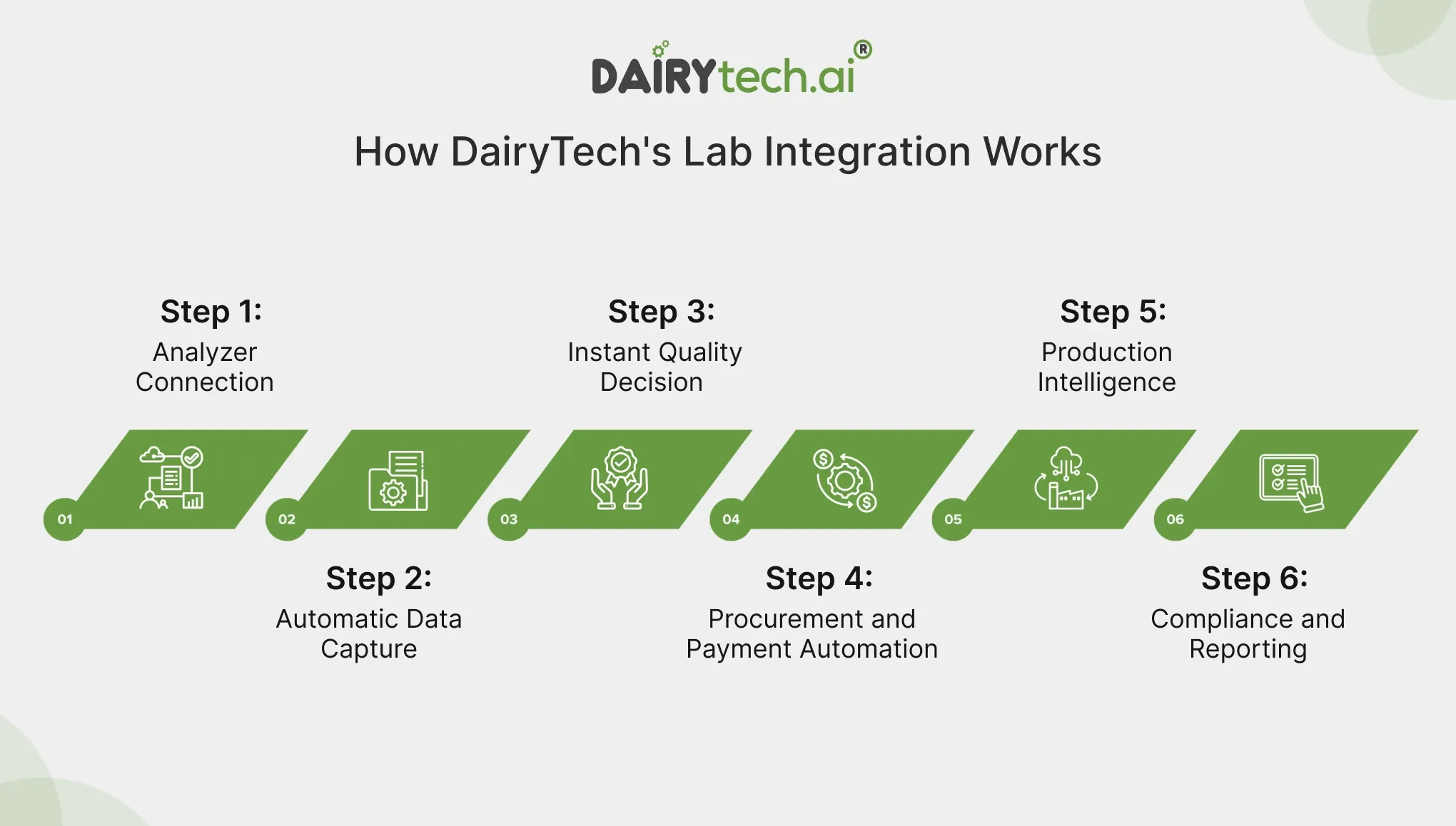
Step 1: Analyzer Connection
DairyTech connects directly to your existing lab analyzers at collection centers, reception bays, and quality labs via standard communication protocols. No replacement of existing hardware is required.
Step 2: Automatic Data Capture
The moment a test completes, DairyTech captures fat%, SNF%, protein, bacteria count, adulteration indicators, and any other configured parameters, logging them against the relevant farmer ID, route, shift, and timestamp.
Step 3: Instant Quality Decision
Configurable quality rules trigger automatic accept/reject flags, with alerts sent to supervisors via mobile or dashboard. Borderline results can be escalated for manual review before acceptance.
Step 4: Procurement and Payment Automation
Accepted batches immediately flow into procurement workflows. Payment calculations run automatically using your configured price formulas, generating accurate farmer ledgers without any manual calculation.
Step 5: Production Intelligence
Incoming quality data feeds production planning dashboards, helping plant managers make informed scheduling decisions based on actual fat and SNF availability.
Step 6: Compliance and Reporting
Every transaction is stored with a complete audit trail. FSSAI reports, quality trend analyses, farmer payment summaries, and batch traceability reports are generated at the click of a button.
Key DairyTech Lab Integration Capabilities
- Native integration with Milko-Scan, Ekomilk, Lactoscan, Foss, and other major analyzers
- Configurable quality parameters and multi-tier pricing formulas
- Real-time dashboards at the plant and route level
- Farmer portal with quality and payment transparency
- Mobile-accessible results for collection center supervisors
- Integrated compliance reporting for FSSAI, ISO, and export requirements
- Built on Odoo’s enterprise-grade architecture: scalable, modular, and future-ready
Who Uses DairyTech?
DairyTech serves dairy businesses across the spectrum, from regional cooperatives processing 20,000 liters per day to large commercial processors handling multi-site, multi-product operations. The platform scales with your business, adding modules for distribution management, cold chain monitoring, and farmer relationship management as your needs evolve.
DairyTech is built for dairy businesses like yours. Schedule a Personalized DairyTech Consultation. Our dairy ERP specialists will map a solution to your specific operation.
Implementation: What to Expect When You Integrate Lab Testing with DairyTech
Implementing lab integration is simpler than most dairy operators expect, especially with a purpose-built solution like DairyTech.
Phase 1: Discovery and Mapping (1–2 weeks)
DairyTech specialists audit your existing lab equipment, data flows, pricing formulas, and compliance requirements to design the integration architecture.
Phase 2: Configuration and Connection (2–4 weeks)
Analyzer connections are established, quality parameters are configured, and pricing rules are set up in the ERP to match your existing commercial terms with farmers.
Phase 3: Parallel Testing (1–2 weeks)
The system runs in parallel with existing processes to validate that automated results match manual records before cutover.
Phase 4: Go-Live and Training
Collection center staff, lab technicians, and quality managers are trained on the new workflows.
DairyTech provides ongoing support through the stabilization period. Typical timeline: 6–8 weeks from kickoff to full go-live for a standard deployment.
Conclusion
Manual lab data entry in dairy operations is not just an inconvenience; it is a source of financial errors, compliance risk, quality failures, and missed business intelligence. As dairy businesses face increasing pressure to operate with greater precision, transparency, and efficiency, lab testing in dairy ERP is rapidly shifting from a competitive advantage to a baseline expectation.
The good news is that the technology to solve this problem exists today. DairyTech, powered by Odoo, gives dairy businesses a proven path to connect their lab analyzers directly to their ERP, turning quality data into a real-time operational asset that drives better procurement decisions, more accurate farmer payments, stronger compliance, and smarter production planning.
The question is not whether to integrate your lab systems. It is how quickly you can do it before the gap between you and integrated competitors becomes a problem you can’t close.
Take the first step toward smarter dairy operations. Start Your Free DairyTech Demo Today. No commitment. Just a clearer picture of what integrated quality control can do for your business.
Frequently Asked Questions (FAQs)
Q1. What is lab testing integration in dairy ERP?
A1. Lab testing integration in dairy ERP is the direct, automated connection between physical lab analyzers (which measure fat, SNF, bacteria counts, and other milk quality parameters) and your ERP software. Instead of manually entering test results, the analyzer automatically transmits data into the ERP, where it flows into procurement, payment, production, and compliance workflows in real time.
Q2. Which lab analyzers are compatible with DairyTech?
A2. DairyTech is compatible with all major dairy lab analyzer brands, including Foss, Milko-Scan, Ekomilk, Lactoscan, BeneSystems, and others. Integration is established via standard communication protocols (RS-232, TCP/IP, USB, or LIMS APIs), so in most cases, your existing hardware does not need to be replaced.
Q3. How does lab integration improve farmer payments?
A3. Farmer payments in dairy are typically calculated based on fat%, SNF%, and quality parameters. When test results are entered manually, errors in data entry translate directly into payment inaccuracies. Lab integration eliminates manual entry, feeds accurate test results directly into your pricing formula, and calculates payments automatically, reducing errors, saving time, and building farmer trust through transparent records.
Q4. Is lab-integrated data compliant with FSSAI and other food safety regulations?
A4. Yes. DairyTech’s integrated lab records are timestamped, linked to batch and farmer IDs, stored with full audit trails, and protected against unauthorized modification, meeting the documentation and traceability requirements of FSSAI, ISO 22000, FSSC 22000, and other applicable standards. Compliance reports can be generated on demand, making audits significantly faster and less stressful.
Q5. How long does it take to implement lab integration in DairyTech?
A5. A standard deployment, covering analyzer connection, quality parameter configuration, pricing formula setup, parallel testing, and staff training, typically takes 6–8 weeks from kickoff to full go-live. Timelines can vary based on the number of collection points, analyzer types, and complexity of pricing structures.
Q6. What types of dairy lab tests can be integrated into DairyTech?
A6. DairyTech can capture and process results from all common dairy quality tests, including fat content, SNF, total solids, protein content, somatic cell count (SCC), total bacteria count (TBC), adulteration indicators (water, starch, urea, neutralizers), antibiotic residues, temperature at reception, and pH/titratable acidity.
Q7. Can DairyTech work for multi-site dairy operations with many collection centers?
A7. Yes. DairyTech is designed to scale from single-plant operations to multi-site dairy businesses with dozens of collection centers, multiple processing plants, and complex distribution networks. Quality data from every location feeds into a centralized ERP with consolidated reporting and cross-site analytics.
Q8. Does DairyTech provide farmer-facing quality transparency?
A8. Yes. DairyTech includes a farmer portal that provides suppliers with visibility into their own quality test results, payment calculations, and transaction history. This transparency significantly reduces disputes and strengthens the relationship with dairy farmers.
Q9. What happens if the analyzer goes offline or the connection is interrupted?
A9. DairyTech includes offline resilience features: if a connection is temporarily disrupted, data is queued and synced once connectivity is restored. Supervisors are alerted to connectivity issues, and fallback manual entry is available with appropriate access controls and audit flagging.
Q10. Is DairyTech suitable for smaller dairy businesses or only large enterprises?
A10. DairyTech is designed to serve dairy businesses of all sizes. Smaller operations benefit from the same accuracy, compliance, and automation advantages as large enterprises — and because DairyTech is built on the modular Odoo platform, you can start with the features most critical to your operation and expand as your business grows.