Dairy manufacturing is one of the most shelf-life-sensitive industries on the planet. A batch of pasteurized milk has maybe 10 days before it’s no good, which may not even make fresh paneer. Even less. Yet many dairy businesses are still managing expiry dates through spreadsheets, whiteboards, or tribal knowledge passed down from warehouse staff who’ve been there for 20 years.
When a sales order is dispatched with stock that expires in two days, or a distributor receives a product with only 30% shelf life remaining, the results are returns, disputes, food waste, and, in the worst cases, regulatory action. These aren’t edge cases. They’re weekly frustrations for dairy operations that haven’t automated expiry-aware selling.
This is where dairy ERP’s inventory and manufacturing modules, configured correctly for dairy, make a real difference. This guide walks through exactly how dairy ERP handles expiry tracking from the warehouse floor through to the sales order and how a purpose-built solution like DairyTech extends that capability for the unique demands of dairy manufacturing.
Why Expiry Management Is Non-Negotiable in Dairy Sales
Before diving into the how, it helps to understand why generic inventory management falls short in dairy.
Most industries track products by SKU and quantity. Dairy adds a third dimension: time. The same SKU, say, 1-liter full-fat milk, can exist in three batches across your warehouse, each with a different production and expiry date. When a customer orders 500 units, which batch do you pick? If you pick the wrong one, you’re either sending nearly expired product (customer complaint incoming) or burning through fresh stock while older batches inch toward write-off.
Multiply that across dozens of SKUs, multiple cold rooms, van sales routes, and B2B customers who have their own minimum shelf-life requirements (often called “minimum remaining shelf life” or MRSL), and you have a genuinely complex operational problem.
Dairy ERP solves this through a combination of lot tracking, expiry date configuration, FEFO picking strategies, and sales order validation rules.
How Dairy ERP’s Lot and Serial Number Tracking Works for Dairy
The foundation of expiry-aware sales in dairy ERP is lot tracking. When you enable lot/serial tracking on a dairy product, such as cheese, butter, yogurt, and UHT milk, every batch that enters your system gets a unique lot number. Attached to that lot number are key dates:
- Production Date: when the batch was made
- Best Before / Expiry Date: the date by which it must be sold or consumed
- Removal Date: an internal date that triggers warehouse alerts before the product is unsellable
Setting this up in Dairy ERP is straightforward. You navigate to the product form, enable “Tracking by Lot,” and then under the inventory tab, define the expiration time (in days from production). From that point, every goods receipt, every production order, and every stock move carries expiry intelligence.
For a dairy operation processing multiple batches per day across fresh milk, cream, and processed products, this lot-level visibility is what separates reactive waste management from proactive shelf-life control.
Want to see how a full dairy ERP manages expiry end-to-end? Read our guide on How Dairy ERP Manages Expiry Dates and Shelf Life.
FEFO Picking
Knowing your expiry dates is step one. Using that data to make smarter picking decisions is where dairy ERP’s FEFO (First Expiry, First Out) strategy comes in.
FEFO is the dairy industry’s answer to FIFO (First In, First Out). While FIFO picks stock by arrival date, FEFO picks by expiry date — always sending out the batch that will expire soonest. This prevents older stock from sitting behind newer stock and quietly ticking toward write-off.
To enable FEFO in dairy ERP, go to the Inventory module settings, turn on “Expiration Dates,” and set FEFO as the removal strategy on your storage location. Once enabled, whenever a sales order triggers a delivery, the dairy ERP’s putaway and picking logic automatically selects lots based on the earliest expiry; no manual decision-making by warehouse staff is required.
This matters enormously in daily dairy operations. A warehouse team picking 200 orders a day cannot manually check expiry dates on every pick. FEFO automates the decision and makes the safest choice the default choice.
Expiry Validation at the Sales Order Stage
Here’s where dairy ERP’s expiry awareness truly shines for dairy businesses: it doesn’t just track expiry in the warehouse. It can block or warn on sales orders before the product ever leaves your facility.
Through Dairy ERP’s inventory rules and optional custom validation, you can configure the system to
- Alert salespeople when the lot assigned to an order will expire within a defined window (e.g., within 5 days of delivery)
- Block delivery confirmation if the expiry date on the assigned lot falls below the customer’s minimum remaining shelf life requirement
- Show expiry information on delivery slips so drivers and customers can see exactly what they’re receiving.
For B2B dairy customers, supermarkets, food service companies, and hotel chains, MRSL compliance is often contractual. A retailer may require that any dairy product delivered has at least 60% of its shelf life remaining. Dairy ERP lets you encode this as a rule per customer or product category, so compliance is automatic rather than dependent on someone remembering to check.
Automated Near-Expiry Alerts and Stock Aging Reports
Proactive expiry management means catching problems before they become write-offs. Dairy ERP’s expiry date alerts let you set removal dates that precede the actual expiry date, giving your team time to act.
For example, a dairy business might set the following:
- Removal Date = 3 days before expiry
- Automated alert sent to the warehouse manager when stock hits the removal date
- An aged stock report is reviewed weekly to catch slow-moving lots before they expire
These alerts can be configured to trigger email notifications, daily ERP activities assigned to specific users, or dashboard flags visible in the Inventory module. When combined with Dairy ERP’s reporting, you get a clear view of which lots are aging and how much value is at risk, critical data for daily planning decisions.
On top of this, a dairy ERP’s forecasting module can flag when your projected sales velocity won’t clear a batch before expiry, letting procurement or sales teams take corrective action (price promotions, reallocation to faster-moving channels) before the product is unsellable.
Batch Traceability: Recalls, Audits, and Customer Confidence
Expiry management isn’t only about preventing waste. In dairy manufacturing, batch traceability is also your defense in a recall scenario.
Dairy ERP’s lot tracking gives you full bidirectional traceability, meaning you can trace a batch from raw milk intake, through production, to the exact sales order and customer it was delivered to. If a quality issue emerges with a specific production batch, you can identify within minutes which customers received it, generate a recall list, and initiate contact, all from the dairy ERP interface.
This level of traceability is increasingly required by food safety regulations. In the US, the FDA’s FSMA 204 rule now mandates traceability records for dairy products at every stage of the supply chain. In the EU, food business operators must be able to identify and isolate affected products within hours. Dairy ERP’s lot traceability features form a solid technical foundation for meeting these requirements.
Struggling to maintain cold chain integrity alongside expiry management? Contact us today.
Dairy ERP Custom Features
Dairy ERP is a powerful, tailor-made ERP. Its expiry and lot-tracking features are genuinely strong and can handle nuances that go beyond what standard dairy ERP handles natively.
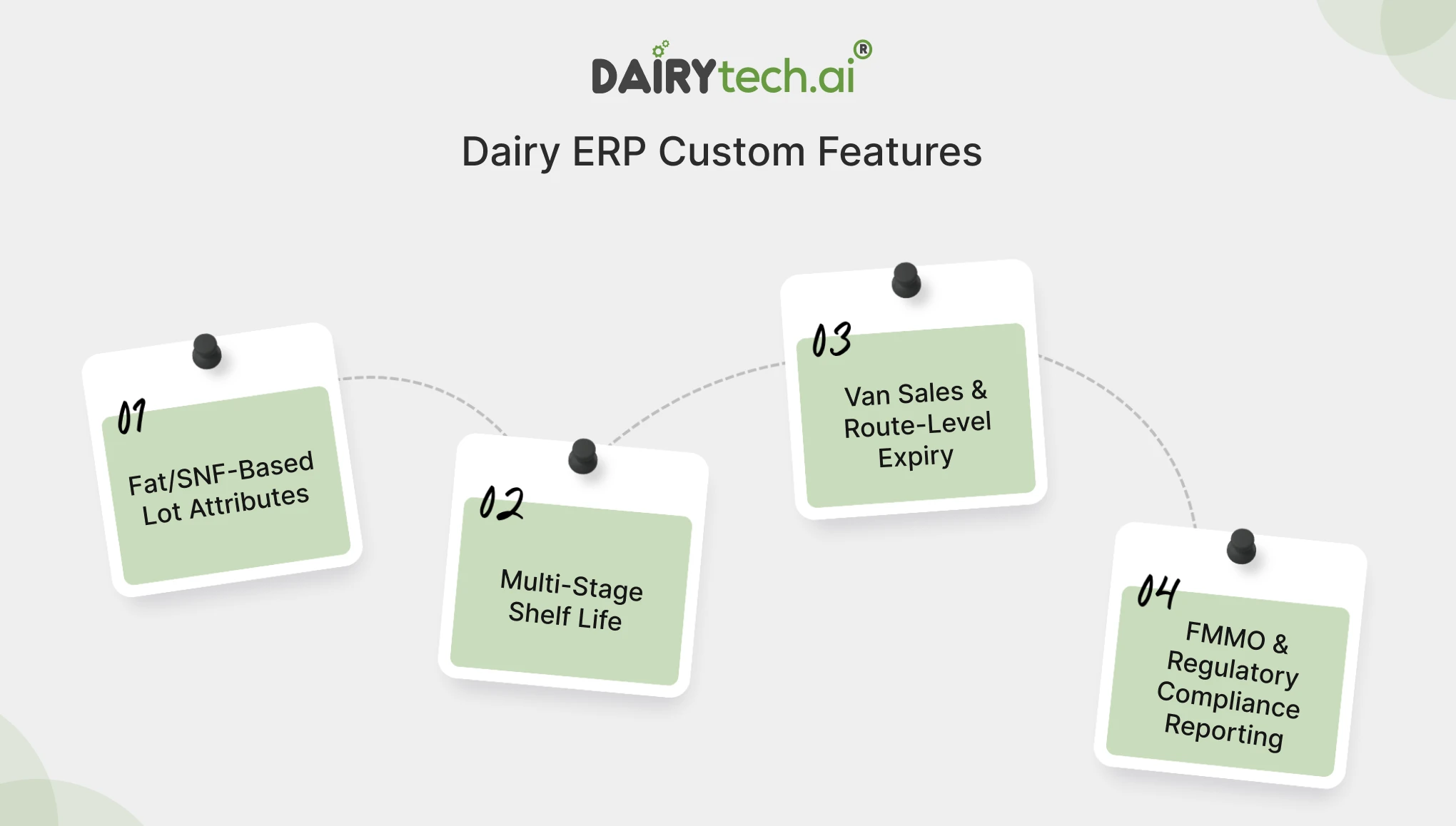
Fat/SNF-based lot attributes
In milk procurement, each incoming lot carries quality parameters (fat%, SNF%, and bacterial count) that directly affect pricing and processing decisions. Standard dairy ERP lot records don’t carry these fields by default.
Multi-stage shelf life
Some dairy products, like artisan cheeses, have an initial curing period followed by a commercial shelf life. Modeling this dual-phase timeline in a standard dairy ERP requires customization.
Van sales and route-level expiry
When your salespeople drive vans with onboard stock, you need real-time expiry visibility at the route level, not just the warehouse level. Tracking which van is carrying which lot and alerting the driver before delivering near-expiry products isn’t out-of-the-box dairy ERP behavior.
FMMO and regulatory compliance reporting
US dairy businesses operating under Federal Milk Marketing Order rules need component-based pricing and compliance reporting that standard dairy ERP doesn’t generate.
This is exactly why Dairytech builds on top of dairy ERP’s core strengths, adding dairy-specific configurations, custom modules, and integrations that make expiry-aware operations work the way a dairy business actually runs and not the way a generic ERP assumes it does.
Bringing It All Together: Expiry-Aware Selling in Practice
Let’s walk through what this looks like in a real dairy operation running on a well-configured dairy ERP system.
A customer orders 200 units of 500ml yogurt for delivery on Friday. When the order is confirmed, the dairy ERP:
- Checks available lots and identifies two batches in the cold room: Lot A (expires in 12 days) and Lot B (expires in 6 days).
- Applies FEFO and assigns Lot B to the delivery, since it expires first.
- Validates against the customer’s MRSL; this customer requires 7 days of remaining shelf life. Lot B has only 6. Dairy ERP flags a warning and reassigns to Lot A.
- Confirms the delivery with expiry information printed on the delivery note, so the driver and customer both know what they’re receiving.
- Updates inventory in real time, adjusting stock aging reports and near-expiry alerts accordingly.
The whole process is invisible to the salesperson. It happens in the background, governed by rules the business configured once. No one has to remember to check. No batch leaves the facility below the required shelf life without someone being explicitly informed and approving it.
That is expiry-aware selling.
Ready to Get Expiry Under Control?
If your dairy business is still managing expiry dates manually or relying on warehouse staff to remember which batch to pick, you’re one missed check away from a costly return, a regulatory issue, or a disappointed customer.
Book a Discovery Call with DairyTech to see how a dairy ERP, configured specifically for your operation, can automate expiry tracking from production through to every sales order.
Take the Next Step
Running dairy operations on disconnected systems costs more than most businesses realize in waste, returns, and staff time spent chasing expiry dates that a system should be tracking automatically.
Consult with Dairytech today and see how we configure Dairy ERP to give your dairy business real-time expiry control, automated FEFO picking, and sales order validation that protects you at every step.
Frequently Asked Questions
Q1. Does Dairy ERP support FEFO (First Expiry, First Out) picking natively?
A1. Yes, Dairy ERP supports FEFO as a removal strategy in its inventory module. Once enabled at the location level and with expiry dates activated on products, the system automatically assigns the soonest-expiring lot to outgoing deliveries.
Q2. Can Dairy ERP block a sales order if the product will expire before delivery?
A2. With the right configuration, including expiry validation rules and minimum remaining shelf life settings, Dairy ERP can warn or block delivery confirmation when the assigned lot doesn’t meet the required shelf life threshold. This is typically set up as part of a dairy-specific ERP implementation.
Q3. How does lot tracking in dairy ERP help with product recalls?
A3. Dairy ERP’s lot traceability provides full forward and backward traceability, from raw material receipt through production to the final customer delivery. In a recall scenario, you can instantly identify every customer who received stock from a specific production lot, enabling fast, targeted action.
Q4. What is the difference between expiry date, best before date, and removal date in dairy ERP?
A4. In dairy ERP, the expiry date is the hard limit (product is unsafe after this). The best-before date reflects optimal quality. The removal date is an internal trigger, set before expiry, that alerts your team to take action (discount, reroute, or write off) before the product becomes unsellable. Dairy businesses typically configure all three to match their products and customer requirements.
Q5. Can a dairy ERP handle expiry management for van sales in dairy distribution?
A5. Standard dairy ERP has limited native support for mobile van sales with lot-level expiry tracking. A dairy-specific ERP layer, like the one DairyTech builds on Dairy ERP, adds van-level inventory tracking, driver-facing POS with expiry visibility, and return/unsold stock reconciliation, filling this gap.
Q6. How does dairy ERP’s expiry management support FSMA 204 compliance for dairy?
A6. Dairy ERP’s lot/serial tracking, combined with purchase and delivery traceability, forms the data backbone needed for FSMA 204 traceability records. For full compliance, dairy businesses typically need additional configuration and reporting modules to generate the specific record formats the FDA requires.
Q7. Is Dairy ERP suitable for small and mid-sized dairy manufacturers, or is it enterprise-only?
A7. Dairy ERP is modular and scales from small businesses to large enterprises. For dairy manufacturers, a purpose-built implementation partner like Dairytech ensures the system is configured appropriately for your size and complexity without over-engineering for operations that don’t need it.