Running a dairy operation without smart reorder rules is like driving without a fuel gauge; you won’t know you’re empty until it’s too late. Stockouts of raw milk, cream, cultures, or packaging can halt production for hours. An overstock of perishable inputs means spoilage and wasted capital.
A dairy ERP system solves this by automating replenishment decisions. But the system is only as good as the reorder rules you configure. This guide walks you through exactly how to set those rules, why they matter, and the parameters that dairy operations often overlook.
What Are Reorder Rules in a Dairy ERP?
Reorder rules are automated triggers in your ERP that initiate a purchase order or a production order when the inventory of a raw material drops to a defined threshold. Instead of relying on manual checks or gut feel, the system monitors stock levels in real time and alerts procurement or acts autonomously when replenishment is needed.
In the dairy industry, reorder rules must account for factors that other industries rarely face:
- Perishability: raw milk, cream, and cultures have short shelf lives
- Demand variability: seasonal peaks (festivals, summer ice cream surges) and sudden private-label orders
- Cold chain dependency: lead times can stretch if refrigerated transport is unavailable
- Regulatory compliance: inputs like food-grade additives carry traceability requirements
Getting reorder rules right in your dairy inventory management software directly impacts production continuity, product quality, and your cost of goods sold.
Types of Reorder Rules Available in Dairy ERP
Before configuring anything, understand the three main reorder models and when each applies to dairy raw materials.
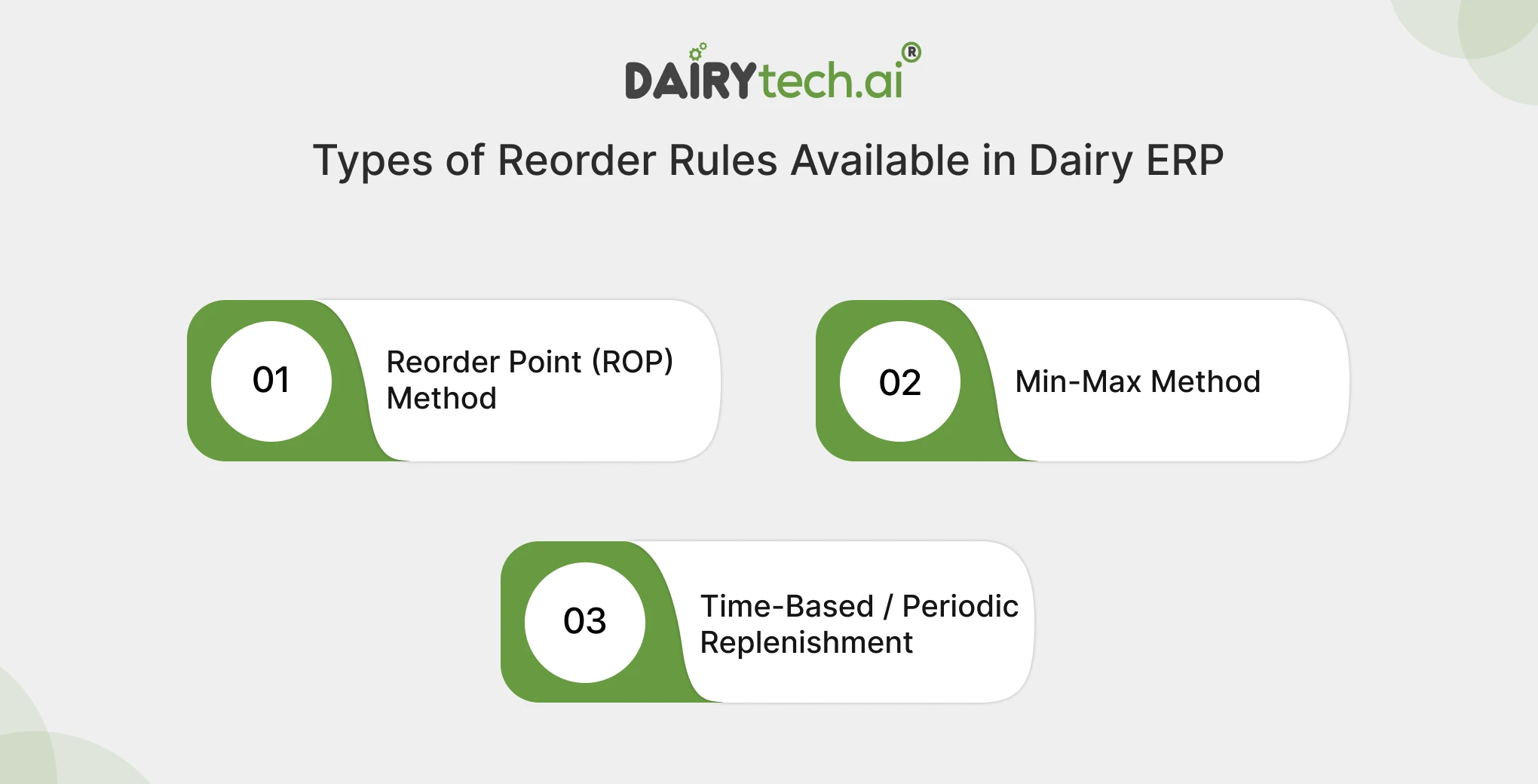
Reorder Point (ROP) Method
A fixed stock level that, once breached, triggers a replenishment order. Best for raw materials with relatively stable consumption, such as packaging material (HDPE bottles, pouches), labels, and cleaning chemicals.
Formula: ROP = (Average Daily Usage × Lead Time in Days) + Safety Stock
Min-Max Method
You define a minimum stock level (trigger) and a maximum stock level (order-up-to quantity). When stock hits the minimum, the ERP orders enough to bring it back to the maximum. Suitable for ingredients like sugar, flavors, and stabilizers where storage space is defined.
Time-Based / Periodic Replenishment
Orders are placed at fixed intervals regardless of stock level. Used for materials sourced from a single supplier on a contract schedule, for example, raw milk collected from farmer pools on a daily or alternate-day cycle.
Key Parameters to Configure Before Setting Reorder Rules
Most teams jump to setting trigger quantities without first defining the supporting parameters. This is the most common reason reorder rules fail in practice.
Safety Stock Level
Safety stock is your buffer against demand spikes and supply delays. For dairy, factor in:
- Historical demand variability (standard deviation of daily usage)
- Supplier reliability score (how often deliveries are late)
- Shelf life of the input (you can’t carry 30 days of safety stock for raw milk)
Formula: Safety Stock = Z × σ (demand) × √Lead Time
Where Z is the service level factor (e.g., 1.65 for 95% service level).
Want DairyTech to auto-calculate your safety stock based on your historical data? Book a free demo
Lead Time per Supplier
Each supplier has a different lead time. Configure lead times at the supplier–material level in your ERP, not just the material level. Raw milk from a local cooperative may have a 1-day lead time; imported cultures may need 10-14 days.
Shelf Life and FEFO Rules
For raw materials with expiry, your ERP should enforce First Expiry, First-Out (FEFO) picking. Reorder quantities must be calibrated so you don’t receive more than what can be consumed before expiry. Set a “maximum days of cover” cap on reorder quantities.
Unit of Measure (UOM) Consistency
Milk is procured in liters or kilograms but consumed in your BOM in kilograms. Packaging may be procured in cartons of 500 but consumed individually. Ensure UOM conversions are correctly mapped before setting trigger quantities, a mismatch here causes phantom stockouts or over-ordering.
Step-by-Step: Setting Reorder Rules in Your Dairy ERP
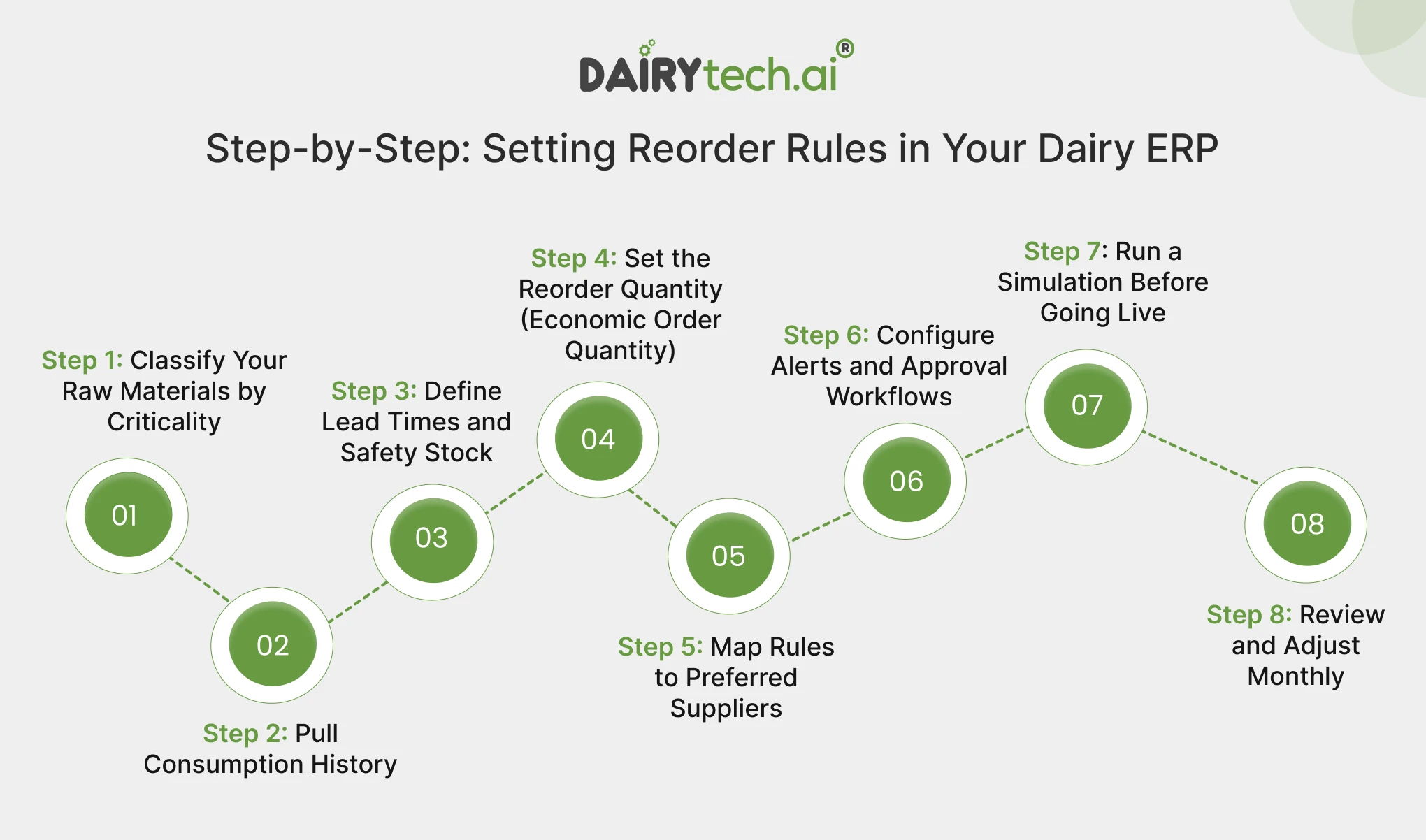
Step 1: Classify Your Raw Materials by Criticality
Use an ABC–XYZ matrix:
- A items: high-value, high-consumption (raw milk, cream, packaging)
- B items: moderate value/consumption (stabilizers, colors, cultures)
- C items: low-value, low-consumption (cleaning agents, minor additives)
- X: stable demand; Y: variable; Z: highly unpredictable
Apply tighter reorder rules and more frequent reviews to A and Z items.
Step 2: Pull Consumption History
In your Dairy ERP, run a consumption report for each raw material over the last 12 months. Note:
- Average daily usage (ADU)
- Peak usage during seasonal periods
- Variance month-over-month
This data anchors your ROP calculation.
Step 3: Define Lead Times and Safety Stock
Using the formulas above, calculate ROP and safety stock for each material. Enter these values in the material master under the MRP/Planning tab of your ERP.
Step 4: Set the Reorder Quantity (Economic Order Quantity)
Calculate EOQ to balance ordering costs against holding costs:
EOQ = √(2 × Annual Demand × Ordering Cost / Holding Cost per Unit)
For perishables, constrain EOQ to a maximum of shelf life minus average lead time, multiplied by daily usage, to avoid ordering more than you can consume while fresh.
Step 5: Map Rules to Preferred Suppliers
Assign each raw material a primary and secondary (backup) supplier in the ERP. When a reorder is triggered:
- The system should default to the primary supplier
- If the primary supplier is flagged (delivery delay, quality hold), it escalates to the secondary automatically
Step 6: Configure Alerts and Approval Workflows
Reorder rules should not always be fully autonomous. Set:
- Auto-approve for C items below a threshold value
- Procurement manager approval for A items or orders above a defined PO value
- SMS/email alerts when stock hits 80% of the reorder point (early warning)
Step 7: Run a Simulation Before Going Live
Use your ERP’s simulation or “what-if” mode to replay the last 90 days with the new rules active. Check how many stockouts and overstock situations the rules would have prevented vs. created.
Step 8: Review and Adjust Monthly
Reorder rules are not set-and-forget. Schedule a monthly MRP review to:
- Update ADU based on recent demand
- Adjust safety stock before seasonal peaks
- Revise lead times if supplier performance changes
Seasonal Demand Planning for Dairy Raw Materials
Dairy demand is highly seasonal. Ice cream raw materials peak in summer; ghee, milk powder, and sweet ingredients surge during Diwali and wedding seasons. Your static reorder rules won’t account for this unless you configure seasonal demand profiles.
In a robust dairy ERP:
- Upload demand forecasts by month or week per SKU
- Let the system back-calculate expected raw material consumption from the production plan
- Automatically lift reorder points and safety stock during flagged peak periods
This is also where integrating your dairy ERP with a demand forecasting module pays off, the system reads order pipeline data and adjusts reorder triggers proactively, not reactively.
Common Mistakes Dairy Operations Make with Reorder Rules
- Setting rules once and never reviewing them. Demand patterns, supplier lead times, and shelf lives change. Rules must be reviewed at least quarterly.
- Using the same safety stock formula for perishables and non-perishables. Raw milk can’t carry the same buffer logic as packaging film. Constrain safety stock days for any material with a shelf life under 7 days.
- Ignoring quality hold risk. If a batch of cultures fails a quality check, your effective on-hand drops instantly. Factor a quality-rejection buffer into safety stock for high-rejection-rate materials.
- Not accounting for MOQ. Suppliers often have minimum order quantities. If your EOQ calculation gives 80 kg but the supplier MOQ is 500 kg, you’re forced to over-order. Flag MOQ constraints in the supplier master so the ERP respects them when generating purchase orders.
- Over-relying on automation without exception management. Automated reorder rules work until something unusual happens, a supplier goes on strike or a cold chain failure quarantines a batch. Build exception dashboards into your workflow so your procurement team sees anomalies immediately.
How DairyTech ERP Handles Reorder Rules
DairyTech’s purpose-built dairy ERP is designed around the specific complexities of dairy supply chains. Unlike generic ERP systems adapted for food, DairyTech’s inventory module natively handles:
- Shelf-life-aware reorder quantities: auto-caps order quantity based on usable shelf life
- Lot traceability: every reorder ties to a lot, enabling full forward/backward traceability
- Supplier scorecards: reorder routing dynamically adjusts based on real-time supplier performance
- Seasonal demand templates: pre-configure demand uplift periods once, apply every year
- Mobile approvals: procurement managers approve or modify auto-generated POs from their phone
Ready to see reorder automation in action for your dairy plant? Schedule a personalized demo with DairyTech
Integration: Reorder Rules + Production Planning
Reorder rules work best when connected to your production plan. A standalone inventory module only reacts to stock levels. When your ERP integrates raw material planning with the Master Production Schedule (MPS):
- Reorders are triggered by confirmed production orders, not just current stock
- The system can calculate “projected available stock” 30–60 days out
- Procurement can place orders weeks in advance for long-lead-time ingredients
This shift from reactive to proactive procurement is a significant competitive advantage for dairy companies managing tight margins. MRP and demand forecasting work together in food manufacturing, where food logistics covers production-integrated procurement strategies used in the dairy industry.
Compliance and Traceability Considerations
Setting reorder rules in a dairy ERP isn’t just an operational decision; it has compliance implications. FSSAI regulations (India) and FDA/FSMA requirements (US) mandate that all raw material inputs are traceable to their source lot. When your ERP generates a reorder:
- Capture the supplier batch/lot reference at goods receipt
- Link it to the corresponding PO generated by the reorder rule
- Map it forward to finished goods produced using that lot
This end-to-end traceability is only possible if your reorder and receiving workflows are tightly integrated. A dairy ERP that handles reorders in isolation from goods receipt and QC will create traceability gaps.
Conclusion
Setting reorder rules in your Dairy ERP is one of the highest-leverage investments you can make in operational efficiency. Done right, it eliminates stockouts, reduces overstock of perishable inputs, cuts emergency purchases, and gives your procurement team time to focus on supplier relationships rather than firefighting.
The key is to go beyond setting a simple trigger number. Define safety stock using your actual demand variability. Account for shelf life in your order quantities. Connect reorder rules to your production plan. And review them regularly as your business grows and seasons change.
DairyTech’s ERP is built from the ground up for dairy operations — not adapted from a generic platform. Every parameter described in this guide is configurable natively, without workarounds or third-party plugins.
Ready to put your raw material procurement on autopilot? Request a Free Demo of DairyTech ERP.
Frequently Asked Questions (FAQs)
What is the difference between a reorder point and safety stock in a dairy ERP?
The reorder point is the stock level that triggers a new purchase order. Safety stock is the buffer included within that trigger to protect against unexpected demand spikes or supplier delays. The reorder point includes safety stock; it is not separate from it.
Can I set different reorder rules for different plants or locations in the same ERP?
Yes. A good dairy ERP allows location-specific reorder rules for the same material. A plant in Chennai may have different lead times and seasonal patterns than one in Punjab. Rules should be configured at the plant–material level, not just the material level.
How often should dairy companies review their reorder rules?
At minimum, quarterly. For materials with high demand variability (seasonal flavors, fresh cream), review monthly. For materials with stable consumption and long shelf lives (packaging, cleaning chemicals), semi-annual reviews are sufficient.
What happens when a reorder rule triggers but the preferred supplier is out of stock?
Your ERP should have a secondary supplier mapped for each critical raw material. When the primary supplier cannot fulfill, the system automatically routes the PO to the secondary. If no backup exists, it should escalate to the procurement manager with an urgent alert.
How does shelf life affect reorder quantity calculations in dairy ERP?
For perishable inputs, the maximum reorder quantity is capped at: (Shelf Life in Days − Lead Time in Days) × Average Daily Usage. Ordering more than this risks receiving stock that expires before it can be consumed, resulting in waste and write-offs.
Can reorder rules be automated fully in a dairy ERP, or does procurement always need to approve?
Both models are valid. Most dairy operations use a hybrid: C-items and low-value reorders are fully automated, while A-items above a defined PO value require procurement manager approval. This balances efficiency with financial control.
What is the reorder point formula for dairy raw materials?
ROP = (Average Daily Usage × Supplier Lead Time in Days) + Safety Stock. For perishables, add a constraint: ROP must not result in a maximum stock level that exceeds shelf life capacity.
Does DairyTech ERP support automated reorder rules?
Yes. DairyTech’s inventory module supports ROP-based, min-max, and time-based reorder rules with shelf-life constraints, supplier-routing logic, and mobile-based approval workflows built in.