A large retail chain rejects an entire pallet of yogurt at the receiving dock. The reason is that the remaining shelf life is only four days, compared to the contractual minimum of seven. The dairy has already loaded the truck, paid the driver, and cut the invoice. Now it absorbs the return freight, issues a credit note, disposes of the stock, and, if this is a pattern, risks losing the account.
This isn’t an unusual scenario. It’s a predictable outcome of a sales process that treats expiry data as a warehouse problem rather than a commercial one.
In dairy manufacturing, every product you sell carries a countdown clock. Pasteurized milk may be good for 10 days. Fresh paneer, 3 to 5. Flavored yogurt, 21. Hard cheese, 90 or more. The challenge isn’t just tracking these clocks in a cold store; it’s embedding them into every stage of your sales process: order entry, allocation, dispatch scheduling, delivery routing, and post-sale returns management.
A purpose-built Dairy ERP does exactly this. This guide explains how expiry-aware sales order management works, what it costs when it doesn’t, and which specific ERP capabilities close the gap between a reactive operation and a commercially disciplined one.
What Is Expiry-Aware Sales Order Management in Dairy ERP?
Expiry-aware sales order management is the capability to check, enforce, and act on product shelf life data at every stage of the order-to-cash cycle, not just at the warehouse level but from the moment a customer places an order through to delivery confirmation, returns, and financial settlement.
In a dairy ERP, expiry-aware order management means the following:
- Checking whether available stock will meet a customer’s minimum remaining shelf life (MRSL) requirement at the time the order is placed, not at dispatch
- Allocating stock to orders using FEFO (First Expired, First Out) logic automatically, so the right batch goes to the right customer every time
- Blocking the fulfilment of orders where no compliant stock exists, and surfacing the conflict for commercial resolution
- Applying different expiry rules by customer, channel, and SKU, a modern retail chain, an institutional foodservice buyer, and an export importer each have entirely different requirements.
- Generating dynamic pricing recommendations for near-expiry stock so it moves as revenue, not as write-off
- Triggering returns, credit notes, and account adjustments automatically when expiry-related rejections occur
- Feeding expiry-pattern data back into demand forecasting so production volumes are calibrated against actual consumption velocity
This is fundamentally different from generic inventory shelf-life tracking. It’s expiry intelligence embedded in the commercial workflow.
Why Expiry-Blind Order Management Is Costing Dairy Businesses More Than They Realise
Most dairy businesses track expiry dates in some form. The problem isn’t awareness; it’s where in the process that awareness sits. When expiry is managed only at the warehouse stage, by the time a shelf-life conflict is discovered, the commercial damage is already done.
The direct costs of expiry-blind order management include the following:
- Customer rejections at the point of delivery. A retailer or distributor rejecting a short-dated consignment return incurs freight, disposal costs, credit note processing, and, for recurring incidents, commercial penalties or delisting risk.
- Expiry write-offs from misallocated inventory. When sales orders are allocated without FEFO enforcement, longer-dated stock flows to customers while shorter-dated stock sits in the warehouse and expires. This invisible process compounds monthly.
- Margin erosion on emergency discounting. Near-expiry stock discovered late requires deep, reactive discounting to move. When discovered early on, the same stock can be modestly reallocated or discounted before being sold profitably.
- Revenue leakage from under-reported returns. Without automated returns processing linked to expiry data, returned stock is often restocked without a shelf-life check, re-enters the fulfillment cycle, and causes a second rejection or, worse, reaches a consumer with insufficient shelf life.
According to the United Nations Food and Agriculture Organization (FAO), approximately 17% of total food production is lost or wasted globally, with dairy products among the most vulnerable due to their short shelf lives. A significant share of dairy waste at the distribution and retail level is directly attributable to poor shelf-life coordination between manufacturers and their trading partners, the exact gap that expiry-aware ERP closes.
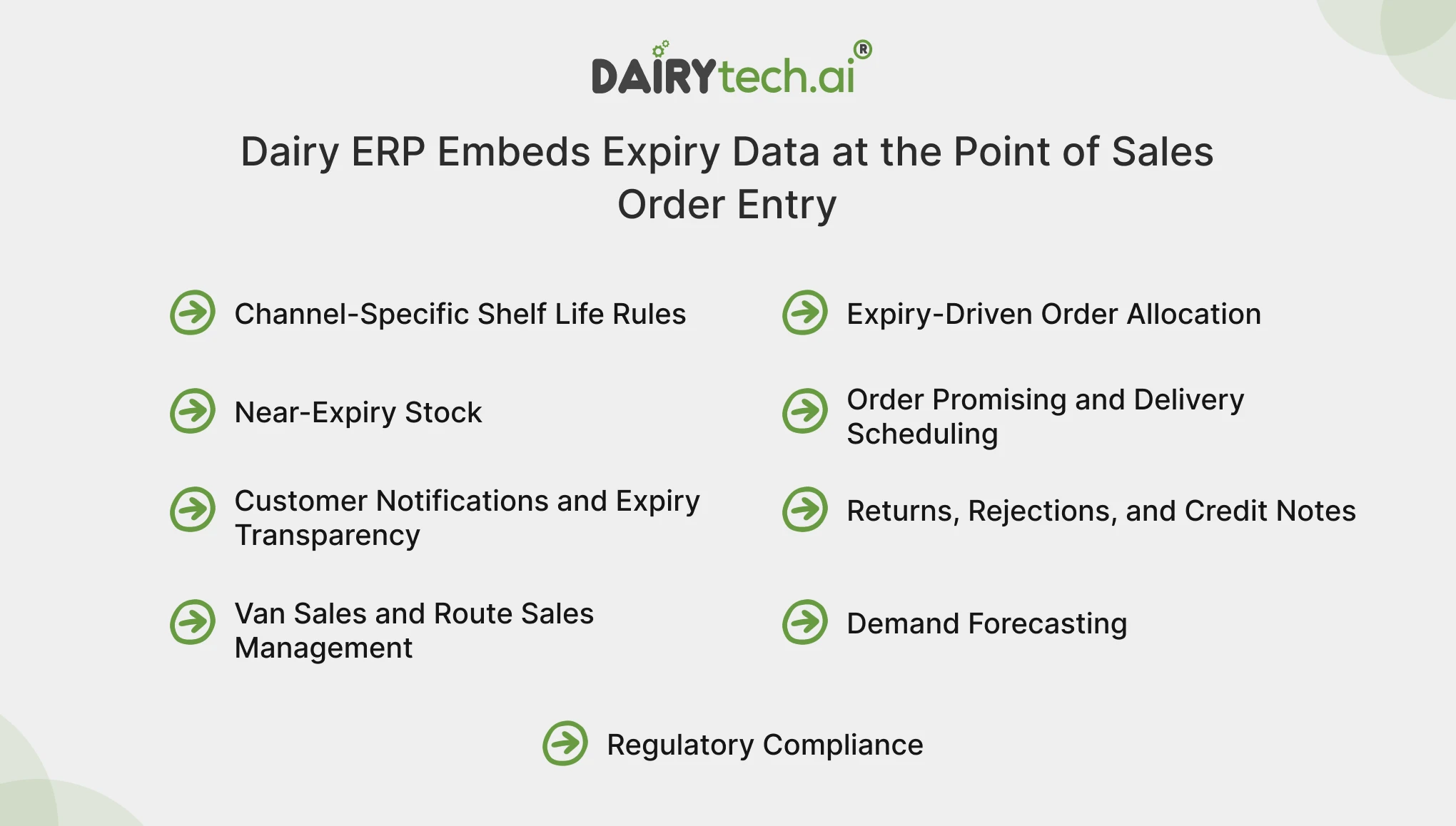
How Dairy ERP Embeds Expiry Data at the Point of Sales Order Entry
The single most commercially valuable change a Dairy ERP makes to the sales process is moving expiry checks from dispatch (where nothing can be fixed) to order entry (where everything can be).
What this looks like in practice:
When a sales representative or customer service agent enters an order in the ERP, the system doesn’t just check whether sufficient stock exists. It checks whether sufficient compliant stock exists, stock that will meet the customer’s MRSL requirement on the expected delivery date.
If the order is placed today for delivery in two days, and the customer requires 5 days’ remaining shelf life at delivery, the ERP checks for stock with at least 7 days’ remaining life today. If no such stock exists, the ERP flags the conflict at order entry, not at 5 am when the driver is loading the truck.
The ERP’s order-entry expiry check covers:
- Customer-specific MRSL configured in the customer master (absolute days or percentage of total shelf life remaining)
- SKU-specific shelf life configured in the product master
- Delivery lead time factored into the compliance calculation
- Real-time available stock by batch and expiry date across all warehouse locations
When a conflict is identified, the ERP presents the commercial options: offer an alternative available date when compliant stock will exist, substitute with a different SKU, split the order across compliant batches, or escalate to a sales manager for a manual override with an audit trail.
The result: Expiry conflicts are resolved commercially, with the customer’s input, before they become operational failures at the loading dock.
See how Dairytech’s sales order module handles expiry compliance in real time. Book a Live Product Demo
Channel-Specific Shelf Life Rules
One of the most underappreciated dimensions of expiry-aware sales management is that different trade channels impose radically different shelf-life requirements. A Dairy ERP that applies a single MRSL rule across all customers will always be either too restrictive for some channels or insufficiently protective for others.
How shelf life requirements differ by channel:
Modern retail (supermarkets, grocery chains)
Typically, the strictest MRSL requirements. A major retail chain may require 70-75% of the total shelf life at delivery. For a 14-day pasteurized milk, that means at least 10 days remaining on arrival. Rejection at the dock for non-compliance is common, automated, and commercially penalized.
Traditional trade (independent retailers, kirana stores)
Generally, more flexible MRSL requirements often accept 40–50% remaining shelf life. However, because these channels lack the cold chain infrastructure of modern retail, the actual risk of consumer-level expiry issues is higher. A well-configured ERP balances the lower formal requirements against the real operational risk.
Foodservice and institutional buyers (hotels, restaurants, canteens)
High consumption velocity means MRSL requirements are typically lower; a hotel kitchen buying 200 liters of fresh cream may be satisfied with 3 days’ remaining life. ERP rules can reflect this formally, rather than relying on informal agreements.
Export customers
Export markets often require the highest MRSL, commonly 80–90% of remaining shelf life, to account for transit time and local distribution lead times. An ERP that does not model export-specific shelf life requirements will either prevent profitable export sales or ship non-compliant stock that is rejected at customs.
Direct-to-consumer (D2C) / subscription delivery
For dairies operating a subscription or direct delivery model, MRSL requirements are set not by a commercial buyer but by consumer expectations. ERP rules should reflect the practical delivery window: if a consumer receives a weekly delivery, a 7-day MRSL at dispatch makes no sense; the ERP should enforce a standard that ensures product freshness at the point of consumption, not just at handover.
All of these rules can be configured in a dairy ERP at the customer, channel, or individual product level and applied automatically at every point from order entry through dispatch.
Expiry-Driven Order Allocation
The link between FEFO inventory management and expiry-aware sales order management is where most manually managed operations break down. FEFO (First Expired, First Out) is the foundational picking rule for any perishable goods operation, and it only works when it’s enforced by the system, not by individual warehouse staff judgment.
How Dairy ERP connects FEFO to sales order allocation:
When a sales order is confirmed and moves to fulfillment, the ERP allocates specific batches to that order based on FEFO logic. The stock that expires the soonest and meets the order’s MRSL requirement is allocated first.
This creates a hierarchy of allocation intelligence that manual processes cannot replicate:
- Stock that meets the customer’s MRSL is allocated in FEFO order (shortest-dated first)
- Stock that falls below the customer’s MRSL but is still within an acceptable threshold for a different channel is flagged for reallocation rather than being wasted.
- Stock approaching near-expiry thresholds that no current order can absorb is surfaced for commercial action (markdown, reallocation, foodservice offer) before it expires.
The FEFO enforcement gap in manual operations: Warehouse staff picking without system guidance default to the nearest or most accessible pallet, which is rarely the soonest-expiring one. Over weeks and months, this invisible behavior creates a cold store with a growing pool of older, shorter-dated stock accumulating behind newer arrivals. By the time the problem becomes visible, it’s a write-off event rather than a manageable situation.
A purpose-built Dairy ERP closes this gap by making FEFO the only available picking option and not the recommended one.
Struggling with FEFO enforcement across multiple cold store locations? Schedule a Free Platform Assessment with Dairytech.
Near-Expiry Stock as a Sales Opportunity
Most dairy operations treat near-expiry stock as a cost problem, something to be minimized or written off. A dairy ERP reframes it as a revenue management challenge: stock that still has commercial value, but only if the right action is taken within the right time window.
The economics of near-expiry stock management:
Near-expiry stock sold at a 30% discount returns 70% of revenue. Near-expiry stock written off returns 0% and adds disposal costs. The difference between these outcomes is almost entirely a question of how early the near-expiry status is surfaced and how quickly the commercial response is triggered.
What dynamic pricing and markdown management look like in a dairy ERP:
- Configurable markdown triggers by product and threshold: When pasteurized milk crosses a 3-day remaining shelf life threshold, the ERP automatically generates a markdown recommendation for the sales team. The recommended discount level can be pre-configured based on the remaining shelf life band, 30% at 3 days, 50% at 2 days, or left as a manual decision, with the alert providing the signal.
- Near-expiry channel reallocation: The ERP identifies near-expiry stock and cross-references it against channels with lower MRSL requirements. Stock that can no longer be sold to a retail customer with a 70% MRSL requirement may still be fully compliant for a foodservice buyer who accepts at 30%. The ERP surfaces this reallocation opportunity automatically, rather than requiring someone to think of it.
- Near-expiry offer generation: Some dairy ERPs with CRM integration can trigger outbound near-expiry offers to pre-qualified customers, bakeries, canteens, and food manufacturers, who regularly accept short-dated dairy at reduced prices. This converts an ad hoc, informal process into a systematic revenue channel.
- Write-off minimization reporting: The ERP tracks the proportion of near-expiry stock that is successfully sold (at any price) versus written off. Over time, this metric measures the commercial effectiveness of the near-expiry management process and identifies where the system needs tuning.
Expiry-Aware Order Promising and Delivery Scheduling
Order promising, the commitment to a customer about what they’ll receive, when, and where, is where expiry-aware sales management intersects most directly with customer relationship management.
The order-promising problem in dairy:
A customer calls to place a weekly order for 500 liters of pasteurized milk. The sales rep confirms availability and delivery for tomorrow. What the sales rep doesn’t check, because they can’t without an ERP, is whether the stock that will be available tomorrow will meet the customer’s 5-day MRSL requirement on arrival. If it won’t, tomorrow’s delivery becomes a rejection, a credit note, and a difficult conversation.
How Dairy ERP handles expiry-aware order promising:
- At order entry, the system models both current available stock and expected available stock (from production runs scheduled in the ERP) against the customer’s MRSL requirement and the proposed delivery date.
- If today’s stock won’t meet the customer’s requirement, but a production run confirmed for this evening will produce compliant stock for a delivery the day after tomorrow, the ERP can offer that as the earliest compliant delivery date.
- For customers with standing orders (weekly or subscription delivery), the ERP’s order-promising logic runs automatically before each cycle, flagging any cycle where planned stock won’t meet the customer’s requirements and triggering a notification to the sales team before the customer is even aware of the conflict.
Delivery scheduling with expiry sequencing:
For multi-stop delivery routes, a Dairy ERP’s logistics and distribution module can sequence delivery stops to prioritize the shortest-shelf-life consignments to the nearest or highest-velocity outlets first. A route serving a mix of small independent retailers and a regional distribution center should deliver short-dated stock to the distribution center (high-velocity, consumed quickly) before the small retailers (lower-velocity, longer time to sell-through).
Automated Customer Notifications and Expiry Transparency
Proactive communication about product shelf life is increasingly a commercial differentiator in dairy sales, particularly with retail and foodservice buyers who manage their own stock rotation and consumer trust commitments.
What automated expiry notifications look like:
- Pre-delivery shelf life confirmation: The ERP sends a pre-delivery notice to the customer with the batch number and best-before date of the stock being delivered, sent before the truck departs, giving buyers the information they need to plan reception, quality checks, and shelf placement without waiting for the physical delivery documentation.
- Near-expiry alerts for standing orders: If a customer has standing weekly or bi-weekly orders, the ERP can automatically notify them when a delivery cycle includes stock with fewer remaining days than their specified preference. This allows the buyer to reduce their order quantity if they have stock on hand, lowering the likelihood of a return.
- Post-delivery expiry confirmation: Delivery documentation generated by the ERP (or by a driver’s mobile app integrated with the ERP) includes batch and best-before dates at the point of handover. Both parties have a record. Customer disputes about product shelf life on delivery become resolvable in seconds rather than escalating into invoice disputes.
Managing Returns, Rejections, and Credit Notes
Expiry-related returns are among the most financially damaging events in dairy sales, not only because of the write-off cost, but also because of the process overhead: logistics coordination, quality assessment, financial settlement, and customer relationship management, all of which must be completed quickly and accurately.
How Dairy ERP automates the expiry-related returns process:
- Return receipt with shelf-life capture: When a return is initiated, the ERP intake process captures the batch number, remaining shelf life at return, and reason code (expiry-related rejection, customer overstocking, or quality complaint). This data drives everything downstream.
- Automated routing by remaining shelf life: Stock returned with sufficient remaining shelf life (above a configured threshold) is automatically routed back to available inventory for a compliant channel. Stock below the threshold is routed to disposal or secondary use, bakery, feed, or processing without requiring manual intervention.
- Automatic credit note generation: Where the return is due to a shelf-life failure on the dairy’s side (dispatch of non-compliant stock), the ERP generates a credit note automatically, linked to the original invoice, the batch, and the return reason. This eliminates the manual credit note backlog that plagues operations handling multiple returns daily.
- Return pattern analysis: The ERP tracks expiry-related returns by customer, SKU, route, and time period. A pattern of returns from a specific customer may indicate a cold chain failure at their site. A pattern by SKU may indicate a production issue with that product’s actual shelf life versus its configured shelf life. A route-based pattern may indicate a temperature excursion in a specific vehicle.
Expiry-Aware Van Sales and Route Sales Management
Van sales, where a driver carries pre-loaded stock and sells directly to retailers along a route, are the most expiry-sensitive sales model in dairy. The driver is simultaneously a warehouse operative, a salesperson, and a last-mile logistics provider.
The specific expiry challenges of van sales in dairy:
- Drivers load multiple SKUs with different shelf lives and MRSL requirements for different customers on the route
- On-route sales decisions, selling a specific product to a customer who wasn’t originally scheduled, may result in stock with insufficient remaining shelf life being placed at an inappropriate outlet.
- End-of-day unsold stock needs to be assessed for remaining shelf life before being returned to inventory.
- Returns received from trade customers during the route need to be assessed for shelf life before being accepted
How a dairy ERP manages expiry across the van sales cycle:
- Expiry-checked van loading: At van loading, the ERP allocates stock to each vehicle using FEFO logic, ensuring that the driver carries the soonest-expiring stock appropriate for each planned customer stop.
- Mobile driver app with expiry visibility: Drivers using a mobile POS integrated with the ERP can see the remaining shelf life and MRSL compliance for each product before selling it to a customer. The app can block a sale if the stock does not meet the customer’s configured MRSL requirement.
- Unsold stock reconciliation with shelf-life check: At the end of the day, the driver’s return of unsold stock is reconciled against the van’s original load. Stock below a minimum shelf life threshold at return time is automatically flagged for disposal rather than being returned to available inventory.
Demand Forecasting Informed by Expiry Patterns
Expiry write-offs are almost always a demand forecasting failure before they become a warehouse management failure. Overproducing a SKU that doesn’t move at the velocity assumed in the production plan creates inventory that inevitably ages toward expiry. A Dairy ERP that connects expiry-pattern data to the demand forecasting module closes this feedback loop.
How expiry data improves demand forecasting accuracy:
- SKU-level write-off trend analysis: If a particular SKU consistently generates 2–3% expiry write-offs monthly, the ERP’s forecasting module receives a signal that production volumes for that SKU are systematically outpacing demand. The forecast is adjusted downward, reducing future overproduction.
- Seasonal demand and expiry correlation: Many dairy products experience seasonal demand shifts, such as fresh cream in the winter baking season and flavored yogurts in summer. The ERP’s forecasting module can correlate historical expiry write-off rates by season and SKU to adjust production volumes proactively ahead of demand troughs.
- Near-expiry sales velocity tracking: When near-expiry stock is sold at markdown, the ERP captures both the volume sold and the discount applied. This data trains the forecasting model on the true demand elasticity at different price points for near-expiry stock, improving the accuracy of markdown recommendations in future cycles.
- Production planning feedback loop: When the ERP’s expiry monitoring flags a buildup of near-expiry stock for a particular SKU, it signals the production planning module to reduce or defer the next production run for that product. This prevents the classic dairy problem of producing new inventory in a cold store full of aging stock.
Regulatory Compliance in Expiry-Aware Sales
Expiry-aware sales management isn’t only a commercial discipline; it’s an increasingly mandatory regulatory one. Food safety regulators in major markets now require documented traceability of perishable products, including date information, through the distribution chain.
FSMA Rule 204 (United States):
The FDA’s Food Safety Modernization Act (FSMA) Rule 204, the Additional Traceability Records for Certain Foods, requires covered food businesses to maintain traceability records that include Key Data Elements (KDEs) at each Critical Tracking Event (CTE) in the supply chain, including receiving, transformation (production), and shipping. For dairy products, this means batch-level records linking production dates, lot numbers, and shipping records must be accessible and producible on regulatory request.
A dairy ERP that embeds expiry data in every transaction, including production, storage, order, dispatch, delivery, and return, creates FSMA 204-compliant traceability records as a byproduct of normal operations without requiring a separate documentation exercise.
FSSAI (India):
The Food Safety and Standards Authority of India requires that all packaged food products, including dairy, be date-marked. FSSAI regulations require manufacturers to maintain production records that substantiate date markings. In the event of a recall or consumer complaint, the regulator expects documentation linking production parameters, date markings, and distribution records, precisely what a well-configured dairy ERP generates automatically.
Export market compliance:
Export customers typically require shelf-life compliance documentation as part of the shipping process, such as certificates of analysis that include production date, best-before date, and batch number. A Dairy ERP that links these to every export dispatch document eliminates manual certificate preparation that creates bottlenecks and errors in export operations.
Where Expiry-Aware Sales Management Fails Without an ERP
Understanding the failure modes of manual expiry management clarifies why the ERP investment delivers measurable commercial returns.
Manual processes that generate predictable failures:
- Order entry without expiry checks means that every sales commitment is made without knowing whether available stock will meet the customer’s requirements on the delivery date. The conflict is only discovered at the warehouse, too late for a commercial fix and only early enough for an operational scramble.
- Spreadsheet-based MRSL tracking requires someone to update customer requirements, apply them to every order allocation, and remember to check them at dispatch. It works when volumes are low, and one person holds all the knowledge. It fails when that person is absent, when volumes grow, or when customer requirements change and the spreadsheet isn’t updated.
- Informal near-expiry management, where the sales manager receives a WhatsApp message from the warehouse about short-dated stock and tries to move it through personal relationships, is not a commercial process. It produces wildly variable outcomes, leaves no audit trail, and generates conflicts when discounted sales displace full-price orders.
- Returns without shelf-life assessment reintroduces short-dated or expired stock into available inventory, creating the risk of a second rejection or, in worst cases, a consumer-level food safety incident.
Each of these failure modes is a predictable consequence of managing expiry as a physical attribute of stock rather than as a data point embedded in the commercial process. A dairy ERP makes expiry data commercially active, from order entry to settlement.
Conclusion
Managing perishable product orders in dairy manufacturing is, at its core, a data coordination problem. The expiry date on every batch is known. The shelf-life requirement of every customer is known. The production schedule generated for tomorrow’s compliant stock is plannable. The near-expiry stock that needs commercial attention is identifiable. The only question is whether these data points are connected through your sales process, warehouse, distribution network, and returns process, or whether they exist in isolation, surfacing as surprises when it’s too late to act.
A purpose-built Dairy ERP makes expiry data commercially active. It moves the expiry check from the loading dock to the sales order. It turns near-expiry stock from a write-off liability into a revenue management opportunity. It closes the loop between expiry patterns and production forecasting, so overproduction shrinks over time. And it creates the regulatory traceability record that modern food safety law increasingly requires.
The dairy businesses that get expiry-aware sales management right don’t just reduce write-offs; they build commercial relationships where customers trust that short-dated stock will never reach their shelves and where every order commitment is backed by real-time visibility into whether it can be honored.
Dairytech’s Dairy ERP is purpose-built for dairy manufacturers and processors, with expiry-aware order management, FEFO enforcement, MRSL controls, and near-expiry sales workflows built in from day one. Book Your Free Expiry-Aware Sales Demo with Dairytech Today
Frequently Asked Questions (FAQs)
Q1. What does “expiry-aware sales order management” mean in dairy manufacturing?
Expiry-aware sales order management means that expiry date data is embedded in the sales process from order entry through delivery and returns, not just tracked in a warehouse. The ERP checks whether available stock will meet a customer’s minimum remaining shelf life requirement when the order is placed; allocates stock using FEFO (First Expired, First Out) logic; blocks dispatch of non-compliant stock; and automates credit note processing when expiry-related rejections occur.
Q2. How is expiry-aware order management different from standard inventory shelf-life tracking?
Standard shelf-life tracking tells you how much shelf life your inventory has. Expiry-aware order management acts on that information commercially, checking compliance at order entry, enforcing FEFO at allocation, generating markdown alerts, blocking non-compliant dispatch, and automatically processing returns. It transforms expiry from a static inventory attribute into a live commercial constraint that shapes every sales decision.
Q3. What is MRSL (Minimum Remaining Shelf Life), and why does it matter in dairy sales?
MRSL is the minimum shelf life a product must have remaining when it reaches a specific customer or trade channel. Modern retail chains may need 70-75% of their total shelf life. Export customers frequently require 80-90%. A dairy ERP stores these customer-specific requirements and applies them automatically during order allocation and dispatch, avoiding costly commercial rejections caused by short-dated stock reaching a buyer who will not accept it.
Q4. Can a dairy ERP prevent retail customer rejections due to short shelf life?
Yes. By checking stock compliance against customer MRSL requirements at order entry, not at dispatch, a Dairy ERP surfaces conflicts when there is still time for a commercial resolution: rescheduling the delivery, sourcing compliant stock from a different batch, or proactively communicating with the customer. By the time the truck is loaded, compliant stock has been confirmed. This doesn’t eliminate all rejections, but it eliminates the preventable ones.
Q5. How does a dairy ERP handle near-expiry stock commercially?
A Dairy ERP generates near-expiry alerts with configurable thresholds by product (e.g., trigger at 3 days remaining for pasteurized milk), automatically changes stock status to restrict it from standard order allocation, generates markdown pricing recommendations, and identifies lower-MRSL channels or customers to which the stock can be reallocated. This converts a reactive write-off process into a proactive revenue recovery process.
Q6. How does expiry-aware sales management work for van sales in dairy?
For van sales, a Dairy ERP ensures that the van is loaded with FEFO-allocated stock matched to the route’s planned customer stops. Drivers using a mobile POS integrated with the ERP can see remaining shelf life and MRSL compliance before completing a sale. Unsold stock returned at the end of the day is assessed for remaining shelf life automatically, with below-threshold stock routed to disposal rather than back into available inventory.
Q7. How does a dairy ERP support regulatory compliance in expiry-related sales?
A dairy ERP creates batch-level traceability records, linking production date, expiry date, quality test results, and dispatch documentation as a byproduct of normal operations. These records support FSMA 204 compliance in the US (which requires traceability records at each Critical Tracking Event), FSSAI compliance in India, and export market documentation requirements. In the event of a recall triggered by an expiry or quality issue, the ERP can produce complete distribution records for affected batches within minutes.
Q8. What happens to expiry-related returns in a dairy ERP?
When a return is received, the ERP intake process captures the batch number, remaining shelf life, and return reason. Stock with sufficient remaining shelf life is routed to compliant inventory for resale. Stock below a minimum threshold is routed to disposal or secondary-use workflows. If the return was caused by a shelf-life failure on the dairy’s side, the ERP generates a credit note automatically, linked to the original invoice. Return pattern data is tracked by customer, SKU, and route to identify systemic issues.
Q9. How does expiry data feed back into demand forecasting?
A dairy ERP tracks expiry write-offs by SKU and time period. Persistent write-offs for a specific product signal that production volumes are outpacing actual demand, prompting a downward adjustment in the forecast. Seasonal patterns in expiry waste identify periods where production volumes should be reduced proactively. Near-expiry sales data at markdown prices trains the model on true demand elasticity, improving the accuracy of future markdown recommendations.
Q10. Can a Dairy ERP handle different expiry rules for different customers and channels simultaneously?
Yes. Customer-specific and channel-specific MRSL rules are stored in the customer master and applied independently at order entry and dispatch for each order. A single ERP instance can simultaneously apply a 75% MRSL for a retail chain, a 40% MRSL for a foodservice buyer, and a 90% MRSL for an export customer, without manual intervention or the risk of applying the wrong rule to the wrong order.